The use of mirrors in Citizen Kane

The famous final sequence, when Kane walks through the corridor of mirrors, is not simply a stylistic and aesthetic choice. Instead, this choice actually resembles one of the primary themes of the films, which is the presence of fractured and fabricated identity. The “many Kanes” that appear because of the mirrored hall shows that there is no true Charles Kane, but instead countless versions of himself that he has portrayed to the general public and been interpreted as. Even Jerry Thompson, who spent weeks studying the life of Kane, could only ever understand him through the fragmented and often unreliable tales told to him by the people closest to Kane.

The mirrors also offer a deep sense of isolation. In Kane’s final days, he spends time not surrounded by loved ones and friends, but by reflections of himself. He has spent years trying to surround himself with people who “love” him, accidentally surrounding himself with people who try and praise him in exchange for power. This isolation can be seen earlier in the film as well, when Susan Alexander sits at her wardrobe, we gaze at her reflection through a mirror. The reflection stands as a confrontation of her loneliness and isolation.
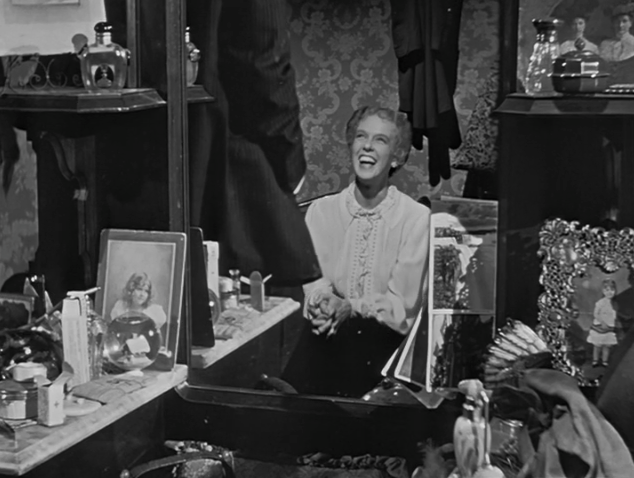
In totality, mirrors and reflections are used throughout Citizen Kane to establish the distorted nature of life these characters are experiencing. Nothing is genuine, not the people they surround themselves with or the stories they tell. Even the story itself goes through multiple levels of connection (a friend, a manager, etc), leading to a convoluted tale that never truly lets us get a good look at who Charles Kane was. And in his final days, he understands that he doesn’t know either.

Comments

3 responses to “The use of mirrors in Citizen Kane”

  1. Andrew Cai Avatar
    Andrew Cai

    Hey Duncan, great observations! This reminds me a lot of what was discussed in class today. Throughout the film, Charles Kane presents different aspects of himself to various people. For example, when he was running for governor, the people most likely saw him as a charismatic leader who would fight for the lower class. But on the other hand, Kane’s first wife saw him as a cold, uncaring, and workaholic husband. As you’ve said, there is no true Charles Kane. Every new firsthand account of the man’s life only confuses the viewer and Thompson even more. You also bring up an interesting point about how mirrors can reflect one’s loneliness. I think it’s especially evident for Kane when he is left with only his reflection during his final days. Do you think it’s also a metaphor about Kane being so lonely, he could only choose to turn inwards and reflect (and regret) on his life journey?

  2. Ethan Zuo Avatar
    Ethan Zuo

    I really like how you tied the mirror to the fractured identity and self-isolation of Kane. He is not just a person, but a set of identity both public and private, and the mirrors make the reflection symbolic.
    Technique-wise, Welles make the mirrors do work rather than be a part of mise-en-scene. The corridor shot you mentioned that showed many Kanes is not just a shot of him walking through the mirror, but Welles designed it so that the camera never appears in the mirrors, only Kane himself. The multiple Kanes that reflected in the mirror gives a hint to the film’s structure, of being multiplications and duplications of Kane. We never know who he really is, only getting fragmented descriptions of him through the people close to him.
    Talking about mirror, the snow globe can also by a type of curved mirror. It symbolizes Kane’s past childhood and the winter, and Rosebud. The curved mirror also represents Kane’s distorted past and memory. We first see Kane reflected through the globe, then at the end the glove shatters into pieces before the film burns away the sled. Breaking of the glass also reflect of what he lost and ended up breaking. Every glassy figure we see in the movie will never give us the true Charles Foster Kane.

  3. Mary Frances Miller Avatar
    Mary Frances Miller

    Hi Duncan,
    I love your interpretation on mirrors as a reflection of the self in regard to the internal feelings of Charles Foster Kane and Susan Alexander. As you said, Mr. Thompson only ever understands Mr. Kane from the fragmented perspective of those around him. The idea of mirrors as a reflection of the self can also be connected to the themes of false love as presented in the movie. The fractured Kanes in the mirror could also represent the many different ways people view him and could infer that Kane can only see himself from the perspective of those whose love he desires. Kane is a man who cares about his reputation than anything, and he will hurt the people closest to him to make a point. The use of mirrors perfectly illustrates the different aspects of Kanes legacy and provides subtle commentary on the fractured way the story is presented.

Leave a Reply to Mary Frances Miller Cancel reply

Your email address will not be published. Required fields are marked *