The candy cane is synonymous with holiday cheer — and they seem to be everywhere this time of year. With 1.76 billion canes sold in the U.S. annually (and 90% falling between Thanksgiving and Christmas), there’s deep technological efficiency and innovation keeping this festive treat in homes.
Early History
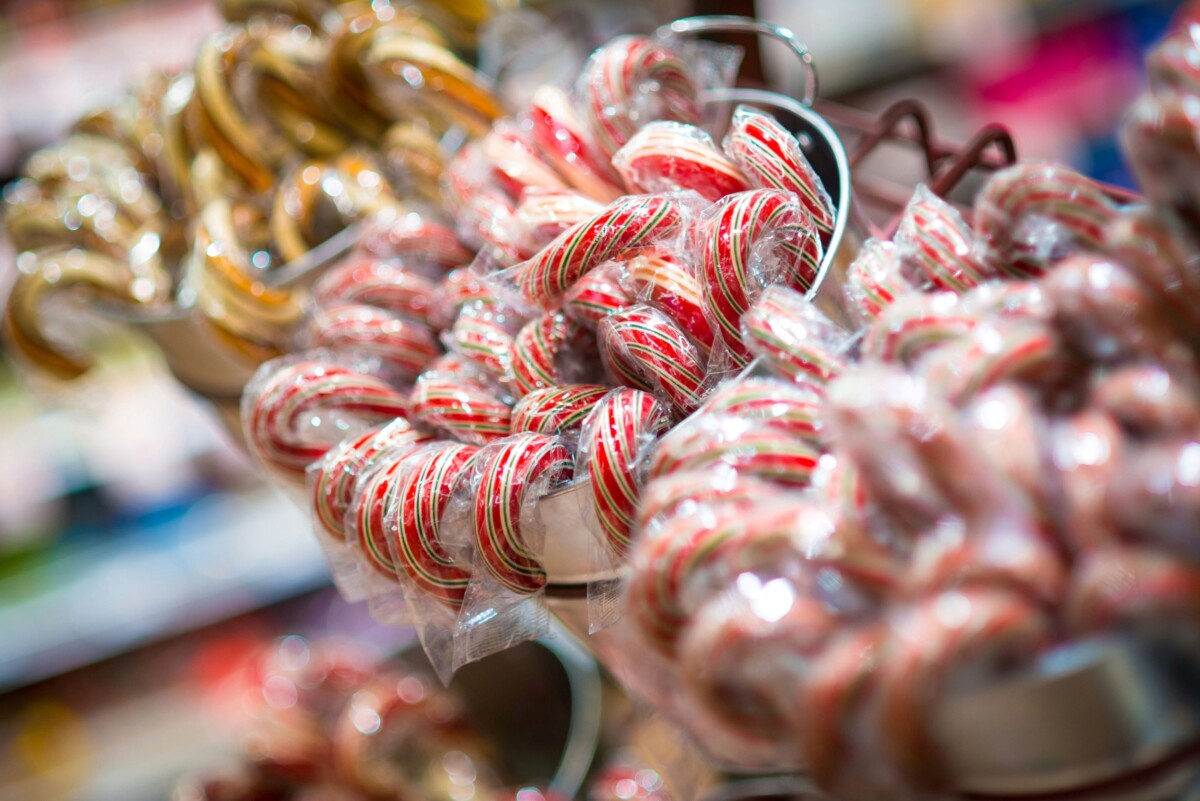 While today we know and love the crooked shape that gives the candy cane its name, the candy cane began as a straight, white sugar strike during the 17-18th century in Europe. These early renditions of the modern-day treat were peppermint or anise flavored, with candymakers mixing, pulling, twisting, and shaping the treats by hand.
Popular German folklore explains the now crooked origins as a choirmaster asking to bend the sticks into “shepherd’s crooks” for children sitting in Christmas services. These traditions carried on for centuries in both Europe and North America, but the long process of production limited output quantity, particularly during large demand surges around the holidays.
20th Century Success Stories
Candy cane popularity continued to surge from its humble origins, yet production continued to stall in the U.S. The problem was the bend: every candy cane had to be bent quickly before the candy hardened, and non-uniform shapes were discarded. This left the industry with a massive technological hole — one that Gregory Keller was happy to fill.
Keller, a Catholic priest and inventor (from our own state of Georgia!), recognized that the shepherd’s crook shape was the bottleneck and jumped into action in 1950. He developed what was called the “Keller Machine” or “Candy Cane Forming Machine,” which bent candy cane, while twisting them into the spiral stripe. The machine was patented in 1960 (US2956520A) and assigned to Bob’s Candies, a company founded by Keller’s brother-in-law, Bob McCormack. Not only did Bob’s Candies now have a hooking machine, they also were granted the patent of what was aptly named the “Candy cane machine” (US2982232A) in 1961. This machine was simpler than prior iterations and would create “unidirectional candy movement,” allowing for less candy cane breakage through feed chains.
Where do we go from here?

Figure in US patent USD785900S1, “Candy cane piece.”
Today, companies produce millions of candy canes per day using descendants of Keller’s designs. Other inventions have included the “Candy cane piece” (USD785900S1) which is for a heart shaped candy cane piece, “Display package for edibles and the like” (US1879952A) to display hanging candy canes, and the star-topped “American patriotic candy cane” (USD478404S1) for those who grow weary of the basic design.
These inventions highlight how the candy cane industry has evolved from plain, white sugar sticks to diverse, smoothly running operations with variations in shape, color, packaging, and flavor. Patents have allowed these independent candymakers the ability to protect their creative and technological improvements, allowing them to meet the seasonal demands of children and adults alike and ensure that the candy cane remains a holiday staple.
— Eloise So