A fellowship opportunity is available in the National Center for HIV/AIDS, Viral Hepatitis, STD, and TB Prevention (NCHHSTP) in Atlanta, GA. The ORISE fellow will work in the Communications, Education, and Behavioral Studies Branch (CEBSB) within the Division of Tuberculosis Elimination (DTBE).
Duration:
The initial appointment is for one year, but may be renewed for an additional year upon recommendation of CDC contingent on the availability of funds.
Duties and Responsibilities:
Specific activities may include:
Contributing to formative research efforts and communications for behavioral change
Aiding the development of question guides and protocols for key informant interviews and focus groups
Helping to transcribe interview and focus group discussions
Preparing transcripts for qualitative data analysis
Participating in data analyses
Assisting in drafting and reviewing internal documents and reports
Presenting findings and recommendations at national forums and in peer-reviewed journals
Supporting message testing efforts around tuberculosis and latent tuberculosis infection testing and treatment for high risk groups
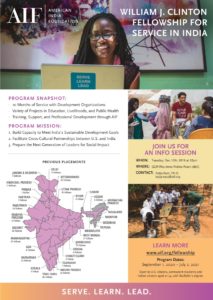
PROGRAM SNAPSHOT: · 10 Months of Service with Development Organizations · Variety of Projects in Education, Livelihoods, and Public Health · Training, Support, and Professional Development through AIF PROGRAM MISSION: 1. Build Capacity to Meet India’s Sustainable Development Goals 2. Facilitate Cross-Cultural Partnerships between U.S. and India 3. Prepare the Next Generation of Leaders for Social Impact
Description *Applications will be reviewed on a rolling-basis.
Two research opportunities are currently available with the Million Hearts® Initiative, in the Division for Heart Disease and Stroke Prevention (DHDSP), within the National Center for Chronic Disease Prevention and Health Promotion (NCCDPHP) at the Centers for Disease Control and Prevention (CDC) in Atlanta, Georgia.
Million Hearts® is a national initiative co-lead by CDC and Centers for Medicare and Medicaid Services (CMS) to prevent one million cardiovascular (CV) events in five years. More information about the initiative can be found at https://millionhearts.hhs.gov/.
Under the guidance of a mentor, the selected participant will gain experience as part of a small and dynamic team that is supporting a national public health initiative to prevent heart attacks and strokes. The types of activities or experiences may include:
Be part of a project management team, supporting the implementation of short term and long term programs
Participate in the coordination of communication activities, providing technical and strategic health communication guidance, and engagement with internal stakeholders
Draft, review, and support the dissemination of health communication materials ranging from social/digital media content, to stakeholder correspondence, to fact sheets and similar products
Conduct literature reviews and write summaries of findings, articles, meeting notes, government reports, etc.
Contribute to the development of slides, tools and other materials suitable for publication on the Million Hearts® website, or as handouts for meetings, etc.
Present results or explain programs to internal and external audiences, including professional meetings and/or conferences
Participate in the facilitation of and co-lead meetings and calls with internal staff and partners
Contribute to developing and sustaining key partnerships
The specific learning objectives for the participant could include:
Increased knowledge and application of public health and communication science principles in a national initiative
Increased knowledge of CV health and strategies to impact CV health This program, administered by ORAU through its contract with the U.S. Department of Energy to manage the Oak Ridge Institute for Science and Education, was established through an interagency agreement between DOE and CDC. The initial appointment can be up to one year, but may be renewed upon recommendation of CDC contingent on the availability of funds. The participant will receive a monthly stipend commensurate with educational level and experience. Proof of health insurance is required for participation in this program. The appointment is full-time at CDC in the Atlanta, Georgia, area. Participants do not become employees of CDC, DOE or the program administrator, and there are no employment-related benefits.
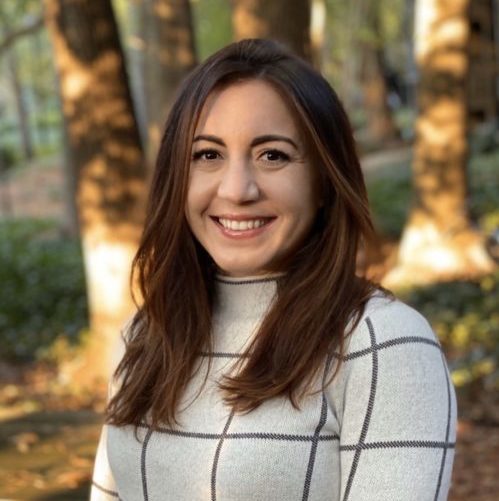
For this week’s #IamEmoryEpi spotlight, we met up with Leah Moubadder!
Tell us a little bit about your academic history:
I graduated in 2016 from Eastern Michigan University with a Bachelor of Individualized Studies (this is code for: I love math and science, but I’m not sure what I’d like to do with it). My three formal concentrations were: (1) biochemistry and organic chemistry, (2) human genetics and pathology and (3) liberal studies.
What are your primary research interests?
My research interests are in environmental exposures and molecular epi, particularly as it relates to reproductive health and cancer.
What were you up this this past summer?
This past summer I worked at Winship Cancer Institute, under the guidance of Dr. Lauren McCullough, on a project investigating the role of obesity in the prognosis of diffuse large B-cell lymphoma by using imaging- and molecular-based assessments of adiposity. I also continued my REAL position at the PBB Registry, under the guidance of Dr. Michele Marcus, where we are examining transgenerational epigenetic inheritance associated with polybrominated biphenyl (PBB) exposure. Lastly, I wrote a manuscript reviewing the current literature linking environmental exposures to the molecular pathogenesis of non-Hodgkin’s lymphoma.
Are there any exciting projects or experiences you are involved in right now?
I’m continuing everything I was doing in the summer – all of which are exciting! Additionally, I’m getting started on my thesis on gene-environment interactions in the PBB-exposed cohort.
What is your favorite part about earning your MPH at Rollins?
The people. Everyone I have worked with at Rollins, in whichever capacity, has been welcoming, helpful, and collaborative.
What advice do you have for 1st year MPH students?
Get (at least a little) out of your comfort zone. By doing so, I’ve learned so much, both academically and professionally, in just the first year.
What books are you currently reading, or what podcasts are you currently listening to?
I listen to the Free Associations podcast religiously. I also just finished the book Educated by Tara Westover and it was awesome!
What are three fun facts that you want people to know about you?
I lived in Japan for a year.
I did the equivalent of 23&me for my dog.
I can’t bake to save my life.
What are you thankful for this Thanksgiving?
So much to be thankful for! I’m thankful for the Epi Department here at Rollins, all of my great mentors, and the incredible friends I’ve made here!
Workplace feedback looks, sounds, and feels different from school feedback. Classroom feedback tends to come by way of test scores, comments on papers, and final grades. These methods of feedback revolve almost entirely around the accuracy and content of your work product. Workplace feedback can (and should!) include the content and quality of your work products, as well as your attributes as an employee. The latter is something that many young professionals struggle with. It can be uncomfortable and is often only reluctantly engaged with by employees and employers. Providing candid feedback on soft skills is difficult; employers may not feel confident in their own soft skills and it is a challenge to provide soft skill feedback that is actionable.
“It was impossible not to feel hurt (“Why don’t they like me?”) and defensive (“I’m getting my work done; if they don’t like it that’s their problem.”)”
I still remember the first time I received feedback about my approach to work. I was used to tackling my job duties and offering to help others. While that approach was beneficial for group projects in school, a colleague pointed out that it was creating friction with a group of colleagues with very different work styles. It was impossible not to feel hurt (“Why don’t they like me?”) and defensive (“I’m getting my work done; if they don’t like it that’s their problem.”) Neither of those helped me navigate my workplace or become a better team member.
“Only one of my ultimate objectives depended on the skills that were graded in school.”
What did help me was to step back and think about the feedback as an opportunity for improvement (rather than a critique of my identity.) I thought about my ultimate objectives: complete my job duties, foster collaboration, maintain open communication with colleagues, and have that communication be pleasant whenever possible. Notably, only one of those depended on the skills that were graded in school. I was able to realign my actions with those goals in mind, develop friendly workplace relationships, and was better able to recruit those same folks for support in other endeavors.
I graduated from Rollins with a MPH in Epidemiology in 2012. I now work for the Georgia Department of Public Health, and I interact with current Rollins students and recent alumni. Rollins students are well equipped for local and state public health job duties through their coursework. What Rollins students, and young professionals in general, could benefit from is openness to and active engagement with feedback.
“Often it is a gift we may not want, but a gift nonetheless.”
It is fundamentally harder to hear feedback on soft skills than on hard skills. It is particularly hard to remember that feedback is a gift. Often it is a gift we may not want, but a gift nonetheless. Soft skills are often heavily weighted in decisions on advancement. An employee may be technically brilliant, but without the soft skills to help drive the organization forward, their career goals may be stymied. Being open to improving both hard and soft skills helps to build a solid path for continued advancement.
As a potential employer, I can work to establish and improve mechanisms for feedback. Often in academic and government settings there isn’t much emphasis on feedback for soft skills.
“If you find yourself in a workplace without a formal feedback process, ask for one!”
This is a disservice to both the employee and the company. On-the-job training, and the corresponding evaluation processes, should reflect not only job-specific tasks but also the interpersonal skills that enable staff to navigate complex professional environments. Our team does not have a formal process for providing feedback to current students, and I’m working with others to establish one.
If you find yourself in a workplace without a formal feedback process, as either a student volunteer or a full-time-employee, ask for one! Reach out to your supervisor and establish regularly scheduled meetings where you can review not only your quantifiable job performance but also your soft skills. Your employer may have performance reviews, but they may not include feedback for professional skills.
“Request feedback and be open to it.”
Ask your supervisor “How do you think I’m performing with respect to interpersonal relationships and office dynamics? What can I do to improve my listening and communication skills? What areas should I further develop, and do you know of any resources or trainings that might be helpful?”
Request feedback and be open to it. Although difficult, this is a crucial component of continued development and a competitive advantage. Rollins offers many opportunities to prepare for public health work; Use this time to increase your technical knowledge AND your interpersonal skills that will help you succeed as a professional.
Elizabeth Hannapel graduated from Rollins in 2012 with a MPH in Epidemiology. While at Rollins, her interests included Infectious Diseases and Public Health Emergency Preparedness. Now, Liz serves as the state coordinator for legionellosis and shigellosis, and leads infectious disease outbreak investigations for the Georgia Department of Public Health. Follow Liz on Twitter @LizBitler.
For this week’s #IamEmoryEpi spotlight, we met up with Kristin Harrington!
Tell us a little bit about your academic history:
I went to the University of Wisconsin in Madison for undergrad, and I majored in biochemistry and global health. I worked for a couple of years, and then started the MD/PhD program here at Emory in 2016.
What are your primary research interests?
My primary research interests are in infectious disease transmission modeling (specifically for tuberculosis), using a combination of field work, Bayesian statistics, and geospatial methods! My advisor is Neel Gandhi.
What were you up this this past summer?
This summer I was mainly working on writing up my F30 fellowship grant for the NIH – so lots of writing and communicating with all of my collaborators for what will eventually become my dissertation! I also worked on the data analyses for a couple of other research projects I am involved with, and went to a few summer courses focused on biostatistical methods for ID modeling. I was also able to travel to the Republic of Georgia, and France!
Are there any exciting projects or experiences you are involved in right now?
Currently my research has been focused on some of the other projects I have going on separate to my dissertation. I am involved in a project comparing diagnostic tests for cryptococcal disease, which is an opportunistic fungal infection – I presented this work at the IDWeek conference in DC last month, and hopefully the manuscript will be completed soon! My other project is looking at pulmonary diseases (like asthma and COPD) in people with HIV in Atlanta, and I just submitted an abstract to the ATS conference for next May.
What is your favorite part about earning your PhD at Rollins?
My favorite part about getting my PhD here at Emory is being surrounded by such amazing faculty and students – all of the students are so accomplished and have so much to share in terms of their experiences, and the faculty are so well known for their contributions to the field of epidemiology.
What advice do you have for MPH students?
Take advantage of all of the opportunities here at Rollins – for involvement in teaching, research projects, taking courses, everything! One thing I really missed when I graduated college and started working was being supported by an academic institution that really provides as much as possible for you to succeed moving forward.
What books are you currently reading, or what podcasts are you currently listening to?
The books I have currently on my coffee table to start reading over winter break are Talking to Strangers by Malcolm Gladwell, Know My Name by Chanel Miller, and Dying of Whiteness by Jonathan Metzl. Podcasts that I am always listening to are All Songs Considered and The Daily!
What are three fun facts that you want people to know about you?
I lived in 5 states and in the Philippines before starting high school.
I absolutely love kickboxing.
I am obsessed with my bikes and all sports/activities bike-related!
Description *Applications will be reviewed on a rolling-basis.
An opportunity is currently available with the Behavioral and Clinical Surveillance Branch of the Division of HIV/AIDS Prevention (DHAP), within the National Center for HIV/AIDS, Viral Hepatitis, STD, and TB Prevention (NCHHSTP), at the Centers for Disease Control and Prevention (CDC) in Atlanta, Georgia.
This fellowship offers the opportunity to gain exposure to a high-priority, high-impact project focusing on domestic HIV surveillance. With 23 participating health department jurisdictions throughout the United States and Puerto Rico, the Medical Monitoring Project (MMP) provides crucial data on clinical and behavioral characteristics from the only nationally representative sample of persons living with HIV. MMP data are used to monitor issues affecting people living with HIV, which include topics such as describing racial disparities in viral load suppression and exploring the prevalence of depression and its effect on adherence to HIV medications. MMP collects data through personal interview and matched medical record abstraction. This fellowship will provide training opportunities related to survey design, survey implementation, and survey evaluation.
Under the guidance of a mentor, the participant will have the opportunity to develop the following abilities:
Writing and reviewing skills to contribute to the development of guidance documents and protocols Qualitative methods to code and analyze data Survey design and evaluation techniques to evaluate and improve survey implementation Presenting and writing skills to disseminate products such as training materials, scientific posters and presentations, or manuscripts Project management skills and techniques to evaluate survey implementation Collaboration skills to communicate effectively with external and internal stakeholders Anticipated Appointment Start Date: January 6, 2020
This program, administered by ORAU through its contract with the U.S. Department of Energy to manage the Oak Ridge Institute for Science and Education, was established through an interagency agreement between DOE and CDC. The initial appointment can be up to one year, but may be renewed upon recommendation of CDC contingent on the availability of funds. The participant will receive a monthly stipend commensurate with educational level and experience. Proof of health insurance is required for participation in this program. The appointment is full-time at CDC in the Atlanta, Georgia, area. Participants do not become employees of CDC, DOE or the program administrator, and there are no employment-related benefits.
Qualifications The qualified candidate should have received a master’s or doctoral degree in one of the relevant fields. Degree must have been received within five years of the appointment start date.
Preferred skills:
Experience in qualitative coding and analysis Excellent verbal and written communication skills Experience in qualitative and quantitative research methods Interviewing and survey administration skills Experience using qualitative data analysis software such as NVivo Experience working with people with HIV or other diverse populations
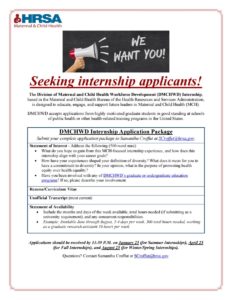
The Division of Maternal and Child Health Workforce Development (DMCHWD) Internship, based in the Maternal and Child Health Bureau of the Health Resources and Services Administration, is designed to educate, engage, and support future leaders in Maternal and Child Health (MCH).
DMCHWD accepts applications from highly motivated graduate students in good standing at schools of public health or other health-related training programs in the United States.
Statement of Interest – Address the following (500-word max):
• What do you hope to gain from this MCH-focused internship experience, and how does this internship align with your career goals?
• How have your experiences shaped your definition of diversity? What does it mean for you to have a commitment to diversity? In your opinion, what is the purpose of promoting health equity over health equality?
• Have you been involved with any of DMCHWD’s graduate or undergraduate education programs? If so, please describe your involvement.
Resume/Curriculum Vitae
Unofficial Transcript (most current)
Statement of Availability
• Include the months and days of the week available, total hours needed (if submitting as a university requirement), and any concurrent responsibilities.
• Example: Available June through August, 3-4 days per week, 300 total hours needed, working as a graduate research assistant 10 hours per week.









Recent Comments