T 12/06 Food Sovereignty & Resistance: The Legacy of the Lumbee Indian Tribe of North Carolina

On December 6, Dr. Malinda Lowery will lead a virtual talk about the food sovereignty and resistance of the Lumbee Indian Tribe of North Carolina. Email jbantum [at] dillard [dot] edu to RSVP.

Time: 7:00 pm to 8:30 pm

Place: Zoom Link and ID – 861 9701 4127

Emory Wheel Features Indigenous Language Path Listening Sessions

On November 16, the Emory Wheel featured an article about the Indigenous Language Path Listening Session at Emory’s Oxford and Atlanta campuses.

Emory held Indigenous language path listening sessions to honor Muscogee Nation

Indigenizing Emory: University Welcomes Muscogee People for Indigenous Language Path Listening Sessions

Emory University hosted its second series of Indigenous Language Path listening sessions on October 27th and 28th at Emory’s Oxford and Atlanta campuses. The events culminated with the Muscogee Teach-In on the academic quad.
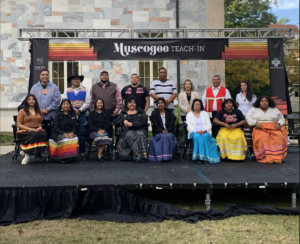
Elected officials, spiritual leaders, teachers, and citizens of Mvskoke Etvlwv (Muscogee Nation) who flew from Oklahoma to their ancestral homeland in present-day Georgia for the listening sessions and teach-in.  This process of community consultation and relational accountability guides the Indigenous Language Path Working Group as it  takes next steps in its efforts to  assimilate Emory to Muscogee knowledge through the original language of the land.

Dr. Iris PrettyPaint (Blackfeet), from the Native-led consulting firm KAI, facilitated the listening sessions at the Oxford and Atlanta campuses. The sessions began with a welcome and an acknowledgement of Emory’s history of Native removal and slavery from Dr. Greg McGongle, Dean of Religious Life and University Chaplain This segued into the purpose of the Listening Pathway Session: to create physical, visual, and digital reminders of Muscogee present, past, and future. The mission is to correct the “past tense” histories of Native people commonly taught in schools. This session continues the work started November 2021 to engage Emory’s campus in open dialogue and furthering the commitments of the land acknowledgement. During the Listening Sessions, leaders of Emory University asked students to provide input on how the Language Path can be refined to meaningfully honor Indigenous presence on campus. Reverend Chebon Kernell, a member of the Seminole Nation of Oklahoma and of Muscogee Creek ancestry, spoke of our responsibility to respect and honor the earth just the earth provides for us.

The Muscogee Teach-In began with welcome and opening remarks by leaders from both. This segued to traditional Mvskoke hymns by Muscogee elders. The language teachers shared traditional stories, such as why the opossum has a bare tail or how the animals divided the day and night. Each was told in Mvskoke with English translation in Mvskoke Language Preservation Program. This was followed by the Mvskoke Cultural Lab & Stories sponsored by Brittney Cuevas (owner of Four LOCV) and Denise Barnett (assistant for Four LOCV) where participants created corn husk people. The event ended with a Stomp Dance led by Rev. Chebon Kernell. Students and faculty were invited to join the Muscogee dancers in the final social dances.

This Indigenous Language Path is one of several efforts at Emory to indigenize the campus in ways that honor and respect Indigenous peoples and their rights within their ancestral homelands

Support Brittney Cuevas and Indigenous craftsmanship here.

Sat 11/19 First Voices Festival

On November 19, 7 Stages, in collaboration with Turtle Island Trading, Zintkala Zi PowWow and the L5P Business Association, presents The First Voices Festival: A Celebration of Indigenous Cultures.

This festival will offer audiences in Atlanta, for the first time, an opportunity to engage in music, dance, theatrical performances, food, and Indigenous history, wisdom, and culture through storytelling, outreach, and engagement events. The goal is to provide Indigenous and Native American artists a platform to share their stories, art, and culture while promoting diversity, equity, and inclusivity to help people better understand how choices today can impact generations to come. Click here to purchase/register tickets for each event.

Powwow (Free – Need to register)

Time: 9am to 5pm

Place: Little 5 Points Soccer Field

Art of Activism Meal & Dialogue (Free – Need to register)

Time: 5pm to 6:30pm

Place: The Wrecking Bar

Evening Performances ($10-$40 for tickets)

Time: 7pm to 9pm

Place: 7 Stages

F 11/11 UGA NASA presents a Native American Heritage Month Powwow Exhibition

On November 11, UGA’s Native American Student Association, with support from the Institute of Native American Studies, Multicultural Services and Programs, and Gable Distinguished Professor of History, James F. Brooks, is hosting a Celebration of Native American Heritage with an Exhibition Powwow at Reed Quad. Dance Styles exhibited will include Men’s Fancy, Women’s Fancy Shawl, Grass, Jingle and Hoop dances.  This is the key event of UGA’s Native American Heritage Month. Join us at Reed Quad for Native American Music and Dance in celebration of Indigenous American Identity and Culture

Time: 1:00pm to 5:00pm

Place: University of Georgia at Reed Quad

The Emory Wheel Features the Southeast Woodlands Stickball Summit

On October 31, The Emory Wheel published an article on the historic Southeast Woodlands Stickball Summit.

Southeast Woodlands Stickball Summit explores history and variations of classic game in Atlanta

Th 11/17 Art Circle #19: Indigenous Perspectives

On November 17, the Art Circles Organizing Team will be hosting an Indigenous Perspectives Art Circle.
The event’s theme: “Indigenous people have lived in the Americas for thousands of years, including the Muscogee Creek people who lived, worked, and produced knowledge on the land that Emory University now occupies. Indigeneity and Indigeouns identity are defined and redefined by many different individuals across time, place, and culture; we do not intend to limit this definition, but we are excited to explore how art can function as an expression of that identity, in all its multitudes. Art allows for the expression and acknowledgment of culture and perspective through the sharing of stories, history, language, and knowledge.” 
If you are interested in joining this vibrant conversation, please contact Zimra Chickering (zimra [dot] chickering [at] emory [dot] edu). Your reservation will be noted and a reminder email will be sent with the discussion guidelines the day before the discussion. To participate, please bring along any art piece that engages with the theme, whether that be visual art, a poem, a song, a story, or anything else you want to share. This is not an academic discussion. Each person will have three minutes to talk about their chosen work, but do not feel worried about filling up that time, as it is simply a cap to provide equitable time for all participants. It is encouraged that you to share your thoughts and feelings openly and informally. 

Time: 7:30 pm to 8:45 pm

Place: Cannon Chapel Breezeway

For more information, contact Zimra Chickering at zimra [dot] chickering [at] emory [dot] edu.

M 11/7 Europe and Beyond

On November 7, the Bill and Carol Fox Center for Humanistic Inquiry (FCHI) will host Europe and Beyond,  discussion based seminars led by Distinguished University Professor Lynée Lewis Gaillet and Postdoctoral Fellow Alexander Cors to foster research-centered, cross-disciplinary intellectual community among faculty and graduate students at Emory University, Georgia State University, and Agnes Scott College working on Europe and Europe-related topics. Registration is needed to obtain the zoom information.

Time: Nov 7 from 4:15 to 6:15 pm

Place: Zoom Registration

For more information about FCHI

For more information on the European Studies LISTSERV,  contact Mary Taylor Mann at mtmann [at] emory [dot] edu.

Emory Hosts Chickasaw, Choctaw, Cherokee, and Muscogee Delegations for Historic Stickball Summit

The Southeast Woodlands Stickball Summit Exhibition Game took place on October 15th at the Historic Fourth Ward Activities field along the Atlanta Beltline. Related to the modern game of lacrosse, Native American stickball (toli) is one of the oldest sports in North America.

Visitors to the Activities Field were greeted by the newly installed sculpture of two Chickasaw toli sticks created by event co-organizer Addison Karl entitled Itti’ Kapochcha To’li’.

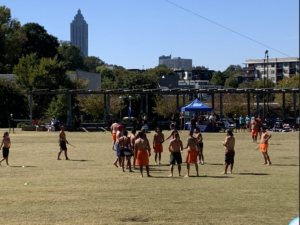
The October 15 Stickball Summit brought together Cherokee, Choctaw, Chickasaw, and Muscogee communities to play their traditional sport on Muscogee land for the first time in two centuries. The first game played was the Chickasaw version of stickball. The object of the game was to hit a fish on the top of a pole in the center of the field. It is a social game: players were broken into men and women teams of which anyone could join to play. Teams encircled a 15-foot pole to throw the ball up to turn the fish. Second was the Choctaw version.  In this variation, each team has a goalie to defend their side’s pole and the offense players attempt to hit the top of the 10-foot pole of the other team. Players threw the ball over longer distances to cross the field while others centered around their pole to protect it. The last game played followed Cherokee rules. Their version was in set teams of nine and the first team to twelve points (passing the goal line) won. This game consisted only of men, and they play barefoot wearing only athletic shorts so their full body is connected to the earth. Wrestling is important in this version as this was the most tactile form to release aggression built over disputes. At the end of the game, all players purified themselves with water to wash away their dispute and resume peace.

Later the same day, the Carlos Museum at Emory University hosted a panel discussion. It began with a documentary of women reclaiming stickball within the Cherokee community. Afterwards, a youth delegation from the Boys and Girls Club of the Mississippi Band of Choctaws performed the Snake Dance in full regalia. This led into the discussion led by Dr. Natalie M. Welch, Ph.D. (Eastern Band of Cherokee Indians), Addison Karl (Chickasaw/Choctaw), Casey Bigpond (Mississippi Band of Choctaw), Ace Greenwood (Chickasaw/Cherokee), Tosh Welch (Eastern Band of Cherokee Indians), and Dr. Monte Randall (Muscogee Nation). They spoke of their connection to stickball and how impactful it was to play with each other in brotherhood. It ended with wisdom and strengths each panelist gained through stickball and how they pass it onward to future generations.

Atlanta Beltline sponsored the 2022 Stickball Exhibition with the Native American and Indigenous Studies Initiative and the Carlos Museum.

LeAnne Howe (Choctaw) Discusses Native Resilience Through Stories and Sports

How do we learn? Who do we learn from? How do we carry their lessons? These are some of the thought-provoking questions Dr. LeAnne Howe asked the group of faculty, graduate students, and undergraduates gathered for her recent talk at Emory, “Embodied Tribalography in Fictional Characters and in Native History” on October 12. Dr. Howe is an enrolled member of the Choctaw Nation and the Eidson Distinguished Professor at the University of Georgia.

Dr. Howe’s talk began with an acknowledgment of Emory’s occupation of Muscogee land and  reaffirmed Emory’s commitment to build relations with the original caretakers of this land.   She then read selections from her new novel, 1918 Union Valley Road. Weaving evocative imagery of their family’s farm in Ada, Oklahoma, Dr. Howe recounts her grandmother’s stories life, love, and the lessons the birds taught her during the 1918 flu pandemic. Through a dramatic reading of the text, Howe connected directly with her grandmother’s anguish on the night her first husband succumbed to the deadly influenza.

Afterward, Dr. Howe spoke about embedded historical and spiritual knowledge in Choctaw games, particularly “base and ball.” She narrated a traditional Choctaw story about a dispute between the animals and the birds at the Nanih Waiya Mound. In this origins story, the central themes of hospitality, sportsmanship, and consensus formed the basis of Choctaw cultural identity.  At the pivotal point in the story, the birds were short a player. Eagle granted squirrel wings, and the flying squirrel played for his adopted team with as much dedication as his own. This story is embodied in the position of the Fani Mingo/Miko (squirrel chief) within traditional tribal governance, as this office served as an advocate for other communities outside the Choctaw Nation. In this way, sportsmanship ensured all views had representation in council discussions.  These values enabled the Choctaws to persist through the traumas of colonization and removal. Dr. Howe concluded by noting how these embodied stories enable resurgence and return of Indigenous peoples to their homelands through these ancient yet enduring ball games.

Dr. Howe’s talk kicked off the Native American and Indigenous Studies Initiative’s week celebrating Indigenous sports and was made possible through the generous co-sponsorship of the Hightower Fund, the Department of English, the Program in Creative Writing, and the Department of History.

View more of Dr. LeAnne Howe’s work: