F 02/25: Decolonizing Global Health Series: Ensuring Equitable Partnerships

The Emory Global Health Institute presents the Decolonizing Global Health Series of 2022. The second installment of this series will be a panel discussion about Emory University’s global health partnerships with indigenous people – and the ways in which we can decolonize, reconstruct, and ensure equity in these relationships.

Join the event from 12:00-1:00PM EST on Feb. 25, 2022, for the second installment of “Ensuring Equitable Partnerships with Indigenous Peoples in the U.S.” You can register here.

Speakers include: Beth Michel MPH (Associate Dean of Admissions and Lead for Native American Affairs, Emory), Seh Welch PhD (President, AI/AN/NH coalition, Centers for Disease Control and Prevention), and Lorrie King MPH (Instructor, MDP, Emory; Special Projects Director, Romero Institute’s Lakota People’s Law Proect)

To watch the recording of the first installment of this series, click here.

Objectives:

  • Increase awareness of the role of colonization on academic global health partnerships in the U.S. and in low-and-middle income countries
  • Create a platform for partners to share challenges, lessons learned, and recommendations for more equitable engagement in global health
  • Compile best practices for global health partnerships at Emory University

F 02/25: Invited Talks in the Emory English Department on Native American Literature – Emil’ Keme

The Emory English Department is hosting a series of speakers on Native American and Indigenous Literature and Culture. Emil’ Keme is the second in this speaker series, with his talk titled: The Maya Environmental Imagination. Humberto Ak’abal’s The Animal Gathering

Join us on Friday, 2/25 at 4:00PM EST over Zoom to hear Emil’ Keme of UNC speak.

Link to Zoom here.

Description:
This presentation focuses on K’iche’ Maya poet Humberto Ak’abal’s first book of poetry, The Animal Gathering (1990). I argue that in his invocation of animals, Ak’abal develops a critique of Western modernity and, more specifically, the armed conflict and genocide against Maya peoples in Guatemala. The destruction of the Indigenous world in Abiayala (The Americas)–Ak’abal’s work suggests–has generated a profound crisis in humanity that has come to undermine a loss in our original relationship with animals, Mother Earth, and the planet as a whole.  Ak’abal’s poetry book expresses these concerns through the existential crisis of the poetic voice who, once he encounters the animals invoked, aims to reconnect with them, the natural world, and his ancestral origins.

Bio:
Emil’ Keme (K’iche’ Maya Nation) is a member of the Maya anticolonial collective Ix’b’alamquej Junajpu Wunaq’ and Associate Professor at UNC-CH. He is the convener of the Critical Ethnic Studies collective at Carolina, and the author of the book Le Maya Q’atzij/Our Maya Word (2021), which was awarded Cuba’s 2020 Casa de las Americas literary criticism prize.

M 02/28: Invited Talks in the Emory English Department on Native American Literature – Sharon Holland

Emory English Department is hosting a series of speakers on Native American and Indigenous Literature and Culture.

Join us on Monday, 2/28 from 4:00-5:30PM EST over Zoom to hear Sharon Holland speak.

Link to Zoom here.

Bio: Sharon P. Holland holds a PhD in English and African American Studies from the University of Michigan and is the author of RAISING THE DEAD: READINGS OF DEATH AND (BLACK) SUBJECTIVITY. She is also co-author of a collection of trans-Atlantic Afro-Native criticism with Professor Tiya Miles entitled Crossing Waters/ Crossing Worlds: The African Diaspora in Indian Country. Professor Holland is also the author of The Erotic Life of Racism, a theoretical project that explores the intersection of Critical Race, Feminist, and Queer Theory. For more information on her work, see her blog.

T 03/15 – T 05/03: Interdisciplinary Workshop in Colonial and Postcolonial Studies – Emory University

Spring 2022 Seminars for the Interdisciplinary Workshop in Colonial and Postcolonial Studies. Speaker schedule listed below.

All seminars located in the Major Room, Bowden Hall 323. From 4:15-5:45PM EST. In compliance with Emory University’s COVID-19 protocols, masks are required.

Tuesday, March 15: Professor Malinda Lowery (History) Indigenous Oral History in the South 

Thursday, March 17: Professor Sa’ed Atshan (Anthropology) Natives and Palestinians: Transnational Indigenous Solidarity

Tuesday, March 22: Professor Mariana Candido (History) Women, Power, Property: Gendered Strategies to Secure Rights in 19th-century Angola

Tuesday, March 29: Professor Emerita Kristin Mann (History) Freedom, Return, and Incorporation into New Homelands: The Transatlantic Lives of Yoruba Enslaved in the 19th-century

Tuesday, May 3: One-day graduate student workshop on colonial and postcolonial studies

(For questions, contact Hugo Hansen at hugo [dot] hansen [at] emory [dot] edu)


M 2/21 Club Native:  How Thick is Your Blood? by Tracey Deer

Movie Screening- Club Native:  How Thick is Your Blood? by Tracey Deer. 
Monday February 21, 7:00-8:30 PM EST
Location:  White Hall Room 205
Free and open to the public. Masks Required. No food or drink. 

A powerful documentary exploring Kanienʼkehá꞉ka (Mohawk) governance, identity, and blood quantum laws on the Kahnawake First Nation Reserve. Produced in 2008 (78 min).

Co-produced by Rezolution Pictures and the National Film Board of Canada
website:  https://rezolutionpictures.com/portfolio_page/club-native/

W 12/1* Safety for Our Sisters: Ending Violence Against Native Women

Safety for Our Sisters: Ending Violence Against Native Women
Wednesday, December 1, 2021, 7:30 PM EST
Location: Ackerman Hall in the Michael C. Carlos Museum and Zoom
Masks Required

“The more we become humans that non-Natives have to interact with, the more difficult it is to justify a legal narrative that dehumanizes us.”                                                                                                                 —Mary Kathryn Nagle, The New Yorker

The Carlos Museum welcomes Mary Kathryn Nagle, an enrolled citizen of the Cherokee Nation, for a lecture in conjunction with the exhibition Each/Other: Marie Watt and Cannupa Hanska Luger.

Nagle is a partner at Pipestem and Nagle Law, P.C. where she works to protect tribal sovereignty and the inherent right of Indian Nations to protect their women and children from domestic violence and sexual assault. She is also an award-winning playwright who studied theater at Georgetown University before graduating summa cum laude from Tulane Law School. From 2015-2019, she served as the Inaugural Director of Yale University’s Indigenous Performing Arts Program. She has received commissions from Arena Stage, Portland Center Stage, the Denver Center for the Performing Arts, Round House Theater, Yale Repertory Theatre, and the Oregon Shakespeare Festival. In the fall of 2020, her play Sovereignty was performed over Zoom at the Carlos in honor of Indigenous People’s Day, reuniting the original cast from the Arena State production.

In a lecture titled “Safety for Our Sisters: Ending Violence Against Native Women,” Nagle will discuss the ways in which both her legal work and her artistic work draw attention to the pervasive issue of violence against Native women, who suffer disproportionately high levels of rape and domestic violence.

This lecture is made possible through the generous support of the Grace Welch Blanton Lecture Fund.

Image

Th 11/18* Decolonizing Decatur: A Discussion with Beacon Hill Black Alliance for Human Rights

Decolonizing Decatur: A Discussion with Beacon Hill Black Alliance for Human Rights
Thursday November 18, 2021, 7 pm,  PM EST
Open to the Public
Join a discussion with Fonta High, co-chair of Beacon Hill Black Alliance’s “Decolonize Decatur” committee, and Emory students who advocated and successfully removed the “Indian War” cannon from downtown Decatur’s courthouse square.

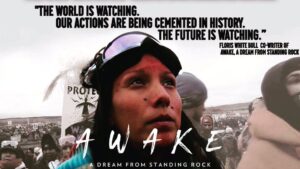
T 11/16* AWAKE: A Dream from Standing Rock Film Screening

AWAKE: A Dream from Standing Rock
a film by Myron Dewey, Josh Fox, and James Spione (2017; 84 minutes)

November 16, 2021, 7 PM EST
Location: White Hall, Room 102

Free and open to the Emory community.
Please, no food or beverages.
Masks are required.

Awake, A Dream from Standing Rock tells the story of the #NODAPL Native-led water protectors’ actions to enforce treaty obligations and halt construction of a $3.7 billion Dakota Access Pipeline under the Missouri River at the Standing Rock Sioux Reservation.

The documentary is co- directed by Indigenous filmmaker and Digital Smoke Signalsfounder Myron Dewey (1972-2021), a citizen of the Walker River Paiute Tribe and a pioneer in drone camera journalism and live stream field journalism.

Dewey’s co-directors are Academy Award nominated filmmaker Josh Fox (Gasland, How to Let Go of The World and Learn To Love Everything Climate Can’t Change) and Academy Award nominated filmmaker James Spione (Incident In New Baghdad).

An event in conjunction with the Native American and Indigenous Studies Initiative at Emory University
For more info, contact Prof. Debra Vidali, debra [dot] vidali [at] emory [dot] edu


Su 11/14* Recital/Lecture by Indigenous Violinist Heidi Senungetuk

Recital/Lecture by Indigenous Violinist Heidi Senungetuk
November 14, 2021, 4 PM EST
Location: Michael C. Carlos, Ackerman Hall

In this recital/lecture, violinist and Emory Visiting Professor of Music Heidi Senungetuk (Kingikmiut Inupiaq), will present two works that highlight Indigenous modes of creativity in music. The first of these two,  For Heidi Senungetuk, was composed by Raven Chacon (Navajo Nation) as part of his series For Zitkála Šá. The second piece on the program, “Qutaaŋuaqtuit: Dripping Music,” created for the ongoing art exhibition Soundings: An Exhibition in Five Parts, which brings attention to concepts of musical score interpretation, Indigenous language revitalization, interpretation of ancestral material arts, and musical performances as acts of sovereignty.

Su 11/14* Gallery Talk with artist Cannupa Hanska Luger

Gallery Talk with artist Cannupa Hanska Luger
November 14, 2021, 2:30 PM EST
Location: Michael C. Carlos Museum, Level Three Exhibition Galleries 
Sign Up Required
In accordance with Emory University’s Gathering Policy, masks must be worn at this event.

Cannupa Hanska Luger, one of the two contemporary Indigenous artists whose work is featured in Each/Other: Marie Watt and Cannupa Hanska Luger, will give a gallery talk about his work in the exhibition focusing on collaboration, social engagement, and innovative use of materials.

This program is part of Cannupa Hanska Luger’s artist residency, made possible through the generous financial support of the Hightower Lecture Fund, the Michael C. Carlos Museum, and Emory University’s departments of Art History, English, Sociology, Anthropology, African American Studies, History, Film and Media Studies, and Women’s, Gender, and Sexuality Studies, the Native American and Indigenous Studies Initiative, and the James Weldon Johnson Institute for the Study of Race and Difference.