Thursday, October 8, 2020 at 7:30 pm Eastern.
Live online Zoom lecture. Registration required. Free.
Hosted by: The Michael C. Carlos Museum.
Professor Claudio Saunt, Richard B. Russell Professor in American History; Co-Director, Center for Virtual History; Associate Director, Institute of Native American Studies, University of Georgia
In May 1830, the United States formally launched a policy to expel Native Americans from the East to territories west of the Mississippi River. Justified as a humanitarian enterprise, the undertaking was to be systematic and rational, overseen by Washington’s small but growing bureaucracy. But as the policy unfolded over the next decade, thousands of Native Americans died under the federal government’s auspices, and thousands of others lost their possessions and homelands in an orgy of fraud, intimidation, and violence.
Claudio Saunt, Richard B. Russell Professor in American History at the University of Georgia, discusses his new book Unworthy Republic: The Dispossession of Native Americans and the Road to Indian Territory, in which he explores how expulsion became national policy and describes the chaotic and deadly results of the operation to deport 80,000 men, women, and children in order to secure new lands for the expansion of slavery and to consolidate the power of the southern states.
In telling this gripping story, Saunt shows how the politics and economics of white supremacy lay at the heart of the expulsion of Native Americans; how corruption, greed, and administrative indifference and incompetence contributed to the debacle of its implementation; and how the consequences still resonate today.
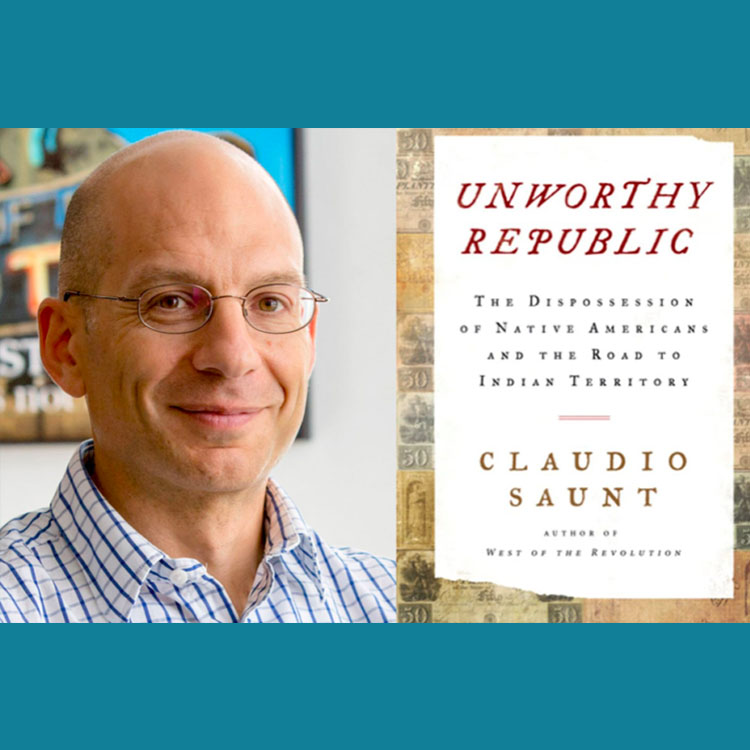
“One of the most important books published on U.S. history in recent years and should be required reading for all Americans. — Sven Beckert, Laird Bell Professor of History, Harvard University, author of Empire of Cotton
“Unworthy Republic offers a much-needed corrective to the American canon, showing how a heavy-handed president, a deadlocked Congress, and a lust for profit combined to construct a shameful national legacy. This book is timely, provocative, heart-wrenching, and original―a riveting story that invites us all to reflect on how we got where we are today.” — Elizabeth Fenn, Distinguished Professor, University of Colorado Boulder
Registration link for this free Zoom program:
https://emory.zoom.us/webinar/register/WN_wZdZipReRXGRxZcpSabZtg
To purchase a copy of Unworthy Republic, email the Carlos Museum Bookshop at mburell [at] emory [dot] edu. Please include your name and phone number and let us know if you would like the order shipped to you or if you would like to arrange for curbside pickup outside the museum.
This program is made possible through the generous support of the Grace Welch Blanton Lecture Fund.