
 Whereas the regulation of how food is grown, sourced, prepared, and consumed has formed Judaism’s core and longest evolving set of rules, Jewish cookbooks—that is collections of recipes including the author’s personal food memories and/or information related to the history or the cultural and religious significance of the listed dishes, or, in general, cooking, housekeeping, heathy diet, and hygiene—are a 19th-century phenomenon. The books that Paul Entis, executive director of the Tam Institute for Jewish Studies (gourmand and Jewish food connoisseur), donated to the library deepen our knowledge of all aspects of Jewish and non-Jewish foodways and expand it beyond the alimentary horizon and the genre of the cookbook. These books demonstrate that cooking is not the monopoly of professionals, and, through their varied geographical focus, they highlight that the Jewish and non-Jewish gastronomical worlds are closely intertwined, offering similar esthetic, spiritual, and alimentary experiences. Not less importantly, the Passover Haggadahs among the donated works will enrich Pitts Library’s Haggadah collection.
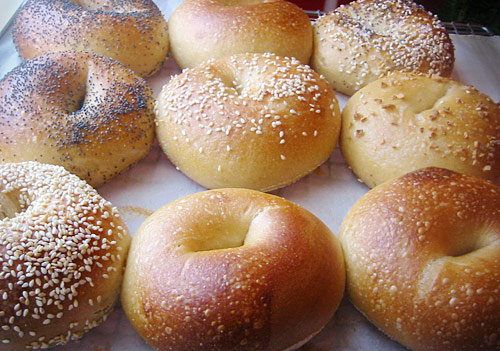
The example of one of the most broadly consumed food stuff considered Jewish, the bagel, especially highlights the broad geographical and cultural scope of the donated book collection turning to cooks at various stages of proficiency. In her “The Children’s Jewish Holiday Kitchen,” the famous cookbook author Joan Nathan transcribed the bagel recipe the well-known, Washington-based political consultant, activist, and homemade bagel baking contest winner Mark Talisman (1941–2019) developed. While Talisman praised the bagel as “an American metaphor”1 representing Jews in the American food scene while helping build bridges over ethnic divides, Nathan emphasized the long route of migration that brought bagel from Eastern Europe not only to the US but also to Canada. In her “The Jewish Holiday Baker,” recording a recipe for Montreal bagels, she explains that they do not resemble “New York’s water bagels,” rather those prepared in Krakow and Paris (p. 82). For her, the bagel represents the transnational nature of Jewish foodways.
Her bagel recipe for children includes the lists of ingredients and equipment and 14 drawings with captions to guide the reader-baker through the baking process (pp. 140-141). In her book for adults—in addition to learning that by adding salt to the list of ingredients, she diverts from the original Canadian version—the reader has to go without the list of necessary equipment. However, she provides detailed instructions about the length of the time one must wait for the dough to rise, how to shape the bagels, and the desirable size of the bagels. The bagel baker in the making even learns that the strip that is bent into a circle is called flechtel in Yiddish. Nathan’s encouragement for children, “Any roundish shape will do” (p. 140), changes when addressing adults: “It takes 4 to 5 weeks, 6 hours a day” for a professional baker to make the perfectly rounded bagel (p. 83).
The plurality of Jewish foodways and culinary traditions and the modern passion for the fusion kitchen is apparent also in Janna Gur’s “The Book of New Israeli Food and The Modern Jewish Table” by Tracey Fine and Georgie Tarn. Particular ingredients, such as lemon zest, or intangible concepts, like simplicity or economical cooking, are among the subjects these books explore, while also providing recipes for holidays and everyday feasts. As these cookbooks reflect late 20th– and early 21st-century trends in Jewish cooking so does “Uplifting People and Planet: Eighteen Essential Jewish Lessons on the Environment” by Rabbi Yonatan Neril and Evonne Marzouk demonstrate recent trends in Jewish thought on food and alimentation. It documents the importance of ecological consciousness, sustainability, and environmental ethics in kosher and Jewish food production and consumption.
In the chef-authors’ memoirs included in the donation, personal memories and recipes merge. One should add, these are recipes not only for sustenance but for life in general. For example, in “Consuming Passion: A Food-Obsessed Life,” Michael Lee West’s Love Stimulant recipe for finding reciprocated love and Remedy for Lonely Heart, that is, a tasty treatment to find true friendship, promises exciting culinary experiences (scientific proof of the effectiveness of the cures are not included). Taking another angle, in her “The Sharper Your Knife, the Less You Cry: Love, Laughter, and Tears in Paris at the World’s Most Famous Cooking School,” the memoirist-chef Kathleen Flinn quotes her patisserie teacher observing, “Pastry is like people,” and adds that, “Some dough needs a lot of kneading, some requires less. Some dough is satisfied to rise just a little, while other dough needs to double in size. All dough needs warmth to rise.” (p. 49)
The collection is an important addition to Woodruff Library’s food and Jewish studies collections reinforcing the connections between foodways and literatures across cultures while also opening a window onto Jewish cuisines and thought.
[1] “The Great Bagel Boom,” Chicago Tribune, August 19, 2021; Originally Published: February 21, 1996 https://www.chicagotribune.com/1996/02/21/the-grear-bagel-boom/