
For the first time, items from Emory’s Rose Library will be on exhibit at the world’s busiest airport, where millions of travelers coming through Hartsfield-Jackson Atlanta international can take a break and explore materials on the history of hip hop in Atlanta and its torchbearer, EarWax Records.
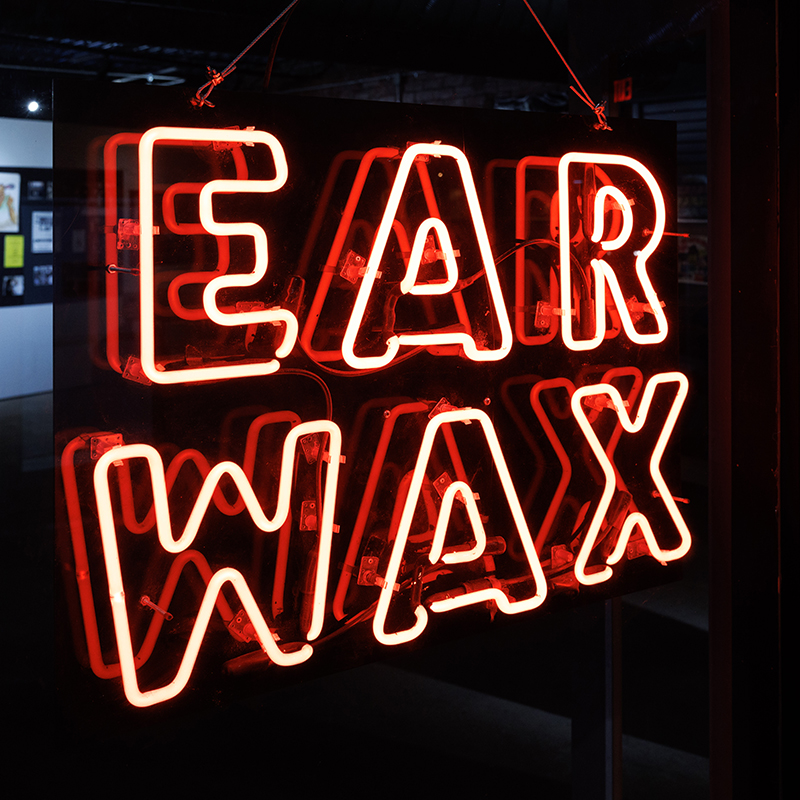
Photo: CatMax Photography
“Beyond the 50: Continuing Hip Hop’s Legacy in Atlanta” celebrates 50 years of hip hop music and looks to the future. The traveling exhibit pays homage to EarWax Records, which opened on Peachtree Street in 1993, and its owner, Darryl “Jasz” Smith. The store, which closed in 2007, became known for its community vibe, hard-to-find music, especially hip hop, and its live performances, which included Atlanta’s OutKast.
The free exhibit is located on Concourse E, near the Delta Sky Club between gates E11 and E15. It’s easy to spot because the cases housing the materials are large – about 6 feet tall by 12 feet long.
“Beyond the 50” opened on Nov. 15 and will run for two years. Concourse E hosts both domestic and international flights, so a wide variety of audiences will see the exhibit on their way to and from their travels.
The exhibit features a replica of the original EarWax storefront as well as production equipment, records, artist posters, mix tapes, stickers, graffiti, various boom boxes, books on hip hop and education, and vintage hip hop magazines. Drawn from the Stuart A. Rose Manuscript, Archives, and Rare Book Library and the personal collections of Smith and his collaborators, the display highlights the breadth of the EarWax materials held at Emory.
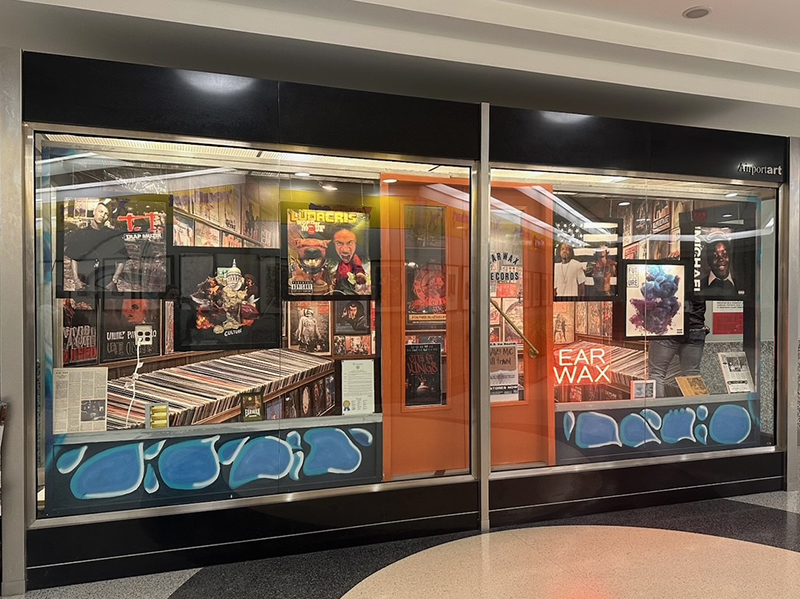
The first case in “Beyond the 50: Continuing Hip Hop’s Legacy in Atlanta” features a replica of the EarWax Records storefront. The store was known for its hard-to-find hip hop music and its community vibes. Exhibit photos courtesy Hartsfield-Jackson Atlanta International Airport.
“Beyond the 50: Continuing Hip Hop’s Legacy in Atlanta” follows the successful 2023 exhibition, “You Don’t Got Dis: A Hip Hop Legacy.” That previous show, curated by Smith and displayed at Emory’s Science Gallery Atlanta, traced the pivotal, genre-defying story of EarWax Records and its impact on Atlanta’s music scene. “Beyond the 50” expands on this legacy, offering new perspectives on EarWax’s history, its key figures, and the enduring impact of hip hop.
“EarWax Records played a critical role in elevating the artistry and craft of hip hop and its creators,” says Valeda F. Dent, vice provost of Libraries and Museum at Emory University.

EarWax Records owner Jasz Smith speaks during a panel at an event for the “You Don’t Got Dis” exhibition at Science Gallery Atlanta in November 2023. Photo credit: CatMax Photography.
“Jasz Smith is a brilliant curator and historian, and we are absolutely thrilled that the 2023 exhibit he and his team created will live on in the busiest airport in the world,” Dent adds. “We expect thousands of visitors to interact with the re-creation of EarWax’s shop and artifacts as they pass through the airport this holiday season and beyond.”
The exhibit is also a way to inspire travelers to consider what they could do and create with Rose Library materials.
“It’s important that people are aware of what we have at the Libraries because hopefully that knowledge will enable them to take the next step of using our materials to produce scholarship, art, documentaries, or personal research projects,” says Clint Fluker, senior director of culture, community, and partner engagement for Emory University Libraries & Museum. Fluker served as curatorial director for both “Beyond the 50” and “You Don’t Got Dis.”
Two turntables and a microphone
The exhibit’s first display case revives the EarWax store entrance, with images of hip hop artists visible in the windows.
“We wanted to recreate the original storefront,” says Smith. “And there are six lightboxes in the window of artists like OutKast, Future, Ludacris, and T.I.”
The second case reflects the history of hip hop, displaying factoids and materials such as record album covers, flyers, framed photographs, books, and promotional materials.
For the third case, “We built a recording studio that has original studio equipment, and we created a tribute to Patchwerk, which is the oldest, still-standing hip hop studio in Atlanta,” says Smith. “I have some record plaques from Patchwerk in there, and I have their rug that says Patchwerk.” The case displays sound mixers, turntables, record awards, and posters promoting DJ events.
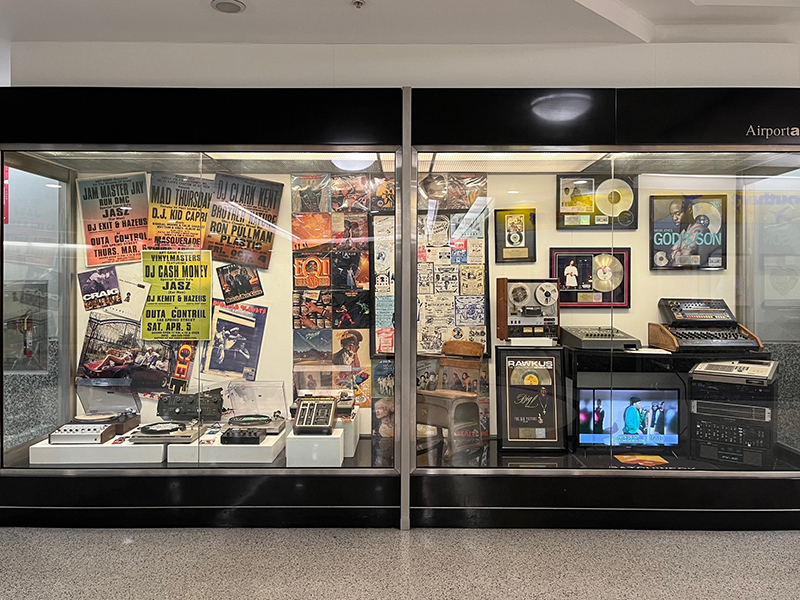
The third case represents a recording studio and displays a sound mixer, turntables, awards, and promotional posters for hip hop DJ events.
The fourth case, called “Hip Hop is Global,” shows how the genre has grown beyond the neighborhood to have a worldwide impact in music and marketing. The case is filled with magazines, clips of performance flyers, books, documentary DVDs, and different styles of boomboxes. Two hip hop documentaries play on screens.
The Emory-airport connection
The idea for “Beyond the 50” emerged from ongoing discussions within the airport about how to honor Atlanta’s cultural leadership on a global stage, says Jess Bernhart, the airport’s art program manager. The airport’s relationship with Emory began last year, when the airport exhibition “This Land Calls Us Home,” featuring works by Indigenous artists, traveled to Emory and was displayed this spring in the Woodruff Library’s Schatten Gallery.
“Hip hop may have started in the Bronx, but Atlanta has played a defining role in its evolution — and EarWax Records is a central part of that history,” says Bernhart. “When Emory Libraries approached us about exhibiting archival materials related to EarWax, we immediately recognized the opportunity to introduce this story to millions of travelers.”
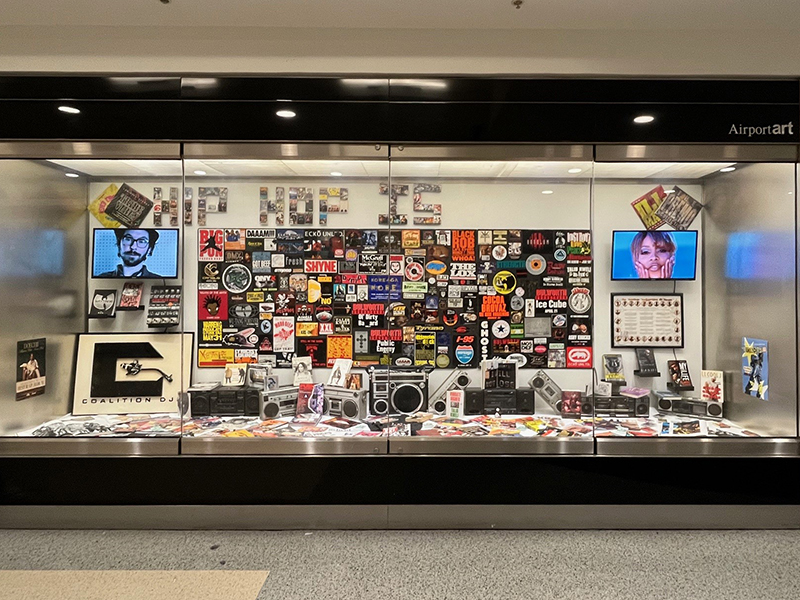
This case shows the global impact of hip hop music, filled with magazines, graphics of hip hop artist and DJ names, different styles of boom boxes, and other materials.
Exhibiting Emory Libraries and Rose Library collections at the Atlanta airport is an ideal way to spread the word about Emory’s humanities research offerings to a global audience.
“My hope for this exhibit is that it will inspire visitors and local residents to visit the Rose Library to learn more about the fabulous collections, including EarWax Records, that we have,” says Dent. “I also hope the exhibit makes a positive impression on potential future students and their families and highlights Emory’s libraries as a key player in the Atlanta pop culture, historical and archival space.”
Referring to the current exhibit’s predecessor, “You Don’t Got Dis: A Hip Hop Legacy,” Dent says, “None of this would have been possible without our partners from Science Gallery Atlanta,” expressing gratitude for the involvement of the original partners from Science Gallery Atlanta – Deborah Bruner, Alexis Faust, and Floyd Hall – as well as Smith, and Fluker, who served as curatorial lead for both exhibitions.
Both Emory Libraries and the Atlanta airport envision collaborating on future exhibitions.
“This project has demonstrated how powerful it is when a world-class research institution and the world’s busiest airport combine their strengths,” says Bernhart. “Emory brings depth, scholarship, and stewardship of Atlanta’s cultural memory; the airport offers extraordinary public visibility. There are many stories within Emory’s collections that deserve a global audience, and we would welcome future opportunities to bring them to life at ATL.”
“Beyond the 50” will be on display when thousands of soccer fans, players, and coaches from around the world pass through the airport when the World Cup comes to Atlanta in June and July of 2026.
While this exhibit offers a brief look into the EarWax world, the EarWax Records archive at the Rose Library is an essential resource for studying Atlanta’s hip hop landscape, and it’s open to visitors, says Fluker.
“We are really interested in connecting our collections to the pulse of our community,” says Fluker. “When we do that, our collections naturally become part of the ecosystem. For example, OutKast was recently inducted into the Hip Hop Hall of Fame. This is a major moment for the city, so it’s great that we are also providing this opportunity for people to learn more about the hip hop landscape in Atlanta, while all eyes are looking toward the city.”
Appointments are available to view these primary source materials by contacting rose [dot] library [at] emory [dot] edu.
—by Maureen McGavin, senior writer, Emory Libraries
Related links:
“You Don’t Got Dis: A Hip Hop Legacy” (Science Gallery Atlanta)
Emory marks 50 years of hip hop with Nov. 10 campus event, Science Gallery exhibit (2023)