
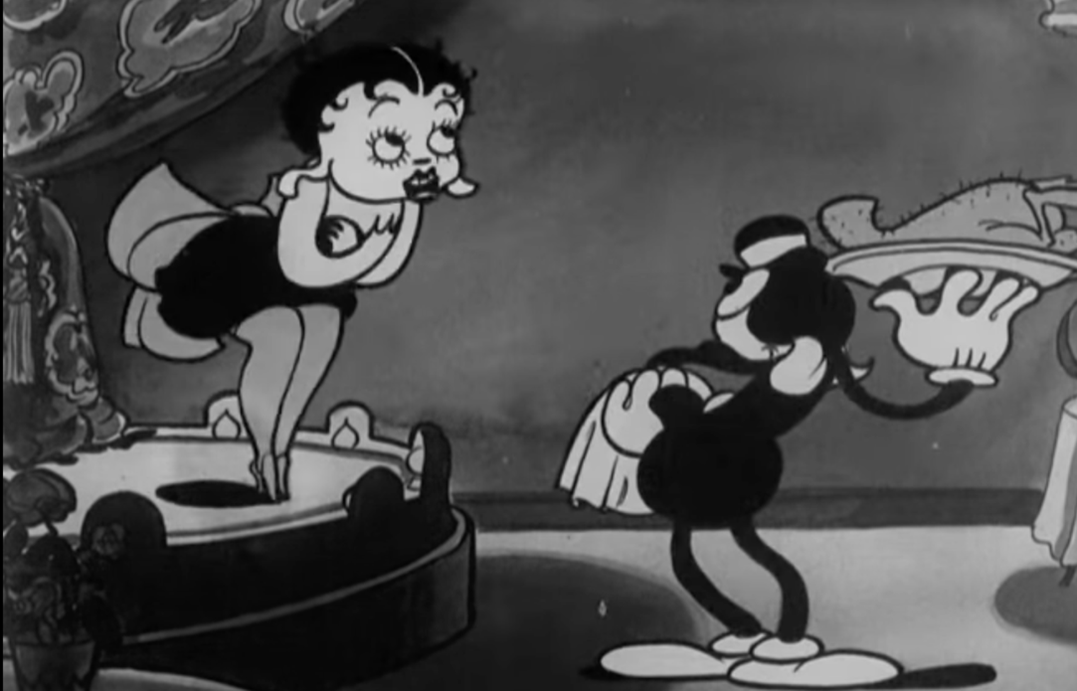
Betty Boop making her debut in the film Dizzy Dishes (1930).
Every year, on January 1, works previously protected by copyright enter the public domain in the United States and become free for everyone to use.
On Jan. 1, 2026, thousands of copyrighted works from 1930 entered the public domain in the United States, along with sound recordings from 1925. Works in the public domain are free for all to copy, share, and build upon. Among this year’s highlights are modernist masterpieces including William Faulkner’s “As I Lay Dying” and T. S. Eliot’s “Ash Wednesday”; detective stories such as Agatha Christie’s “The Murder at the Vicarage”; Olaf Stapledon’s science-fiction classic, “Last and First Men”; Sigmund Freud’s seminal work “Civilization and Its Discontents”; and children’s classics, including the first four Nancy Drew books and the popular illustrated version of “The Little Engine That Could.”
Films featuring Marlene Dietrich, Greta Garbo, the Marx Brothers, and John Wayne in his first leading role are also now in the public domain, along with the musical notation and lyrics of popular songs such as “I Got Rhythm,” “Georgia on My Mind,” and “Dream a Little Dream of Me.” Celebrated modernist paintings by Piet Mondrian and Paul Klee are now free to reproduce, share, and reimagine. Several iconic characters first introduced in 1930 will also have new life as part of the expanding public domain, including Betty Boop, Pluto (originally named Rover), and Blondie and Dagwood.
As Justice Elena Kagan explained just a few years ago in her dissent in Andy Warhol Foundation for Visual Arts v. Goldsmith (2023), “. . . artists don’t create all on their own; they cannot do what they do without borrowing from or otherwise making use of the work of others. That is the way artistry of all kinds—visual, musical, literary—happens (as it is the way knowledge and invention generally develop).” With this new cache of iconic works from a previous era entering the public domain, creators are free to borrow from them, or to reinvent them altogether, to confront the cultural challenges of our own time.
Books and plays
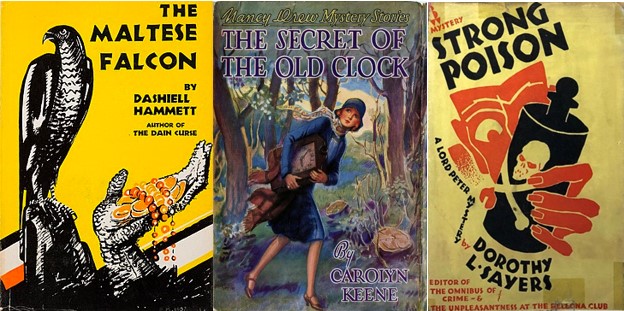
Here are just a few of the classic books that entered the public domain in 2026, with links to copies accessible freely online or available to borrow at Emory Libraries. For those who don’t have an active Emory ID card, check your local library or favorite bookseller for these titles.
- William Faulkner, As I Lay Dying
- Dashiell Hammett, The Maltese Falcon (the full book version)
- Agatha Christie, The Murder at the Vicarage (the first novel featuring Miss Marple)
- Carolyn Keene (pseudonym for Mildred Benson), the first four Nancy Drew books, beginning with The Secret of the Old Clock
- Noël Coward, Private Lives
- S. Eliot, Ash Wednesday
- Evelyn Waugh, Vile Bodies
- John Dos Passos, The 42nd Parallel
- Dorothy L. Sayers, Strong Poison
- Olaf Stapledon, Last and First Men
- Sigmund Freud, Civilization and Its Discontents (in the original German, Das Unbehagen in der Kultur)
Films
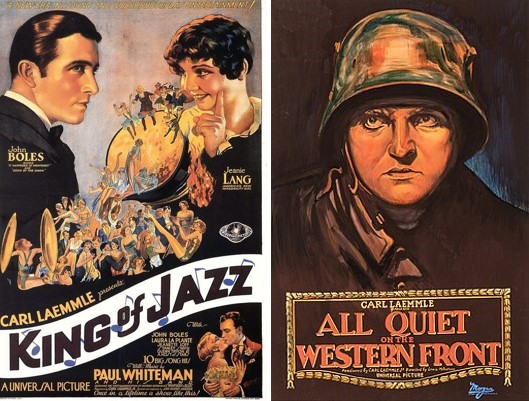
War films, musicals, thrillers, Westerns, comedies, surrealist satires—this year’s newly public domain films run the gamut. Some of the scenes from these films are eerily resonant today. In “King of Jazz,” a man gets drunk and stammers: “You know what’s the matter with this country? It’s a tariff! That’s who!,” referring to the 1930 Smoot-Hawley Tariff Act that deepened the Great Depression. Today, there is a lot of debate about whether the public knows enough about the importance of the rule of law and the protections of due process. At the end of Animal Crackers, Groucho and Chico Marx (as Captain Spaulding and Ravelli) have this exchange.
Groucho: “We go to court and get a writ of habeas corpus.”
Chico: “You gonna get rid of what?”
Groucho: “Haven’t you ever heard of habeas corpus?”
Chico: “No, but I’ve heard of ‘Habie’s Irish Rose’.”
(Groucho sighs in exasperation and walks away)
The list below is a small selection of films that entered the public domain this year; each film listed below is available for streaming in full via its Wikipedia listing (links embedded).
- All Quiet on the Western Front, directed by Lewis Milestone (winner of the Academy Award for Best Picture)
- King of Jazz, directed by John Murray Anderson (musical revue featuring Paul Whiteman and Bing Crosby’s first feature-film appearance)
- Cimarron, directed by Wesley Ruggles (winner of the Academy Award for Best Picture, registered for copyright in 1930)
- Animal Crackers, directed by Victor Heerman (starring the Marx Brothers)
- Soup to Nuts, directed by Benjamin Stoloff (written by Rube Goldberg, featuring later members of The Three Stooges)
- Morocco, directed by Josef von Sternberg (starring Gary Cooper, Marlene Dietrich, and Adolphe Menjou)
- The Blue Angel (Der blaue Engel), directed by Josef von Sternberg (starring Marlene Dietrich)
- Anna Christie, directed by Clarence Brown (Greta Garbo’s first talkie)
- Hell’s Angels, directed by Howard Hughes (Jean Harlow’s film debut)
- The Big Trail, directed by Raoul Walsh (John Wayne’s first leading role)
- The Big House, directed by George Hill
- Murder!, directed by Alfred Hitchcock
- L’Âge d’Or, directed by Luis Buñuel, written by Buñuel and Salvador Dalí
- The Divorcee, directed by Robert Z. Leonard
- Whoopee!, directed by Thornton Freeland
Musical compositions
The year 1930 brought us enduring jazz standards and popular songs. From George and Ira Gershwin came “I Got Rhythm,” the source of the foundational jazz chord progression known as the “rhythm changes,” and “But Not for Me,” memorably featured in the film “When Harry Met Sally.” You might still find yourself humming the classics “Georgia on My Mind” and “Dream a Little Dream of Me” today. Only the musical compositions—the music and lyrics that you might see on a piece of sheet music—are entering the public domain, not the recordings of those songs, which are covered by a separate copyright with a different term of protection.
The following musical compositions represent a small sampling of the cache that entered the public domain at the start of 2026. The links provide additional information and, in limited cases, streaming versions of sound recordings of the compositions.
- I Got Rhythm, I’ve Got a Crush on You, But Not for Me, and Embraceable You, with lyrics by Ira Gershwin, music by George Gershwin
- Georgia on My Mind, lyrics by Stuart Gorrell, music by Hoagy Carmichael
- Dream a Little Dream of Me, lyrics by Gus Kahn, music by Fabian Andre and Wilbur Schwandt
- Livin’ in the Sunlight, Lovin’ in the Moonlight, lyrics by Al Lewis, music by Al Sherman
- On the Sunny Side of the Street, lyrics by Dorothy Fields, music by Jimmy McHugh
- It Happened in Monterey, lyrics by Billy Rose, music by Mabel Wayne
- Body and Soul, lyrics by Edward Heyman, Robert Sour, Frank Eyton, music by Johnny Green
- You’re Driving Me Crazy, lyrics and music by Walter Donaldson
- Beyond the Blue Horizon, lyrics by Leo Robin, music by Richard A. Whiting and W. Franke Harling (possible inspiration for the Star Trek theme song)
- The Royal Welch Fusiliers, by John Philip Sousa
Sound recordings (from 1925)
Some incredible performances have entered the public domain, including the Civil Rights icon Marian Anderson singing “Nobody Knows the Trouble I’ve Seen” in her haunting contralto and “The St. Louis Blues” recorded by Bessie Smith and Louis Armstrong. Only the 1925 recordings made by these artists are entering the public domain, not their later recordings. To listen to old recordings, you can go to the Library of Congress National Jukebox.
- “Nobody Knows the Trouble I’ve Seen,” recorded by Marian Anderson
- “Yes Sir, That’s My Baby,” recorded by Gene Austin
- “Sweet Georgia Brown,” recorded by Ben Bernie and His Hotel Roosevelt Orchestra
- “You’ve Been a Good Old Wagon,” recorded by Bessie Smith
- “The St. Louis Blues,” recorded by Bessie Smith, featuring Louis Armstrong
- “Fascinating Rhythm,” recorded by the Paul Whiteman Orchestra
- “I’ll See You in My Dreams,” recorded by Isham Jones, with Ray Miller’s Orchestra
- “Everybody Loves My Baby (but My Baby Don’t Love Nobody but Me),” recorded by Clarence Williams’s Blue Five
- “If I Lose, Let me Lose (Mama Don’t Mind),” recorded by Louis Armstrong, Fletcher Henderson, and Maggie Jones
- “A Cup of Coffee, A Sandwich and You,” recorded by the Carleton Terrace Orchestra
- “Manhattan,” recorded by The Knickerbockers (Ben Selvin and his Orchestra)
Most works from 1930 are out of circulation, but now that they are in the public domain, anyone can make them available to the public. This enables access to our cultural heritage—access to materials that might otherwise be forgotten. Many cultural gems are waiting to be rediscovered.
This post was adapted by Emory Libraries’ Copyright and Scholarly Communications Librarian John Morgenstern from “Public Domain Day 2026” (licensed CC BY 4.0) by Jennifer Jenkins and James Boyle at the Center for the Study of the Public Domain, Duke University School of Law.