Th 11/11* Emory Climate Talk with artist Cannupa Hanska Luger

Emory Climate Talk with artist Cannupa Hanska Luger
November 11, 2021, 4 PM EST
Location: Michael C. Carlos Museum, Ackerman Hall
In accordance with Emory University’s Gathering Policy, masks are required at this event.
If you would like to attend virtually through Zoom, click HERE.

Cannupa Hanska Luger, whose works are featured in the exhibition Each/Other: Marie Watt and Cannupa Hanska Luger will participate in the Emory Climate Talks series, which explores the scientific and social aspects of global climate change.

Cannupa Hanska Luger is a New Mexico-based multidisciplinary artist who uses social collaboration in response to timely and site-specific issues. Raised on the Standing Rock Reservation in North Dakota, he is an enrolled member of the Three Affiliated Tribes of Fort Berthold and is of Mandan, Hidatsa, Arikara, Lakota, and European descent. Luger produces multi-pronged projects that take many forms—through monumental installations that incorporate ceramics, video, sound, fiber, steel, new media, technology and repurposed materials, Luger interweaves performance and political action to communicate stories about 21st-century Indigeneity. This work provokes diverse audiences to engage with Indigenous peoples and values apart from the lens of colonial social structuring, and often presents a call to action to protect land from capitalist exploits. He combines critical cultural analysis with dedication and respect for the diverse materials, environments, and communities he engages.

Among other works, Luger will discuss The Mirror Shield Project (2016), a social engagement work, which invited the public to create mirrored shields for Water Protectors protesting the Keystone pipeline at Standing Rock. The project has since been formatted and used in various resistance movements across the nation.

This program is part of Cannupa Hanska Luger’s artist residency, made possible through the generous financial support of the Hightower Lecture Fund, the Michael C. Carlos Museum, and Emory University’s departments of Art History, English, Sociology, Anthropology, African American Studies, History, Film and Media Studies, and Women’s, Gender, and Sexuality Studies, the Native American and Indigenous Studies Initiative, and the James Weldon Johnson Institute for the Study of Race and Difference.
Su 11/7* Cannupa Hanska Luger: Artist as Social Engineer

Cannupa Hanska Luger: Artist as Social Engineer
November 7, 2021, 2 PM EST
Location: Ackerman Hall
Masks are required in accordance with Emory University’s Visitor Policy.
If you prefer to attend virtually through Zoom, click HERE.

“In a world polarized politically, economically, racially, and sexually we are forced to question our trust. However, our trust is the mortar that binds our intelligence. We need one another now more than ever. But how do we see eye to eye with human groups we don’t trust? Enter the artist. If we can subvert the idea art is an object, a noun, then we can reinstate the truth that art is a verb, an action. In developing processes that include society as a medium the act of making builds communities that are embedded in the object of these processes. It connects people that may not engage with one another to create work together. Thus the role of the artist is bridge-builder.”                                                                —Cannupa Hanska Luger

Join us for an artist talk titled “Cannupa Hanska Luger: Artist as Social Engineer” in which the contemporary Indigenous artist will discuss his practice and the collaboration and social engagement at its core, from his recent Something to Hold Onto installation at the Mesa Contemporary Arts Museum in Mesa, Arizona to his current video, installation, and land-based Future Ancestral Technologies.

This program is part of Cannupa Hanska Luger’s artist residency, made possible through the generous financial support of the Hightower Lecture Fund, the Michael C. Carlos Museum, and Emory University’s departments of Art History, English, Sociology, Anthropology, African American Studies, History, Film and Media Studies, and Women’s, Gender, and Sexuality Studies, the Native American and Indigenous Studies Initiative, and the James Weldon Johnson Institute for the Study of Race and Difference.
Cannupa Hanska Luger’s work is featured in the exhibition Each/Other: Marie Watt and Cannupa Hanska Luger, on view at the Carlos Museum through December 12, 2021.

Sa 11/6* Here Song Walk with Cannupa Hanska Luger

Here Song Walk with Cannupa Hanska Luger
Saturday November 6, 2021, 1 PM EST
 Registration Required

Cannupa Hanka Luger’s ancestors, the people of the Northern Plains Tribes of North America, studied horizon lines to create melody and other types of sonic experiences. This practice, known as “singing the horizon,” connected them to place and reinforced their relationship to the land.

Working with Atlanta’s Flux Projects, Luger created Here Song, a mobile app that allows users to trace the land and create tonal resonances—sonic stories that engage directly with the land.

Join Cannupa Hanska Luger and master naturalist and nature photographer Kathryn Kolb, for a guided walk through Atlanta’s Cascade Springs Nature Preserve, one of the largest areas of old-growth forest in the city. The park lies on Cascade Road, which follows the ancient Native American Sandtown Trail that stretched from Stone Mountain to the Creek village of Sandtown on the Chattahoochee and into Alabama.

Meet at 1 PM at the Kilgo Circle entrance to the Carlos Museum to board the bus to Cascade Nature Preserve.
Space is limited and registration is required by clicking HERE.
In accordance with Emory’s Gathering Policy, masks will be required on the bus.


M 11/1* Carlos Reads The Lumbee Indians: An American Struggle

Carlos Reads The Lumbee Indians: An American Struggle
Monday November 1, 2021, 7:30 – 9:00 PM EST
Registration Required: Call 404-727-6118; Space is limited
Fee:  $30 for Carlos Museum members; $50 for nonmembers, and includes the cost of the book.

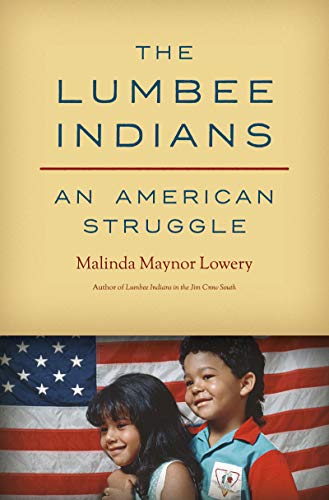
Malinda Maynor Lowery’s recent book, The Lumbee Indians: An American Struggle, examines the remarkable history of the largest tribe east of the Mississippi, who have survived in their original homeland, maintaining a distinct identity as Indians in a biracial South.

Dr. Lowery, who recently joined the Emory faculty as Cahoon Family Professor in History, will lead readers in a discussion of the book, which intertwines her family history with that of the Lumbee, shedding new light on America’s defining moments from the first encounters with Europeans to the present day. How and why did the Lumbees both fight to establish the United States and resist the encroachments of its government? How have they not just survived, but thrived, through Civil War, Jim Crow, the civil rights movement, and the war on drugs, to ultimately establish their own constitutional government in the twenty-first century? Their fight for full federal acknowledgment continues to this day, while the Lumbee people’s struggle for justice and self-determination continues to transform our view of the American experience.

“The compelling saga of the Lumbee nation demands to be heard, and Malinda Maynor Lowery’s transcendent historical and cultural mastery of the Lumbee past make her the paramount historian to write it. This profound and lyrical work, in both its impeccable scholarship and its dazzling and seductive storytelling, reveals anew that the complexities of American history remain impenetrable without the foundational prism of Native American experience. And yet the Lumbee story illuminates that larger history better than any that spring to mind. Lowery’s radiant narrative unveils the Lumbee nation from distinctive angles of vision with which we all must reckon to understand even our own histories.   —Timothy B. Tyson, author of The Blood of Emmett Till

Carlos Reads The Lumbee Indians: An American Struggle

M 10/11* Indigenous Storytelling: Language, Culture, and Nature with Dr. Maung Nyeu

Indigenous Storytelling: Language, Culture, and Nature with Dr. Maung Nyeu
Monday, October 11, 1:00-2:00 PM EST
Location: Zoom Webinar
Sponsored by: Emory’s Office of Spiritual and Religious Life
RSVP here. For questions, please contact religiouslife [at] emory [dot] edu.

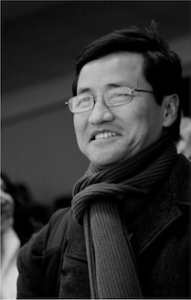
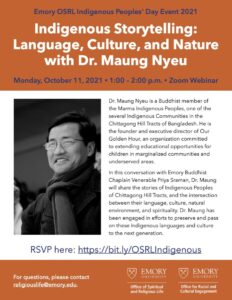
Dr. Maung Nyeu is a Buddhistmember of the Marma Indigenous Peoples, one of the several Indigenous Communities in the Chittagong Hill Tracts of Bangladesh. He is the founder and executive director of Our Golden Hour, an organization committed to extending educational opportunities for children in marginalized communities and underserved areas.

In this conversation with Buddhist Chaplain Venerable Priya Sraman, Dr. Maung will share the stories of Indigenous Peoples of Chittagong Hill Tracts, and the intersection between their language, culture, natural environment, and spirituality. Dr. Maung has been engaged in efforts to preserve and pass on these Indigenous languages and culture to the next generation.

Dr. Maung Nyeu comes from the Marma Indigenous Peoples of Chittagong Hill Tracts, Bangladesh. He is the founder and executive director of Our Golden Hour, an organization that is committed to serving educational needs to the children in marginalized communities and underserved areas. He is a award-winning author of children’s books and multilingual picture dictionaries, and was nominated as one of the fifty most inspiring stories by BBC World Service.

indigenous-peoples-day-event-2021-LETTER-DIGITAL (2)


W 10/6* Film Screening on the Emory Quadrangle

Film Screening on the Emory Quadrangle
October 6th, 2021, 7:30 PM, EST
Location: Emory University Quadrangle
In case of rain, the film will be shown in Ackerman Hall on Level Three of the Carlos Museum and masks will be required in accordance with Emory’s Gathering Policy.

The Arrivals wash up on the shore. They make contact with another civilization they call “the Hosts.” And from there, the story splinters, following diverging perspectives. Starting as a procession through the LA State Historic Park, Sweet Land becomes an opera that erases itself.

Named “Best New Opera” by the Music Critics Association of North America in 2021, The Industry’s Sweet Land is a grotesque historical pageant that disrupts the dominant narrative of American identity.

Bring a lawn chair or a blanket and join us on Emory’s Quadrangle for an outdoor screening of the film version of Sweet Land, recorded in March of 2020, outside in Los Angeles State Historic Park.
“opera as astonishment” — Mark Swed, Los Angeles Times
“a head-spinning abstraction of colonialism and whitewashed mythology” — Joshua Barone, The New York Times
“a gut punch” — Alex Ross, The New Yorker
Click HERE to watch a trailer for the flim.
Click HERE to view a digital program for the 2020 Los Angeles production.

Tu 10/5* Pre-Screening Conversation

Pre-Screening Conversation
Presenters: Megan O’Neil,  Raven Chacon, Yuval Sharon, Cannupa Hanska Luger
Tuesday October 5th, 2021, 7:30 PM EST
Location: Zoom
Click HERE to register.

Megan O’Neil, faculty curator of the Art of the Americas and curator for the Carlos Museum’s presentation of Each/Other: Marie Watt and Cannupa Hanska Luger, hosts a pre-screening conversation with the creators of Sweet Land, the winner of the 2021 Music Critics Association of North America’s Best Opera award.

Joining Dr. O’Neil will be composer Raven Chacon, member of the Navajo Nation; director Yuval Sharon, founder and artistic director of The Industry and a 2017 winner of a MacArthur Fellowship; and costume designer and director Cannupa Hanska Luger (Mandan, Hidatsa, Arikara, Lakota, European).

F 10/8* Georgia’s Land Lotteries and Native Americans

Georgia’s Land Lotteries and Native Americans
Presenter: Dr. Hendry Miller (Georgia Archives Collections Manager)
October 8th, 2021, 12-1 PM EST 
Location: Virtual October Lunch and Learn 
Download Microsoft Teams app to attend this event; register here.

“Georgia’s Land Lotteries and Native Americans” explores Native American reactions to Georgia’s expanding territory in the early nineteenth century. We will first describe land distribution systems in Georgia and then use records of Georgia’s land lotteries to explore how Native Americans interacted with Georgia officials and within their own societies. Lastly, the presentation will discuss what resources are available online and at the Georgia Archives.

Hendry Miller is the Collections Manager at the Georgia Archives, where he has worked since 2018. Originally from Barrow County, Hendry studied history at Valdosta State University and conducted graduate work at Florida State University, earning a Ph.D. in 2017. His research and education focused on American history, particularly the Colonial and Early American South.

The link to the event will also be available on the Georgia Archives webpage.

The Georgia Archives is a unit of Board of Regents of the University System of Georgia. The Georgia Archives identifies, collects, manages, preserves, provides access to, and publicizes records and information of Georgia and its people, and assists state and local government agencies with their records management.

M 10/1* Indigenous Storytelling: Language, Culture, and Nature with Dr. Maung Nyeu

Indigenous Storytelling: Language, Culture, and Nature with Dr. Maung Nyeu
October 1, 2021, 1-2 PM EST
Location: Zoom
RSVP

Dr. Maung Nyeu is a Buddhist member of the Marma Indigenous Peoples, one of the several Indigenous Communities in the Chittagong Hill Tracts of Bangladesh. He is the founder and executive director of Our Golden Hour, an organization committed to extending educational opportunities for children in marginalized communities and underserved areas.

In this conversation with Buddhist Chaplain Venerable Priya Sraman, Dr. Maung will share the stories of Indigenous Peoples of Chittagong Hill Tracts, and the intersection between their language, culture, natural environment, and spirituality. Dr. Maung has been engaged in efforts to preserve and pass on these Indigenous languages and culture to the next generation.

For questions, please contact religiouslife [at] emory [dot] edu.

Su 9/26* Student Studio: Sewing Circle with Marie Watt

Student Studio: Sewing Circle with Marie Watt
September 26, 2021, 1 PM EST
Location: Emory Quadrangle
*In the event of rain, the sewing circle will be held in Ackerman Hall on Level Three of the Museum and masks will be required in accordance with Emory’s Gathering Policy.
This event sponsored by the Hightower Lecture Fund, the Michael C. Carlos Museum, and Emory University’s departments of Art History, English, Sociology, Anthropology, African American Studies, History, Film and Media Studies, and Women’s, Gender, and Sexuality Studies, and the James Weldon Johnson Institute for the Study of Race and Difference

Artist Marie Watt (Seneca), has been holding sewing circles for 15 years. They are integral to her artistic practice as direct opportunities to engage with communities and build relationships, to share her belief in the connective power of creating together. The many hands and voices brought together during sewing circles inform and define the eventual piece, embedding the participants’ stories into the very stitches and knots.

Sewing circles are inclusive by nature and by design. Everyone’s voice is equal in a circle; circles can expand or contract as needed to create space. The panels being stitched often start with an Indigenous point of view and these themes then become touchstones for conversation, connection, and cross-cultural knowledge generously exchanged by participants.

Join Marie Watt on the historic Emory quadrangle for a sewing circle inspired by US Poet Laureate Joy Harjo’s collection, An American Sunrise.

  • No sewing experience necessary
  • Come and go as you wish
  • Bring a friend and pass the invitation on to others