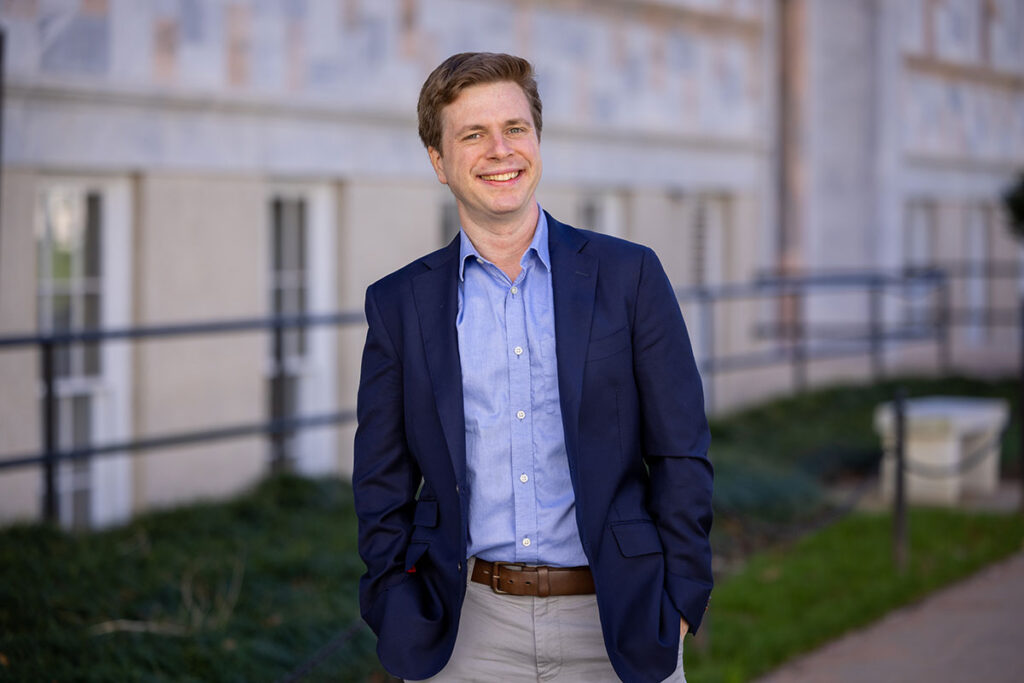
Dr. Jeffrey Lesser, Samuel Candler Dobbs Professor of History, was awarded honorable mention from the Latin American Studies Association (LASA) Brazil Section for his latest book, Living and Dying in São Paulo: Immigrants, Health, and the Built Environment in Brazil(Duke University Press, 2025). The award category is Best Book in the Humanities, or the Antonio Candido Prize.
In his review of Lesser’s work in the Hispanic American Historical Review, Gilberto Hochman (Oswaldo Cruz Foundation) writes: “Through meticulous and multidisciplinary research, Lesser establishes a dialogue with the growing Brazilian historiography on the city, health, and epidemics, adding new questions and answers from the countless layers that are established over time in an urban space.”
Third-year doctoral student Becca Aponte (African history) has published a pair of articles in the American Historical Association’s newsmagazine Perspectives on History. Aponte’s columns examine the theme “Africa, Women, and the Global History of Capitalism” through contemporary and historical commerce and culture in Dakar, Senegal.
The columns intersect with Aponte’s research in French West Africa, which (as she describes) examines “how women constructed alternative regimes of property, credit, and commerce across a century of imperial expansion in rural Senegal – from the abolition of slavery to the dismantling of colonial subjecthood.” Aponte’s graduate work is advised by Professors Mariana P. Candido, Adriana Chira, and Clifton Crais.
Read about Aponte and the other summer 2026 Perspectives columnists here, and find links to her two columns:
Four History majors students are among the 2026-27 cohort of Undergraduate Humanities Honors Fellows at Emory’s Fox Center for Humanistic Inquiry (FCHI). The fellows program supports undergraduates as they complete their honors theses, introduces them to the life of the humanities, and provides a venue for interdisciplinary interchange, mentorship, and conference-style presentation. Fellows will conduct research intersecting with the FCHI’s theme for this year, Habitat, which researchers will engage as “both a physical place for living and the necessary conditions for thriving.”
View short profiles of 2026-27 fellows from the History Department below and follow the links to more extended biographies.
Emma Faz is double-majoring in Classics and History. Her thesis, “Exploring Potential Uses of Room X in the House of the Vettii,” examines erotic wall paintings in Pompeii’s House of the Vettii as a lens to understand how concepts of sexuality, status, and power coexisted in a Roman home
Cabot Postol studies History and African Studies. His thesis project, titled “Iron & the Bomi Hills: Liberia, the United States, and Cold War Resource Sovereignty, 1945-1977,” is a microhistory that analyzes questions of sovereignty, the environment, labor, and the postwar economic order.
William Shan is a History major who studies how Irishmen lived, moved, and conceived of themselves in early-nineteenth century Sierra Leone as governors, justices, commissioners, bureaucrats, soldiers, settlers, and merchants. His thesis is titled “The Empire’s Laboratories: Ireland, Sierra Leone, and the Movement of Policy and Personnel, 1808-1841.”
Eloise So is a History and English double major. Her project, “The Suburban Dream in Chinatown: Culture, Place, and Family in San Francisco, 1945–1965,” examines how postwar life shaped Chinese American migration from San Francisco’s Chinatown to the city’s western neighborhoods.
Dr. Joseph Crespino recently appeared on 11 Alive to discuss the life and legacy of Dolly Parton, who died at the age of 80 on August 25, 2026. Crespino discussed Parton’s uniquely broad appeal amid stark political and cultural polarization. An expert on the history of the United States with a focus on the U.S. South since Reconstruction, Crespino also highlighted Parton’s impact on global perceptions of the peoples and cultures of the rural South, particularly Appalachia.
Crespino is Senior Associate Dean of Faculty, Divisional Dean of Humanities and Social Sciences, and Jimmy Carter Professor of History.
Dr. Daniel LaChance, Andrew W. Mellon Faculty Fellow in Law and the Humanities and Associate Professor, has received a Distinguished Achievement Award from his alma mater, Carleton College. LaChance was one of just three people in his graduating class of 2001 to receive the award, which “recognizes exceptional achievement and impact within the field or fields of professional accomplishment, non-professional pursuit, or volunteer service.” Read the award citation below:
Daniel LaChance ’01 is a leading scholar, teacher, and public intellectual in the field of American legal studies whose work has been widely recognized for its originality, impact, and interdisciplinary reach. After studying English at Carleton, he earned his PhD in American studies from the University of Minnesota, where his dissertation received the Best Dissertation Award in the Arts & Humanities. During his graduate studies, he was recognized for his exceptional promise, winning national awards such as the Graduate Student Paper Prize from the Law & Society Association and securing prestigious William Stout and Thomas Wallace Fellowships. LaChance’s career is marked by significant scholarly achievements, including the publication of his highly acclaimed first book, Executing Freedom: The Cultural Life of Capital Punishment in the United States (2016), which earned the Choice Outstanding Academic Title Award. He also co-authored Crimesploitation: Crime, Punishment, and Pleasure on Reality Television (2022), a pioneering study that bridges the gap between legal history and popular culture. Currently associate professor of history at Emory University, he has been honored with the John Emory Award for Teaching and Advising and appointed as a Winship Distinguished Research Professor. His commitment to public engagement is further demonstrated by his frequent contributions to The New York Times, The Washington Post, and Newsweek. LaChance is a beloved teacher, honored for his mentorship and dedication to students and his deep commitment to public service, evidenced by his teaching in Georgia prisons. Shaped by his Carleton education, he exemplifies intellectual excellence, humility, and a profound commitment to justice.
The History Department celebrates Senior Graduate Program Administrator Katie Wilson on completing twenty years of service to Emory University. Katie has been instrumental to the success of our graduate students and the graduate program as a whole. This milestone was recognized at the Emory College of Arts & Sciences Staff Service Awards Ceremony and at a gathering of History Department faculty and staff colleagues. Thank you, Katie, for your exceptional work.
The Emory History Department is pleased to welcome four new doctoral students for the fall 2026 semester. Browse abridged profiles of the new graduate cohort below and follow the links to read their full biographies on the History Department website.
Asa Ackerly received his B.A. from Boston College. Framed by Latin American environmental and economic history, his research examines the different development models that Mexico pursued in the nineteenth century to accelerate economic growth and advance national sovereignty. His advisors are Drs. Thomas D. Rogers and Yanna Yannakakis.
Theophilus Humphrey is an Atlanta native and received his B.A. and M.A. from Georgia State University. He studies the labor, entrepreneurial networks, and community institutions that African Americans built across the nineteenth and twentieth centuries, paying particular attention to the Sweet Auburn district. His advisors are Drs. Crystal Sanders and Carl Suddler.
Micah Lynn received his B.A. from the University of Southern Mississippi and M.A. from the University of Kentucky. Lynn studies the intersection of racial violence, memory, and place in the American South and its borderlands. He aims to use oral history to extend the study of lynching further into the 20th century. His advisors are Prof. Hank Klibanoff, Dr. Allen E. Tullos, and Dr. Jason Morgan Ward.
Sophie Reed received her B.A. from the University of Michigan. She is interested in race and ethnicity, media studies, women and gender studies with a focus on health, disability studies, cultural history, American studies, and archives. Her interdisciplinary research sociohistorically contextualizes the phenomenon of culturally-mediated eating disorders and body image in minority populations in the US across the 20th century. Her graduate advisors are Drs. Eric L. Goldstein, Ellie R. Schainker, and Chris Suh.
Dr. Andrew G. Britt (PhD, ’18) has published his first book, I’ll Samba Someplace Else: A Spatial History of Race, Ethnicity, and Displacement in São Paulo, with Duke University Press. Someplace Else charts the interwoven history of three of the city’s most iconic neighborhoods, popularly known as “African” Brasilândia, “Japanese” Liberdade, and “Italian” Bela Vista. Drawing on granular archival research, historical GIS, and sustained engagement with African-descendent cultural organizations in São Paulo, Britt demonstrates how the mid-twentieth-century construction of these neighborhoods served both to reproduce racial inequities and bolster discourses of multicultural harmony.
Mural by artist JOKS in São Paulo’s Brasilândia neighborhood.
Barbara Weinstein, Silver Professor of History at New York University, offered the following praise: “Andrew Britt has given us a remarkable book. By combining the latest digital tools with a trove of archival and oral sources, he enables us to see the city of São Paulo from entirely new angles.”
Britt is Assistant Professor in the Department of African and African Diaspora Studies at the University of Texas at Austin. He completed his doctoral training in 2018 under the advisement of Drs. Jeffrey Lesser and Thomas D. Rogers.
The Emory News Center recently published a feature story about the research led by Dr. Jeffrey Lesser, Samuel Candler Dobbs Professor of History, in the Bom Retiro neighborhood of São Paulo, Brazil. Headlined “Understanding health, history and environment in urban Brazil,” the piece highlights the innovative methods that inform Lesser’s work, including for his most recent book, Living and Dying in São Paulo: Immigrants, Health, and the Built Environment in Brazil (Duke University Press, 2025). The article also describes the productive cross-disciplinary collaborations that Lesser has cultivated with graduate and undergraduate students, including second-year doctoral student Paula Manfredini and History honors student Lucia Alexeyev.
Find an excerpt of the piece below, and read the full article.
“Lesser, who frequently visits the neighborhood accompanied by student researchers who are just as likely to be medical, theology or public health scholars as history majors, researches the historical dimensions of how health problems arise — not just via germs or disease, but also from the many different ways people live their daily lives within the urban environment. This unusual approach brings his team into contact with a wide variety of individuals who shape public health, including policymakers, street-level health teams and and ordinary people from diverse backgrounds.
‘Being a historian is a great way to be left alone,’ says Lesser, the Samuel Candler Dobbs Professor of Latin American History at Emory. ‘But I started to realize I would be a better scholar if I was surrounded by people who had different expertise than my own, who challenged me as opposed to my doing it all in my own head.‘”
Dr. Alison Collis Greene, Associate Professor of American religious history and Associated Faculty in the History Department, was recently recognized by the Candler School of Theology for her exceptional contributions inside and outside of the classroom. Greene received the Provost’s Distinguished Teaching Award for Excellence in Graduate and Professional Education, as well as the award for Outstanding Service to the Candler Community by a Faculty Member.
Greene’s teaching centers on United States religious history, particularly American religions as they relate to politics, wealth and poverty, race and ethnicity, the environment, and the modern rural South. She also directs the Master of Theological Studies Program.