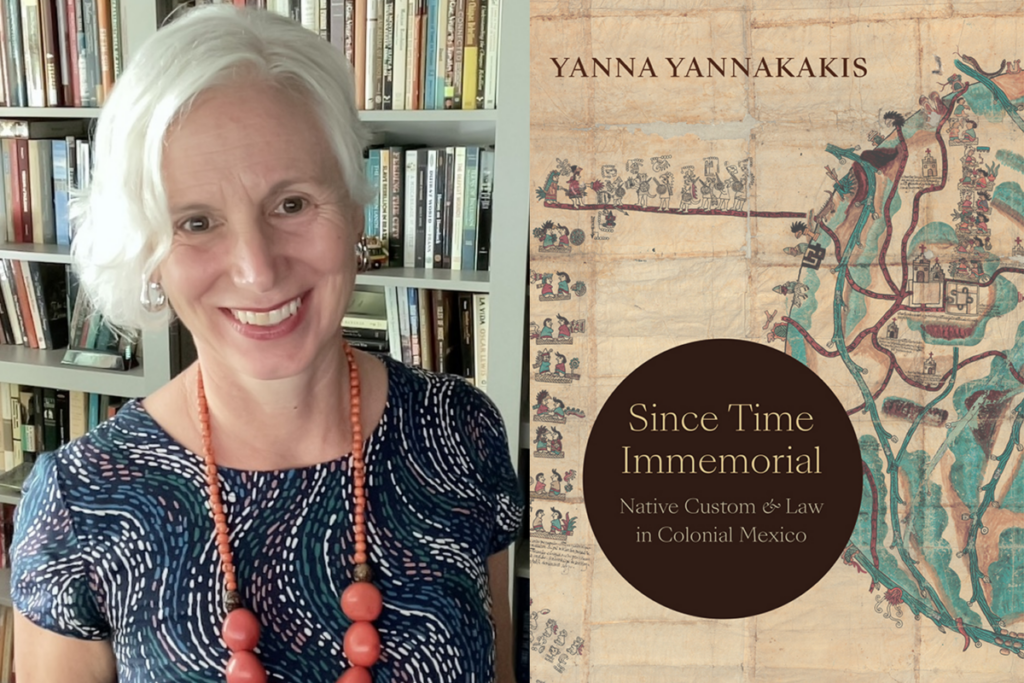
Congratulations to Dr. Yanna Yannakakis, Samuel Candler Dobbs Professor of History and Department Chair, on winning the Howard F. Cline Memorial Prize from the Conference on Latin American History for her latest book, Since Time Immemorial: Native Custom and Law in Colonial Mexico (Duke University Press, 2023). The Klein prize is awarded biennially to the book or article in English, German, or a Romance language judged to make the most significant contribution to the history of Indians in Latin America. Since Time Immemorial has received two other major awards: the 2024 Friedrich Katz Prize from the American Historical Association and the 2024 Peter Gonville Stein Book Award from the American Society for Legal History. Her first book, The Art of Being In-Between: Native Intermediaries, Indian Identity, and Local Rule in Colonial Oaxaca (Duke University Press, 2008), also won the Klein prize. Find the abstract of Since Time Immemorial below, and read the Open Access version of the book (made possible via Emory’s TOME initiative) here.
In Since Time Immemorial Yanna Yannakakis traces the invention of Native custom, a legal category that Indigenous litigants used in disputes over marriage, self-governance, land, and labor in colonial Mexico. She outlines how, in the hands of Native litigants, the European category of custom—social practice that through time takes on the normative power of law—acquired local meaning and changed over time. Yannakakis analyzes sources ranging from missionary and Inquisition records to Native pictorial histories, royal surveys, and Spanish and Native-language court and notarial documents. By encompassing historical actors who have been traditionally marginalized from legal histories and highlighting spaces outside the courts like Native communities, parishes, and missionary schools, she shows how imperial legal orders were not just imposed from above but also built on the ground through translation and implementation of legal concepts and procedures. Yannakakis argues that, ultimately, Indigenous claims to custom, which on the surface aimed to conserve the past, provided a means to contend with historical change and produce new rights for the future.