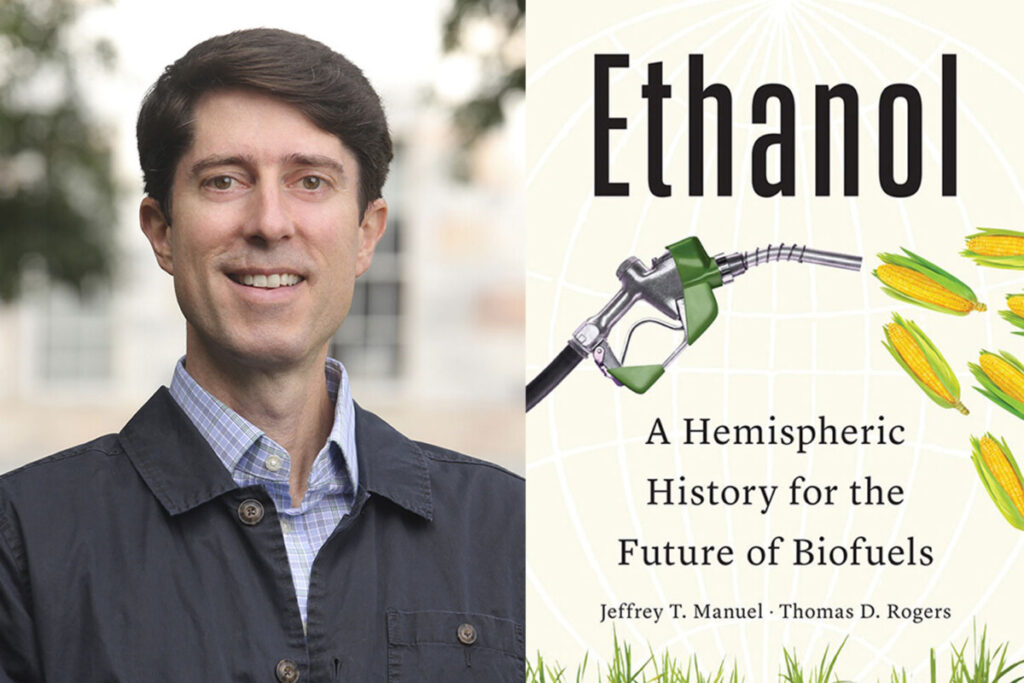
Dr. Thomas D. Rogers, Professor of History with specializations in environmental and labor history, has published a new book with co-author Dr. Jeffrey T. Manuel (Southern Illinois University Edwardsville). Titled Ethanol: A Hemispheric History for the Future of of Biofuels, the book chronicles the transnational history of ethanol in Brazil and the U.S. (the globe’s largest producers). Ethanol, which is Rogers’s third book, offers “the first full picture of the long history of this renewable fuel that from the beginning offered an imperfect alternative to oil.”
The Emory News Center recently published a conversation with Rogers about Ethanol, titled “Emory historian Tom Rogers talks biofuel beyond borders.” Read the abstract of the book below and the full Q&A here.
Though ethanol, a liquid fuel made from agricultural byproducts, has generated controversy in recent years—good or bad for the environment? a big-ag boon or boondoggle?—its use goes back more than a century. Tracing the little-known history of this promising and contentious fuel, Ethanol: A Hemispheric History for the Future of Biofuels reveals the transnational nature of ethanol’s development by its two biggest producers, the U.S. and Brazil. By drawing the connections between the shifting fortunes of ethanol in these two countries, the book presents the first full picture of the long history of this renewable fuel that from the beginning offered an imperfect alternative to oil.
Though generally presented as parallel stories, the histories of ethanol in the U.S. and Brazil are inextricably linked. Authors Jeffrey T. Manuel and Thomas D. Rogers show how policies in one country shaped those in the other. Brazil patterned its mid-century development on the U.S. model, adopting an automobile- and highway-focused transportation system and a fossil fuel-intensive agricultural sector. U.S. policymakers in turn took note when Brazil responded to the 1970s oil shocks by distributing ethanol nationwide, replacing half of its gasoline consumption. In the 2000s, the nations’ leaders worked together to dramatically expand ethanol production. Today, as a new generation of biofuels meant to power aviation and fight climate change again connects Brazilian and U.S. ethanol, Manuel and Rogers explain how the fuel’s future, like its history, is complicated by technical, scientific, economic, and social questions—about how to calculate carbon emissions, agricultural land use, national security and sovereignty, and the balance between government regulation and market forces. Understanding the future of biofuels demands a reckoning with this extensive, shared history—a reckoning that Manuel and Rogers’s far-reaching, deeply researched book brings into view.