Allitt Reflects on the Life and Legacy of Queen Elizabeth II

Dr. Patrick Allitt, Cahoon Family Professor of American History, recently authored a piece for the Emory News Center reflecting on the life and legacy of Queen Elizabeth II, who died in September. At Emory Allitt teaches courses on American intellectual, environmental, and religious history, on Victorian Britain, and on the Great Books. He was born and raised in Britain. Read an excerpt from the piece below along with the full article: “Reflecting on the life and legacy of Queen Elizabeth II.”

I was born and raised in Britain so I’ve been hearing about the queen since early childhood. When I was five, at school for the first time, my class followed her route on a big map of North America as she traveled across Canada on an official visit. We were told that the queen was good, and that she headed the British Empire, which was also good. That was 1961.

Now I teach American history to American students. Nothing about America surprised me more when I first came here, in the 1970s, than discovering the American love affair with the British monarchy. After all, the United States fought a revolutionary war to get away from Britain; the second half of the Declaration of Independence is a detailed denunciation of King George III.

Patrick Allitt, “Reflecting on the life and legacy of Queen Elizabeth II,” Emory News Center, September 8, 2022.

LaChance Quoted in Article on Media Coverage of Last Meal Custom

Daniel LaChance

Dr. Daniel LaChance, Winship Distinguished Research Professor in History, 2020-23, and Associate Professor of History, was quoted in an article in The Oklahoman about media coverage of the last meals that people sentenced to death request. The piece comes as the state of Oklahoma has scheduled an unprecedented number of executions between 2022 and 2024. LaChance discusses how the custom affects popular perceptions and policy of the death penalty, specifically, and crime and punishment more broadly. LaChance is the author of Executing Freedom: The Cultural Life of Capital Punishment in the United States (University of Chicago Press, 2016) and, most recently, Crimesploitation (Stanford University Press, 2022), co-written with Paul Kaplan. Read an excerpt from the piece in The Oklahoman below along with the full article: “‘When they stop serving last meals, we’ll stop reporting it.’ Oklahoma death row custom stirs debate.“

The humanizing element of the last meal ritual might contribute to the state’s justification of executions and public support for the practice, one researcher said.

“It represents a kind of way making the violence of the state look more virtuous, more civilized, more humane and not the kind of dirty violence of the murderers the state is punishing,” Daniel LaChance, a history professor at Emory University in Atlanta, said.

While condemned individuals become institutionalized and forgotten by the public as real people with unique personalities, their choice of last meal reveals something of their character, from simply eating what is on the prison menu that day, to requesting extravagant feasts.

LaChance argues the act of choosing also portrays a condemned person as an autonomous agent, capable of decision-making, which has the effect of showing him to the public, without regard to his upbringing, socio-economic status and mental health, as a free moral agent who willfully committed his gruesome crime.

“There’s a way in which by highlighting the last meal and last words, the irony is it serves a retributive purpose,” LaChance said. “It shows the public this person is very much alive and has something to lose. They are losing their lives and the ability to do things people do — plan for the future and consume food according to their taste. And the state engages in these rituals to remind us these are people who deserve what they are getting.”

Josh Dulaney, “‘When they stop serving last meals, we’ll stop reporting it.’ Oklahoma death row custom stirs debate.” The Oklahoman, August 14, 2022.

Price Offers the Long View of Pandemics in the U.S. on MSNBC

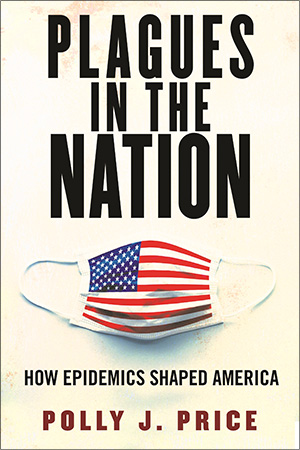
Price’s Plagues in the Nation

Dr. Polly J. Price, Asa Griggs Candler Professor of Law, Professor of Global Health, and Associated Faculty in the History Department, recently appeared on MSNBC’s The Mehdi Hasan Show to discuss the COVID-19 pandemic in historical context. Price is the author of Plagues in the Nation: How Epidemics Shaped America, just published in May of 2022 by Beacon Press. Watch the clip of Price in the embedded video below or on YouTube at “Why Wasn’t America More Prepared For Covid-19?“

Polly J. Price on the Mehdi Hasan Show, July 27, 2022.

Dudziak Contextualizes Americans’ Detachment from U.S. Wars

Mary L. Dudziak

Dr. Mary L. Dudziak, Asa Griggs Candler Professor of Law at the Emory University School of Law and Associated Faculty in the History Department, recently discussed her newest book in a Q&A with Tevah Gevelber of Responsible Statecraft. Dudziak argues that many Americans have long had a disconnect with wars fought in the name of their country, well before the aftermath of the Vietnam War (commonly seen as the origin of that disconnect). Dudziak also discusses how the consolidation of war powers in the executive branch, and specifically the hands of the president, has contributed to widespread detachment among American citizens from wars fought outside the U.S. Read an excerpt from their conversation below along with the full article here: “Why are Americans so unplugged from the wars in their own name?“

It’s common to point to the end of the military draft after the U.S. war in Vietnam as the point when most of the polity lost direct engagement with war. American civilians lost a more fundamental connection with war much earlier, however: when U.S. wars became foreign wars, after the Civil War and warfare with American Indian nations. Americans came to understand war in a visceral way during the Civil War. Battles happened in settled areas. U.S. civilians were war casualties. Family and friends of soldiers arrived at devastated battlefields looking for their loved ones, so they were not immune from the sensory experience of war.

Tevah Gevelber, “Why are Americans so unplugged from the wars in their own name?“, August 1, 2022.

Anderson Discusses Anti-Blackness and Gun Legislation on CNN

The cover of Carol Anderson’s 2021 book, The Second.

Dr. Carol Anderson, Charles Howard Candler Professor of African American Studies and Associated Faculty in the History Department, was quoted in a CNN article on the racialized dimensions of contemporary legislation related to gun possession and gun control. Anderson’s most recent book, The Second: Race and Guns in an Unequal America (Bloomsbury, 2021), interrogates the links between anti-Blackness and the second amendment throughout U.S. history. Read an excerpt from the article below along with the full piece: “The fight to curb gun violence without inflaming racial biases.”

The issue when it comes to gun control isn’t necessarily the law, according to Carol Anderson, an African American studies professor at Emory University. Sometimes, the issue is the enforcement of the law.

“Let’s go back to the Bruen decision in New York, that horrible decision by the US Supreme Court,” Anderson said, referring to the high court’s ruling in June that struck down a century-old New York gun law and that observers suspect will unleash a wave of lawsuits seeking to loosen restrictions at the state and federal levels. “The amicus curiae brief from public defenders said, The NYPD has used this law to go after Black folks. Look at what this has done.”

Anderson, the author of “The Second: Race and Guns in a Fatally Unequal America,” said that, at the core, the problem was policing.

“That’s the component I don’t think is understood well enough,” she said. “We’ve got to clean up policing.
Until we take anti-Blackness seriously, we’re going to keep dancing around the issue.”

Brandon Tensley and Eva McKend, “The fight to curb gun violence without inflaming racial biases,” CNN, July 31, 2022.

Anti-Defamation League Hosts Lipstadt on “Fighting Hate from Home” Webinar

Dr. Deborah E. Lipstadt on the ADL’s webinar “Fighting Hate from Home.”

The Anti-Defamation League hosted Dr. Deborah E. Lipstadt, Dorot Professor of Modern Jewish History and Holocaust Studies and the U.S. State Department’s special envoy to fight antisemitism, on their webinar “Fighting Hate from Home” in late July of 2022. In conversation with ADL CEO Jonathan Greenblatt, Lipdstadt discussed her work thus far in combating antisemitism around the world, including through trips to, and negotiations with officials in, Israel, Saudi Arabia, and the United Arab Emirates. Watch the full webinar above or on the link to the ADL’s YouTube page.

Emory Launches African-American Studies PhD Program

Flyer for new doctoral program in African American Studies.

Emory has launched a new doctoral program in African American Studies, the first of its kind in the U.S. Southeast. The interdisciplinary program will draw on the expertise of more than 50 scholars across schools at Emory, including from the College’s Department of History. Dr. Walter C. Rucker, Professor of African American Studies and History, will serve as core faculty in the program and as the Director of Graduate Studies. The program will be built around four of the pillars of African American Studies: interdisciplinarity, intersectionality, community engagement, and transnationalism. The first cohort of four doctoral students is expected to begin in the fall of 2023. Read more information about the program on the AAS website, as well as in the following coverage in the press:

Lowery Helps to Forge Relationships of Learning and Healing with Muscogee Nation

Dr. Malinda Maynor Lowery, Cahoon Family Professor of American History and a member of the Lumbee tribe of North Carolina, was one of fifteen Emory community members to travel earlier this year to Okmulgee, Oklahoma, to meet with members of the Muscogee Nation. Before the founding of Emory, Michelle Hiskey of the Emory News Center writes, the Muscogee “lived, worked, produced knowledge on, and nurtured the land where Emory’s Oxford and Atlanta campuses are now located.” The journey to Oklahoma was part of a broader Emory initiative, commissioned by President Fenves and co-led by Lowery, to memorialize Indigenous peoples who previously lived on land now owned by Emory, including through the development of “physical reminders and remembrance rituals on campus, such as a Muscogee (Creek) Language Path that highlights Muscogee language and knowledge.” Learn more about this endeavor, the Indigenous Language Path Working Group, on their website here. Also see the Emory News Center’s piece “In Oklahoma, Emory builds relationships with the Muscogee Nation,” which includes the quote from Lowery below.

“At Emory, we want to embrace a spirit of accountability,” said Malinda Maynor Lowery (Lumbee), Emory College of Arts and Science’s Cahoon Family Professor of American History and co-chair of the Indigenous Language Path Working Group. “But frankly, we’re not sure how to do that without the direction of the Muscogee Nation.”

“Who was Atticus Finch?”: Crespino Offers Insights

Dr. Joseph Crespino, Jimmy Carter Professor of History, was featured in an Emory News Center piece centered on the question “Who was Atticus Finch?” In 2018, coinciding with the publication of Crespino’s most recent book, Atticus Finch: A Biography (Basic Books), Emory University’s Stuart A. Rose Manuscript, Archives and Rare Book Library acquired a collection of correspondence and memorabilia from author Harper Lee. The correspondence within that collection shed light on the perceived discrepancies between Atticus Finch as represented in Lee’s famous novel To Kill and Mockingbird and the more recently-published Go Set a Watchman. Learn more about how Crespino’s research contributes to our understanding of this seminal character in U.S. literary history through the Emory News Center article as well as the video below.

Crespino discusses his research on Harper Lee and Atticus Finch.

Anderson Cited in ‘Salon’ Article on Links between Abortion, Racism, and Guns

Dr. Carol Anderson, Charles Howard Candler Professor and Chair of African-American Studies, was cited in a Salon article examining the links between abortion, racism, and guns. The piece, “Abortion, racism and guns: How white supremacy unites the right,” was written by Tamara Kay and Susan L. Ostermann. Kay and Ostermann offer historical context for the Supreme Court’s overturning of the precedent set by Roe v. Wade, particularly how white supremacy shaped early abortion criminalization. They draw a direct parallel to the anti-Black dimensions of the Second Amendment, the topic of Anderson’s most recent book, The Second: Race and Guns in a Fatally Unequal America (Bloomsbury, 2021). Read an excerpt from the Salon piece citing Anderson below along with the full article here.

The Second Amendment also has white supremacist roots. When it was ratified in 1791, many states had laws to prevent enslaved and free Black people from possessing or bearing arms. Prior to the Civil War, Black people were targeted by armed slave patrols, and after the war and the failure of Reconstruction, Black Codes enacted across the Jim Crow South prohibited formerly enslaved people from possessing guns.  Carol Anderson, chair of African American Studies at Emory University and author of “The Second: Race and Guns in a Fatally Unequal America,” argues that long after the abolition of slavery, the Second Amendment has been used against Black people: “(P)ervasive anti-Blackness, even after the civil rights movement, turned the Second Amendment’s law for protection — the castle doctrine, stand your ground and open carry — against African Americans.” She concludes that the Second Amendment “is lethal; steeped in anti-Blackness, it is the loaded weapon laying around just waiting for the hand of some authority to put it to use.”