Alison Collis Greene Discusses Book ‘No Depression in Heaven’ on ‘Monthly Review’ Podcast

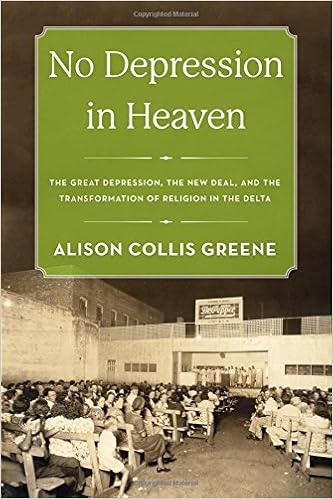
Dr. Alison Collis Greene recently discussed her book No Depression in Heaven: The Great Depression, the New Deal, and the Transformation of Religion in the Delta (Oxford University Press, 2015) on the Monthly Review podcast Money on the Left. Greene is Associate Professor in the Candler School of Theology and Associated Faculty in the History Department. Read the summary of the episode below and find both the audio and transcript at “No Depression in Heaven with Alison Collis Greene.”

In this episode of Money on the Left, we speak with historian Alison Collis Greene about her book No Depression in Heaven with an eye toward contemporary debates around the Green New Deal. Subtitled The Great Depression, the New Deal, and the Transformation of Religion in the Delta, Greene’s book critiques what she calls the “myth of the redemptive depression” which, particularly in the American south, eroded the legacy of the original New Deal by affirming regressive fantasies of self-help and individualism. 

Many on the left today see the “New Deal” framing of contemporary social and ecological politics as a concession to liberal nostalgia. However, No Depression in Heaven reminds us that right-wing and religious dismissals of the New Deal played a key part in rolling back government provisioning under neoliberalism. From our perspective, then, the original New Deal remains a crucial rhetorical battleground for the future of American political economy.  

‘Archival Lives’ Conference Brings Leading Scholars of the African Diaspora and Slavery to Emory

In early December 2019 leading scholars of the African diaspora and slavery will gather at Emory University for a conference entitled “Archival Lives.” The conference is organized by Adriana Chira (Assistant Professor, History), Clifton Crais (Professor, History and Director, African Studies), and Walter C. Rucker (Professor, History and African American Studies). The History Department is a co-sponsor of the conference, which will feature multiple current and emeritus faculty along with PhD program alumni. Read more about the event on the website for Emory’s Institute for African Studies: “Archival Lives Conference.”

Crespino Discusses Polarization, Past and Present, on GPB’s ‘Political Rewind’

Dr. Joseph Crespino, History Department Chair and Jimmy Carter Professor of History, was recently a featured guest on Georgia Public Broadcasting’s show Political Rewind. The special edition show, which is hosted by Bill Nigut, was titled “Our Polarized Politics, How Did We Get Here?” Read a summary of the show below and listen to the full conversation at GPB’s Political Rewind.

“Today on Political Rewind, Republicans have called the impeachment investigation of President Trump a Democratic witch hunt. Two decades ago, Democrats attacked the impeachment of President Clinton with similar fury.

Efforts to impeach a president may reveal the deep partisan divide that cleaves our country in two, but the growth of political polarization began long before Clinton and Trump came on the scene.

Today, we’ll look at key moments in American history that revealed the sharpness of our partisan divide, and propelled it forward.”

Dr. Astrid M. Eckert Publishes New Book: ‘West Germany and the Iron Curtain’

west-germany.jpg

Congratulations to Dr. Astrid M. Eckert on the publication of her book West Germany and the Iron Curtain: Environment, Economy, and Culture in the Borderlands with Oxford University Press. The book takes a fresh look at the history of Cold War Germany and the German reunification process from the spatial perspective of the West German borderlands that emerged along the volatile inter-German border after 1945. It also provides the first environmental history of the Iron Curtain. Dr. Eckert is Associate Professor of History.

Carl Suddler Discusses Race and the Criminal Justice System on ‘Politics and Polls’

Assistant Professor of History Dr. Carl Suddler recently appeared on the Princeton University Podcast Politics and Polls. Julian Zelizer interviewed Suddler in a conversation that centered on the racialized nature of the criminal justice system. Suddler’s first book, Presumed Criminal: Black Youth and the Justice System in Postwar New York, was published by NYU Press earlier this year. Listen to the full episode here: “Politics & Polls #156: Black Youth and the Criminal Justice System Ft. Carl Suddler.”

Carol Anderson on Impeachment, Democracy, and White Supremacy in the ‘Washington Post’

Dr. Carol Anderson recently authored an op-ed for The Washington Post, titled “Impeachment is the latest chapter in the battle between democracy and white supremacy.” Anderson, an expert in race, justice, and equality in the U.S., surveys key episodes from U.S. history that contextualize Donald Trump’s reaction to the recently-initiated impeachment investigation. She concludes that “When it comes to a nation held hostage to racism, we have been here before.” Professor Anderson is Associated Faculty in the History Department, Charles Howard Candler Professor of African American Studies, and Chair of African American Studies. She is also the author, most recently, of One Person, No Vote: How Voter Suppression is Destroying Our Democracy (Bloomsbury, 2018). Read an excerpt of the article below along with the full piece here.

“Since the nation’s founding, the refusal to believe in democracy and follow through on the nation’s ideals — equality and freedom — has been the nation’s consistent enemy. Time and time again, white supremacists have sacrificed these principles to advance their own interests and that of their white supporters. Trump has followed suit, adding the disregard for the rule of law to the list. When challenged, he has also invoked the strategy white supremacist leaders have also mastered: threats of violence and extortion.”  – Carol Anderson

Deborah Dinner Quoted in ‘Washington Post’ Article on Gender Discrimination in the Workplace

Dr. Deborah Dinner, Associate Professor at Emory Law and Associated Faculty in the History Department, recently contributed to an article in The Washington Post. Dinner, a specialist in the legal history of gender and work, discusses gender discrimination in the workplace in advance of a Supreme Court case that will revisit LGBTQ rights at work. Marisa Iati wrote the piece, titled “Supreme Court, set to rule on LGBTQ rights at work, addressed gender discrimination 30 years ago.” Read an excerpt below along with the full piece.

“The stereotype is that a male should dress in a certain way or perform his gender identity in a particular way or should have romantic relationships with women and not men,” Dinner said. “And so by discriminating on the basis of somebody’s gender identity or on the basis of their sexual orientation, what an employer in fact is doing is discriminating on the basis of a gender stereotype.” – Deborah Dinner

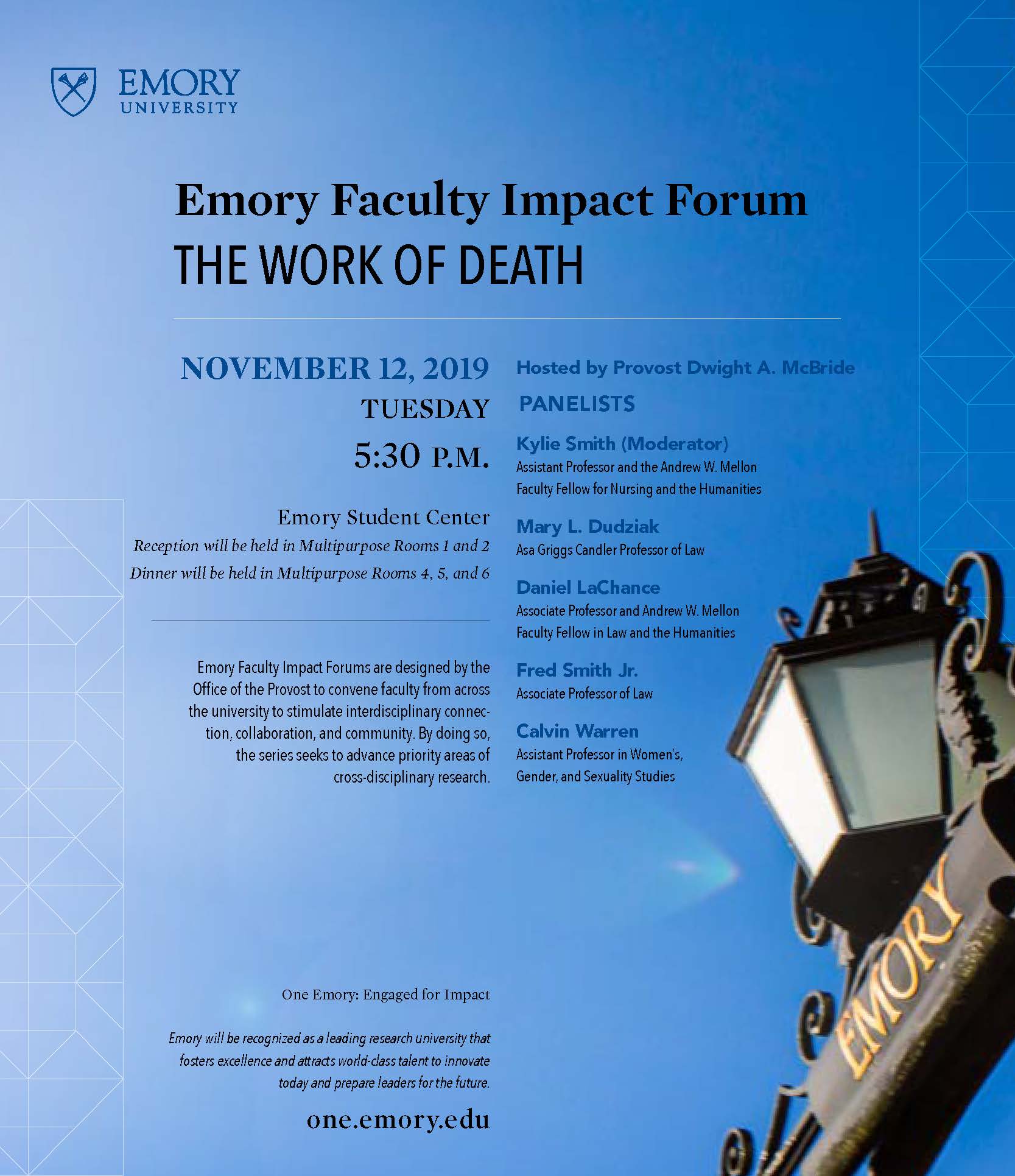
Emory Faculty Impact Forum on “The Work of Death” to Feature LaChance and Dudziak

Emory University’s Office of the Provost regularly hosts faculty impact forums to stimulate interdisciplinary connection, collaboration, and community. Provost Dwight A. McBride will host the next forum in mid-November, which will focus on how to understand, conceptualize, and study the sociality of the dead. Two History Department faculty members will participate in the conversation, titled “The Work of Death”: Associate Professor Daniel LaChance and Mary L. Dudziak, associated faculty in the History Department and Asa Griggs Candler Professor of Law. Read more about the event on the flyer below and register here.

20-PROV-PROV-0068-Faculty Forum 2


Daniel LaChance in ‘Process’: “Capital Punishment and the Battle for America’s Soul”

Associate Professor of History Dr. Daniel LaChance recently authored a piece for Process: a blog for american history. Entitled “Capital Punishment and the Battle for America’s Soul,” the article examines official and public stances on capital punishment, especially in the context of cultural wars of the late twentieth and early twenty-first centuries. LaChance, who is Andrew W. Mellon Faculty Fellow in Law and the Humanities, authored Executing Freedom: The Cultural Life of Capital Punishment in the United States with the University of Chicago Press in 2016. Read an excerpt of the Process piece below along with the full article here.

“These days, support for capital punishment is concentrated among whites, Protestants, and Republicans—key demographic constituencies of the conservative side of the late twentieth century culture wars. This may explain the unusual zeal with which the Trump administration has tried to prop up capital punishment despite its declining popularity. The federal government has not executed anyone since 2002, yet Attorney General William Barr recently announced that the Department of Justice would set December 2019 execution dates for five federal death row inmates…

“Given the symbolic value that the death penalty carried in the late twentieth century, Trump’s embrace of capital punishment is politically shrewd. His unapologetic enthusiasm for state killing plays to a white, Protestant, Republican base whose support for capital punishment has not faltered even as crime rates have fallen, perhaps because they see the death penalty as a positive good rather than a necessary evil. If that base shares the sensibility of their culture war forebears, support for the death penalty is not only a tool for controlling crime, but also an expression of allegiance to values—personal responsibility, the sacredness of innocent life, and the firmness of a nation’s convictions—that they feel have degraded in the United States since the 1960s. Trump’s defiant embrace of the death penalty is perhaps a sign to them that their nation is on its way to becoming great again.” 

‘On Middle Ground,’ Co-Authored by Dr. Eric L. Goldstein, Wins Book Prize


The Southern Jewish Historical Association recently awarded the quadrennial book prize to On Middle Ground: A History of the Jews of Baltimore (Johns Hopkins UP, 2018), co-authored by Emory Associate Professor Eric L. Goldstein. Goldstein’s co-author is Deborah R. Weiner. On Middle Ground argues that Baltimore stands out among large U.S. cities in that it is neither fully northern nor fully southern, and that the Jews of Baltimore have shared in this “middle” position. The prize committee noted that the authors “consistently ask the question of how Baltimore differed from comparable communities while still reflecting the broad social and economic patterns with which scholars of American Jewish history are familiar.” Read another committee member comment below and order a copy of the book here.

“[One] committee member wrote that On Middle Ground ‘can stand alone as a history of an important American city as well as a history of Jews who settled there.’ That the authors also manage to accomplish this feat in a manner that has the potential for appeal to a wide readership makes On Middle Ground a volume truly deserving of the SJHS book prize.”