Dr. James Roark, Samuel Candler Dobbs Professor of American History, Retires

Dr. James Roark, Samuel Candler Dobbs Professor of American History, will retire at the end of the semester after 33 years at Emory. A specialist in the 18th and 19th century history of the American South, Roark has served as department chair twice and has authored or coauthored numerous works. They include Masters Without Slaves: Southern Planters in the Civil War and Reconstruction (1977), Black Masters: A Free Family of Color in the Old South (1986), and The American Promise, which is about to release its 7th edition.


Professor Joseph Crespino on Georgia Public Broadcasting’s “Political Rewind”

Photo of

Joseph Crespino, Department Chair and Jimmy Carter Professor, recently joined Georgia Public Broadcasting’s “Political Rewind” for a conversation about echoes between past and present presidential races. Hosted by Bill Nigut, the segment was titled “Historical Parallels Between the 2016 Campaigns and Past Races.” You can find the full audio for the show at this link, and below is a plug elaborating on one part of their conversation:

We take a close look at “Confessions of a Republican,” a remarkable 1964 TV commercial that questions the fitness of the Republican presidential nominee Barry Goldwater to serve in the Oval Office. Crespino says the spot could easily be transplanted into today’s race as Democrats raise questions about Donald Trump’s preparedness and temperament to be president.

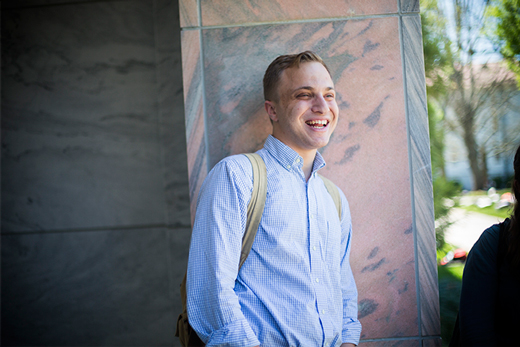
Graduating History Major, Ami Fields-Meyer, Named Emory College Class Orator

Story image

Following the university-wide commencement ceremony on May 9, senior history major Ami Fields-Meyer will speak to his fellow graduates as the class orator at the Emory College diploma ceremony. The Los Angeles native arrived at Emory with sights set on a career in politics as an elected official. A history class early on changed his perspective and led him to a major in History (along with a minor in African-American studies) instead of political science.

“[H]e took a history class focused on the history of inequality in the United States. Fields-Meyer discovered life as a self-described news junkie took on greater depth when he understood the historical context of current events.”

Fields-Meyer also highlights his experience in the Georgia Civil Rights Cold Cases course, co-taught by historian Brett Gadsden and Hank Klibanoff. Gadsden remembers Fields-Meyer fondly from the class: “One thing I’ve really admired is his efforts to bridge the past and the present, to really think about the gap between the two, and understand the echoes of history. That’s testimony to me of a dynamic mind.”

In addition to his accomplishments as a Dean’s Achievement Scholar, Fields-Meyer co-founded TableTalk, an initiative designed to spur conversations between groups at Emory that would not likely otherwise interact.

Read the full profile on Fields-Meyer here.

Dr. Dawn Peterson in ‘Slate’ on “Andrew Jackson’s Adopted Indian Son”

Illustration from John Frost's 1860 biography, A Pictorial History of Andrew Jackson.

Illustration from John Frost’s 1860 biography, A Pictorial History of Andrew Jackson – Internet Archive 

Professor Dawn Peterson was recently interviewed for a piece in Slate by Rebecca Onion. Prompted by discussions following the decision to replace Andrew Jackson with Harriet Tubman on the $20 bill, the article hones in on one piece of Jackson’s life frequently cited by those who defend his legacy: his adoption of a infant Creek boy in 1813. Peterson offers historical context for the adoption of Lyncoya (the name given by Jackson to the orphaned boy) and the practice in southern society more broadly. These insights derive from Peterson’s recent research and especially her forthcoming book Indians in the National Family: Adoption and the Politics of Antebellum Expansion (Harvard University Press in 2017). Read an excerpt from the piece below and check out the full article here.

Though they adopted native children, slaveholders like Jackson imagined “they were assimilating Native people and their lands into the confines of the United States. They believed that what they were doing was a benevolent act, but also understood it as a form of cultural genocide.” 


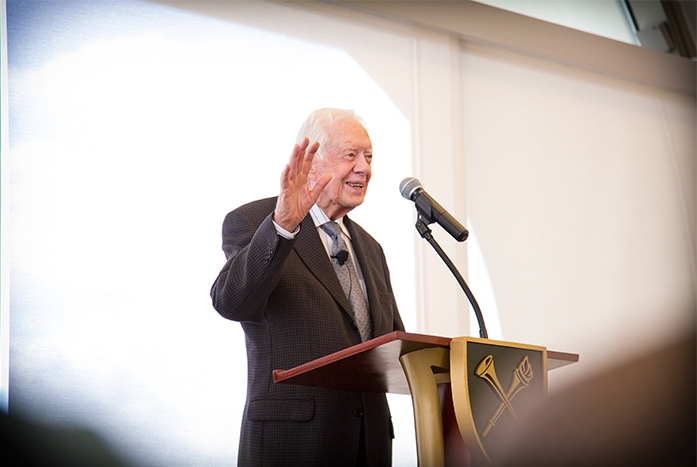
President Jimmy Carter Discusses the Importance of History and Archives with Students from Spring Course Taught by Dr. Joseph Crespino

On April 21 President Jimmy Cater was on Emory’s campus to speak to students in a session titled “Why Archives Matter: Memory, Meaning and History.” Included in the event where students from Dr. Joseph Crespino’s spring undergraduate course on the history of politics and race in the United States. Aside from a lively question and answer period with the attendees, the event served to highlight recent renovations at the Stuart A. Rose Manuscript, Archives and Rare Book Library. Read more about the event on the Emory News Center’s site here.

photo description

Professor Judith A. Miller Consults for the Opera Lafayette’s “Opera and the French Revolution”

“Opera and the French Revolution” debuts on April 29 and May 1 in Washington and New York.  Emory University French historian Judith A. Miller has enjoyed consulting on the production.  The Opera Lafayette will perform the modern world premiere of scenes from Martini’s and Pipelet’s Sapho (1794), as well as Cherubini’s Médée (1797) and Sacchini’s Oedipe à Colonne.   Performances will take place in DC (Lisner Auditorium, GWU) on Fri., April 29, 7:30pm; and in NYC (Jazz at Lincoln Center, Rose Hall) on Sun., May 1, 8pm.  More info and ticket links are on the company’s website.   Emory discounts are available for the DC performance, Code EMORY.  Along with workshops in March in NYC, Professor Miller has contributed to the blog on the production.  An hour before each performance, there will be a panel discussion  featuring Ryan Brown, with stage director Miřenka Čechová and Judith A. Miller.

Professor Jeffrey Lesser on Brazil’s Political Present and Near Future (Canadian Broadcasting Corporation)

In the wake of an historic impeachment vote in Brazil’s congress on Sunday, Professor Jeffrey Lesser offered historically-informed commentary for a Canadian Broadcasting Corporation article, “Brazil President Dilma Rousseff impeachment crisis: What happens next?” Lesser is a specialist in Brazilian history and currently Research Professor at the Institute for Advanced Studies at the University of São Paulo. Check out an excerpt below and the full piece here.

The vote was just the latest step, but a major step toward impeachment. Despite the vote, Rousseff remains the leader. Now the process moves to the Senate, which will vote on whether the upper chamber should put Rousseff on trial for impeachment. (Local news media report that 45 of the 81 senators have said they will vote to hold the impeachment trial.)

It could be about 40 days before that Senate vote is cast. But timing is very difficult to predict, says Jeffrey Lesser a professor of Brazilian history at Emory University and currently research professor at University of São Paulo,  Rousseff has challenged every step of this process. She had asked the country’s Supreme Federal Tribunal, Brazil’s highest court, to suspend the proceedings, but lost that decision. But she could go to the court again, on the grounds that the accusations are faulty.


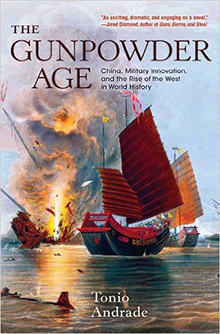
Professor Tonio Andrade and his “The Gunpowder Age” Featured by Emory News Center

The Emory News Center recently published a profile of Dr. Tonio Andrade and his newest work, The Gunpowder Age: China, Military Intervention, and the Rise of the West in World HistoryThe piece, titled “Emory historian tackles China’s military history with ‘The Gunpowder Age,'” is available in full here. Check out an excerpt below.

Over the past year, China has built artificial islands — with their own airstrips and military facilities — as part of its claim to land in the international trade routes in the seas east and south of the country.

The territorial claims escalated this year when U.S. and Taiwan officials said China had put surface-to-air missiles on one of the disputed islands in the South China Sea.

Is this a new threat from a nation that historians have argued remained a military afterthought in part because of the codes of Confucianism?

Not according to Emory historian Tonio Andrade who shows in his new book, “The Gunpowder Age,” that the idea that China has historically been a peaceful nation, little interested in military matters, is not true.

Gunpowder Age

Professor Mary L. Dudziak in ‘Politico Magazine’

Professor Mary L. Dudziak, Asa Griggs Candler Professor of Law and associated faculty in the History Department, recently contributed to a piece in Politico Magazine titled “9/11: What Would Trump Do?” The article features foreign policy and counterterrorism experts, historians, Trump biographers, and psychologists predicting how presidential candidate Donald Trump would respond to a national security crisis. View the full article here and check out an excerpt of Dr. Dudziak’s response below.

The Trump campaign has already generated international criticism for its hostility to Muslims and Mexican immigrants. His inflammatory calls for the use of torture would damage U.S. credibility on human rights. If history is any lesson, Trump would alienate American allies with these policies, undermining U.S. efforts to work together with other countries to combat transnational terrorism.

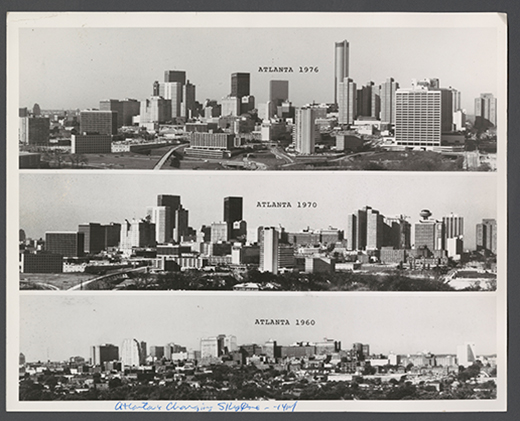
History Graduate Students Curate Exhibition “Changing Atlanta: 1950-1999: The Challenges of a Growing Southern Metropolis”

A new exhibition designed to explore the city of Atlanta’s rapid growth in the second half of the twentieth century is on view in the Robert W. Woodruff Library on the Emory campus through June. Titled “Changing Atlanta 1950-1999: The Challenges of a Growing Southern Metropolis,” the exhibit and corresponding events were co-curated  by Erica Bruchko, W. Michael Camp, and Louis Fagnan (along with Kristin Morgan and Laura Starratt of the Rose Library). The exhibition highlights the rich collections pertinent to Atlanta’s urban history housed at the Stuart A. Rose Manuscript, Archives, and Rare Book Library.

A panel discussion (free and open to the public) will take place on Tuesday, April 12 at 6:30 p.m. in the Jones Room in the Woodruff Library. The discussion will include opening remarks by Joseph Crespino, Chair and Jimmy Carter Professor, and closing remarks by Edward Hatfield, a History Department alumnus and instructor at Kennesaw State University. Read more about the event here.

Story image