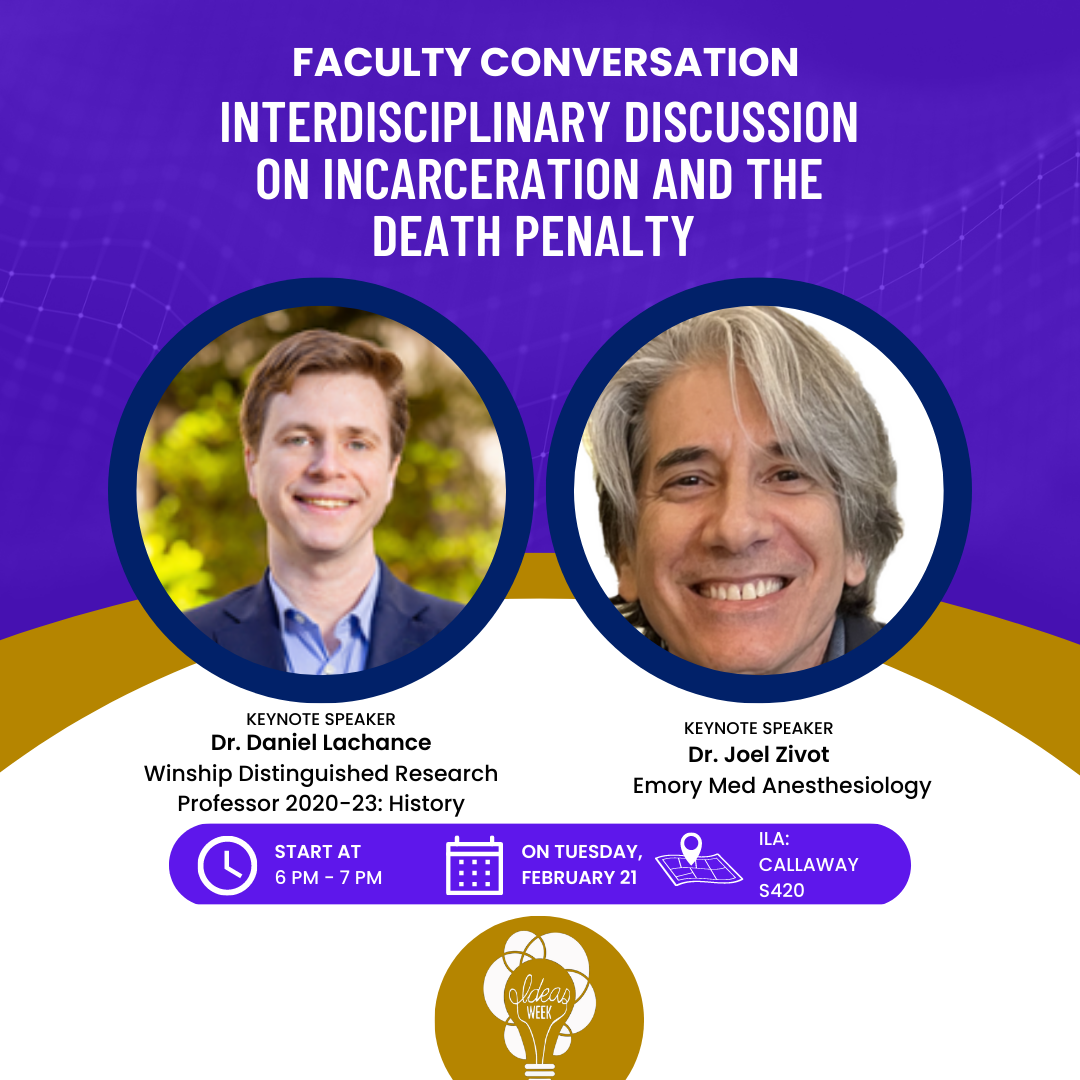
Dr. Daniel LaChance, Winship Distinguished Research Professor in History, 2020-23 and Associate Professor of History, will participate in an upcoming interdisciplinary discussion on incarceration and the death penalty. The event will take place in Callaway S420 on Tuesday, February 21, from 6-7pm. The discussion will also feature Dr. Joel Zivot, Associate Professor in Emory’s Department of Anesthesiology. LaChance is a legal scholar working at the intersection of American legal and cultural history, criminology, and literary studies. His most recent book, co-authored with Paul Kaplan, is Crimesploitation: Crime, Punishment, and Pleasure on Reality Television (Stanford University Press, 2022).
Crespino Discusses Legacy of Jan. 6 on GPB’s Political Rewind
Dr. Joseph Crespino, Department Chair and Jimmy Carter Professor of History, recently appeared on the Georgia Public Broadcasting show Political Rewind. On a panel that included Jim Galloway (former political columnist, The Atlanta Journal-Constitution), Matthew Brown (The Washington Post), and Tia Mitchell (The Atlanta Journal-Constitution), Crespino discussed how the insurrection at the U.S. capitol on Jan. 6, 2021 will be remembered. Crespino is an expert of the political and cultural history of the twentieth-century United States and of the U.S. South since Reconstruction. Listen to the full conversation, hosted by Bill Nigut, here: “Political Rewind: The legacy of January 6th; McCarthy faces a fourth day of House votes.”
Candido and Chira Receive Social Justice Grant through Emory Provost Office
Two History Department faculty members have received a grant from a program within the Emory Office of the Provost designed to foster research and scholarly work that advances social justice. Dr. Mariana P. Candido, Associate Professor, and Dr. Adriana Chira, Assistant Professor, are collaborating on a project titled “Land Dispossession, Inequality and the Legacies of Slavery in Africa and Latin America.” The project envisions the creation of an open-access digital resource on these themes, two undergraduate courses at Emory, and trips to Cuba and Puerto Rico. Read a fuller description of the initiative below, along with other projects funded through this program: “Emory awards funds for five faculty projects focused on arts and social justice.”
“This project, conducted in collaboration with Mariana Dias Paes at the Max Planck Institute for Law and Legal Theory, will study land dispossession in Africa and Latin America and establish an open-access digital resource that shares critical historical documents, transcripts, legal papers and other records relating to the topic. The grant also funds the creation of two undergraduate courses on the politics of development, rural transformation and food sovereignty that will combine a trip to Puerto Rico and Cuba with in-class instruction.“
Andrew G. Britt (PhD, ’18) Publishes Article in ‘Journal of Latin American Studies’
Dr. Andrew G. Britt, a 2018 alumnus of the History doctoral program, recently published an article in the Journal of Latin American Studies. Titled “Spatial Projects of Forgetting: Razing the Remedies Church and Museum to the Enslaved in São Paulo’s ‘Black Zone’, 1930s–1940s,” the piece excavates the history of the former headquarters of Brazil’s Underground Railroad and a longtime museum to the enslaved. The article emerged out of Britt’s dissertation, which was advised by Drs. Jeffrey Lesser and Thomas D. Rogers. Britt is Assistant Professor of History and Digital Humanities at the UNC School of the Arts. Read the abstract of the article below along with the full piece.
“In the shadows of a Shinto torii (gateway) in São Paulo’s ‘Japanese’ neighbourhood rests the city’s first burial ground for enslaved Africans. Recently unearthed, the gravesite is one of the few visible remains of the Liberdade neighbourhood’s significance in São Paulo’s ‘Black zone’. This article excavates the history of the nearby Remedies church, the headquarters of Brazil’s Underground Railroad and a long-time museum to the enslaved. The 1942 demolition of the Remedies church, I argue, comprised part of a spatial project of forgetting centred on razing the city’s ‘Black zone’ and reproducing São Paulo as a non-Black, ethnically immigrant metropolis.”
The Feast of Words Event Celebrates Books by Emory Faculty, including Seven Historians
For the last 19 years the Center for Faculty Development and Excellence, Emory Libraries, and the Emory Barnes and Noble Bookstore have hosted the Feast of Words, an annual event to celebrate the Emory faculty members who have written or edited books in the prior year. The December edition of the festival featured 89 books, including seven by historians at Emory, published between September 1, 2021, and August 31, 2022. Read the titles of the books published by Emory historians below, along with the full list here: “Celebrating Faculty Authors.”
- Tonio A. Andrade. Het laatste gezantschap: De Nederlandse missie van 1795 en de westerse betrekkingen met China. Robert Vernooy, trans. Querido.
- Anthony A. Briggman (Theology) and Ellen Scully, eds. New Narratives for Old: The Historical Method of Reading Early Christian Theology. Essays in Honor of Michel René Barnes. Catholic University of America P.
- Adriana Chira. Patchwork Freedoms: Law, Slavery, and Race beyond Cuba’s Plantations. Cambridge UP.
- Astrid M. Eckert. Zonenrandgebiet. Westdeutschland und der Eiserne Vorhang. Thomas Wollermann, Bernhard Jendricke, and Barbara Steckhan, trans. Ch. Links.
- Daniel LaChance and Paul Kaplan. Crimesploitation: Crime, Punishment, and Pleasure on Reality Television. Stanford UP.
- Pablo Palomino. La Invención de la Música Latinoamericana. Fondo de Cultura Económica.
- Polly Price. Plagues in the Nation: How Epidemics Shaped America. Beacon.
Lipstadt Addresses Antisemitism as Part of ‘Thought Leader Series’
Dr. Deborah E. Lipstadt, Dorot Professor of Modern Jewish History and Holocaust Studies and the U.S. State Department’s special envoy to fight antisemitism, recently discussed her work and global antisemitism as part of Emory’s Office of Diversity, Equity, and Inclusion’s Thought Leader Series. Ambassador Lipstadt was interviewed by Dr. Carol E. Henderson, Vice Provost for Diversity and Inclusion. The Thought Leader Series identifies opportunities to engage in conversation with some of the foremost thinkers at Emory and more broadly across the world who can provide educational awareness around topics and issues that create barriers to experiencing a more inclusive Emory, and a more humane and just society. Lipstadt is Associated Faculty in the History Department. Watch the full conversation above or on YouTube at: “Thought Leader Series | Antisemitism: A Conversation w Dr. Deborah Lipstadt & Dr. Carol E. Henderson.”
TIJS Highlights Recent PhD Graduate Anastasiia Strakhova

Emory’s Tam Institute for Jewish Studies (TIJS) published a feature story on recent doctoral graduate student Anastasiia Strakhova, whose work TJIS supported throughout her graduate career. Strakhova completed her dissertation, titled “Selective Emigration: Border Control and the Jewish Escape in Late Imperial Russia, 1881-1914,” in 2022 under the advisement of Dr. Eric Goldstein and Dr. Ellie R. Schainker. This spring Strakhova is a Postdoctoral Fellow in the Center for Jewish Studies at Duke University. Read an excerpt from the TJIS feature below, along with the full article: “Recent TJIS Graduate Highlight: Anastasiia Strakhova.”
“My research interest evolved gradually,” Dr. Anastasiia Strakhova explains when asked about her scholarly development. After getting her BA in her home city of Kharkiv, Ukraine, and then her MA from the Central European University in Budapest, Hungary, Dr. Strakhova traveled to the United States to continue her education. While studying Yiddish in New York, Dr. Strakhova found her curiosity about Jewish migration. “I was so fascinated about the attachment that Jews felt to the United States, and the romanticization of the old country… And then I got very interested in seeing the archives and reading about the way that people were living [at that time in history].” Dr. Strakhova’s dissertation addresses late Imperial Russian migration policies through the prism of racialization and criminalization of Jews.
Jessica Reuther (PhD, ’16) Publishes Article in the ‘Journal of African History’

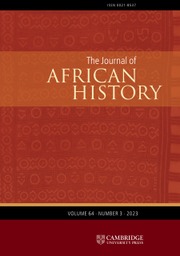
Dr. Jessica Reuther, a 2016 graduate of the African history program, has published an article in the Journal of African History. Titled “Street Hawking or Street Walking in Dahomey?: Debates about Girls’ Sexual Assaults in Colonial Tribunals, 1924–41,” Reuther’s piece centers on sexual assault investigations in colonial Dahomey. Reuther’s analysis of those investigations reveals caregiving practices among older women for girls who suffered sexual assaults as well as the vulnerability of street hawkers to such assaults. Reuther is Assistant Professor of African History at Ball State University. Read the article abstract below.
Between the judicial reorganizations of 1924 and 1941, the colonial tribunals in Dahomey heard more than two hundred cases of rape. Teenage or younger girls engaged in street hawking were the most common victims of rape who reported their assaults to these tribunals. Many of the cases stand out because market women played the dominant role in transforming girl hawkers’ experiences of sexual assault into formal grievances. The history of sexual assault in colonial Africa has largely focused on how ‘customary’ and colonial courts have or have not punished the crime of rape. This approach privileges masculine authorities’ views of sex, consent, and gender violence. This article focuses on the investigative processes in cases of sexual assault. In doing so, two gendered histories emerge: firstly, a history of elder female caregiving to girls suffering the aftereffects of sexual assaults and, secondly, a history of the vulnerability of hawkers to quotidian sexual violence.
Doctoral Student Anjuli Webster to Present at Brown U. Workshop “Rivers on the Move”

History doctoral student Anjuli Webster was recently accepted to an international workshop at Brown University in June of 2023. Titled “Rivers on the Move,” the event will bring together environmental historians, hydrologists, and other historically-minded humanists and natural scientists to understand better how past and contemporary riparian change relate to social and political shifts, from economic development to legal frameworks. The workshop will result in an edited volume of interdisciplinary essays that aim to appeal to a wide range of riverine scholars and students. “Rivers on the Move” is organized by Bathsheba Demuth, Mark Healey, Giacomo Parrinello, and Larry Smith, with support from the Institute at Brown for Environment and Society, in collaboration with the project Shifting Shores, funded by an Emergence(s) grant of the City of Paris. Webster is currently conducting fieldwork for her dissertation, titled “Fluid Empires: Histories of Environment and Sovereignty in southern Africa, 1750-1900.”
Chira Wins Article Prize from the Berkshire Conference of Women Historians

Dr. Adriana Chira, Assistant Professor of History, was recently awarded an article prize from the Berkshire Conference of Women Historians. The prize recognizes Chira’s 2021 article in The American Historical Review, titled “Freedom with Local Bonds: Custom and Manumission in the Age of Emancipation.” The annual award goes to the best article in any field by a woman scholar. The prize committee praised the article’s “creativity in scholarship and expression” and “found Chira’s work to be innovative in its approach and exploration of those seeking manumission from slavery.” The report continued: “Considering social networks as a ‘resource’ in the manumission process offers a new facet for understanding this matrix. Chira also considers the grey area between enslaved and free, building on scholarship considering the nature of identity and freedom among enslaved peoples.” Read the abstract from the article below.
“Throughout the first half of the nineteenth century, across Latin America, expansive rural communities of African descent forged freedom from below in the shadows of highly exploitative extractive economies. Their efforts push us to reconsider established genealogies of the age of emancipation. Freedom through conditional manumission and enslaved people’s reliance on social networks to obtain it opened the door to custom inside first-instance district courts in such areas. Judges turned to vernacular understandings of rights and obligations as they clarified the ambiguous statuses of the conditionally freed for which written law offered few provisions. Through manumission and legal actions to defend freedom, peasants of African descent on the margins of the global economic system grounded their rights in state structures as local custom. Black freedom within such territories represents a mode of community governance that remains invisible if studied by focusing on mobility or nation building. Seen from a place such as Santiago de Cuba, the nineteenth century was not just a time when Africans and Afro-descendants pursued social inclusion through ideologies of national citizenship and diasporic connections. It was also a time of freedom through membership in local communities, which women and families were especially instrumental in forging.“