Congratulations to History major Bronwen Boyd on being named a 2022 Graduating Woman of Excellence by the Center for Women at Emory. Each year the Center invites the community to identify graduating women who have demonstrated great effort, strength of character, and excellence in their time at Emory. Boyd was among 50 outstanding graduates from across Emory’s college, graduate, and professional school divisions honored at a pinning ceremony on March 24.
Graduate Student Anjuli Webster Presents at “Charting African Waterscapes” Conference
History graduate student Anjuli Webster recently presented a paper at the conference “Charting African Waterscapes: A Conference on African Maritime History Across Time and Space.” Webster’s paper was titled “’Kawubheke ukuphangelana kwemifula’: isiNguni waters through Maputo Bay” and was delivered on the panel “Political Ecologies of Water.” Webster’s research uses water as a way to understand the convergence of local and global forces in south Indianic Africa in the nineteenth century. Webster’s dissertation is titled “Water’s Power: Ecologies of Sovereignty, Race, and Resistance in south Indianic Africa.”
Jia-Chen Fu in ‘Atlas Obscura’: “The Secret Maoist Chinese Operation to Conquer Malaria”
Dr. Jia-Chen Fu, Associate Professor of Chinese and Affiliated Faculty in the History Department, recently published an article in Atlas Obscura. Titled “The Secret Maoist Chinese Operation to Conquer Malaria,” the piece recounts the discovery of the most powerful antimalarial drug available today by a young Chinese medical researcher named Tu Youyou in the 1960s-’70s. The breakthrough came during the Cultural Revolution in China and the Vietnam War, context within which Fu situates Youyou’s signal achievement. Read the full story here.
Graduate Student Katrina Knight Presents at Univ. of Maryland HGSA Graduate Conference
History graduate student Katrina Knight recently presented at the University of Maryland’s 16th annual Graduate History Conference. Delivered on a panel with the theme “Histories of Subaltern Revolt,” Knight’s paper was titled “Rebellion, Reformation, or Romanization? The Barbarian Reges and the ‘End’ of the Western Roman Empire.” The focus of the conference this year was “Conflict, Protest, Insurrection, Coup.” Knight’s research centers on the ways in which Roman cultural identity intersected with provincial identity during and after the Roman Empire. Her dissertation is titled “Becoming UnRoman: Romans and Romanness in Late Antique and Early Medieval Britain and Italy, AD 400-700.”
Six History Honors Students Present at Fox Center’s Undergraduate Honors Colloquium
Six History Honors students will present at the upcoming Undergraduate Honors Colloquium, convened by the Bill and Carol Fox Center for Humanistic Inquiry. The History majors featured and the titles of their talks are:
- Scott Benigno: “Depicting Zulu: Race, Empire, and Zulu Representations in the British Metropole, 1820s-1910”
- Bronwen Boyd: “Ceci n’est pas une signare: Locating Women in Nineteenth-Century Urban Coastal Senegal: Using French Representations of the Signares”
- Hannah Charak: “Terror from the Top Down: Violence and Voter Suppression in the Postwar South”
- Willie Lieberman: “The Mystery of England’s First Great Opera: Nahum Tate, Dido, and Womanhood”
- Julien Nathan: “Who is the Nation: Democratization of Leftist Media in West Berlin”
- Matthew Takavarasha: “Apostates of the Rechtsstaat: Jurisprudence between Weimar Democracy and Nazi
Dictatorship”
The event will take place on Wednesday, April 6th, 2022, from 4-6pm EST in Ackerman Hall on the 3rd floor of the Carlos Museum.
Anderson Contributes to ‘NYT’ Panel “Where Does American Democracy Go From Here?”
Dr. Carol Anderson recently contributed to a New York Times panel focused on the theme “Where Does American Democracy Go From Here?” The six panelists offer historical and contemporary perspectives on the state of democracy in the U.S., which has fallen in recent rankings that measure the vitality of democracies across the globe. Anderson is Charles Howard Candler Professor of African American Studies and Associated Faculty in the History Department. She is the author, most recently, of The Second: Race and Guns in a Fatally Unequal America (Bloomsbury Press, 2021). Read one of Anderson’s contributions to the panel below and find the full piece here.
“Anderson: What we’re seeing, I liken it to a land, sea and air attack. The land attack is on voting rights. That is one of the ways that you begin to undermine democracy. The sea attack are these attacks against teaching critical race theory and “divisive” topics, so you can erase people from American history and erase the role of various people in American history. And the air attack is the loosening of Texas and Tennessee both passed laws allowing for permitless carrying of firearms in 2021; the Georgia State Legislature passed a similar bill this year. This is a full-blown assault on American democracy that’s going after voting rights, that’s going after education and that is reinforcing political violence as an acceptable method of bringing about your political aims. That’s where we are, and that’s why this moment is so dangerous.“
Undergraduate Majors Russell and Walker Among Recipients of Robert T. Jones Scholarships
Congratulations to history majors Channelle Russell and Bryn Walker on receiving Emory’s prestigious Robert T. Jones scholarship. In 2022 four graduating seniors were selected for the scholarship, which supports one year of postgraduate study at the University of St Andrews in Scotland. Read the Emory News Center’s short biographical profiles of Russell and Walker below, and check out the other recipients of the awards here.
Channelle Russell
An English and history joint major, with a minor in anthropology, Russell has a deep interest in storytelling.
“From a young age, I have been interested in storytelling as a way to explore and interrogate the world,” Russell says.
Finding her major fields as a sophomore, she pursued a course of study devoted to issues of power, race and gender through scholar-writers such as Audre Lorde, Jamaica Kincaid and Toni Morrison, among others. “Like me, they are all Black women with a story to share,” Russell says.
A first-generation college student who resides in Atlanta, she plans to undertake a master’s degree in creative writing in prose at the University of St Andrews. Her academic interests were born from “the silences and gaps of the literary canon,” as she sought “the ghosts of Black women.” Her work as an undergraduate allowed her to negotiate herself into the narratives that she wanted to read, and subsequently into the narratives that she wants to create, hallmarks that can be seen through her work as an arts and entertainment writer with the Emory Wheel and as the editor-in-chief of Blackstar* Magazine.
Awarded a Woodruff Dean’s Achievement Scholarship at the end of her first year, she was described by a recommender as having “an expansive intellect, keen wit, compassion, poise and thoughtful perspectives on various issues in the world.” She is currently a Mellon Mays Undergraduate Fellow, and her honors thesis investigates gender, sound and slavery in textual representation of Jamaican women.
Bryn Walker
A graduate of Emory’s Oxford College, Walker was described by one of her recommenders as a “delightful person who brings humility, good humor and a mature point of view to all that she undertakes.” A history major who was elected to Phi Beta Kappa in 2021, Walker’s research interests relate to the American South, cultural and social movements, public history and historical memory.
She was drawn to undertake a master’s degree in museum and heritage studies because of an interest in the “parallels between memory in the U.S. South, which was part of my undergraduate research focus, and Scottish historical memory. Methodologically, the U.K. has a much more robust tradition of public history and I’d like to expand the possibilities for public history scholarship in the United States.”
A native of Indianapolis, Indiana, the first-generation college student’s time at Emory has been marked by a dedication to service. Currently a research ambassador for Emory College’s Undergraduate Research Program, Walker has also spent time on both the Oxford College and Emory College Honor Councils, helped new students acclimate to Emory as a two-time orientation leader and was a diversity ambassador for Oxford College’s Office of Diversity and Inclusion.
Issues of diversity have played a significant role in Walker’s research experiences to date, including work on country-level migration policy responses to COVID-19, and a 10-week research fellowship studying Confederate monuments in Georgia and tracing the Georgia United Daughters of the Confederacy’s relationship to state government officials.
Beyond Emory, her public history focus has resulted in two internship experiences, one as an interpretive intern with the National Parks Service at Mount Rushmore National Park and the other with the Teaching with Primary Sources Program at the Library of Congress.
Dr. Julia López Fuentes (PhD, ’20) Publishes Article in ‘Journal of Modern History’
Alumnus Dr. Julia López Fuentes has published an article in the Journal of Modern History, vol 94 Nr. 1 (March 2022), titled “‘A Forgetting for Everyone, by Everyone’? Spain’s Memory Laws and the Rise of the European Community of Memory, 1977–2007.” López Fuentes completed her PhD in 2020 under the advisement of Drs. Walter L. Adamson and Astrid M. Eckert and with a dissertation titled “Thinking Europe, Thinking Democracy: The Struggle for European Democracy in Spain, 1949-1986.” Read the Journal of Modern History article abstract below and find the full piece (limited access) here.
Historians and other scholars of memory have worked extensively on European memory politics, especially around transnational issues such as the Holocaust, as well as on Spanish memory politics, most recently in light of the exhumation of former dictator Francisco Franco. Yet there has been little scholarship to date on how nationally specific incidents, such as the Spanish Civil War and Franco regime, fit into wider trans-European narratives. This article reveals the entanglements between these local and supranational developments by examining the evolution of Spain’s memory laws and discourse, from the 1977 Amnesty Law that followed the end of the Franco regime to the 2007 Law of Historical Memory, in relation to contemporaneous European memorialization patterns. It argues that the shift from a discourse of forgetting in the Amnesty Law to one of commemoration in the Law of Historical Memory is a response to the rise of a European culture of memorialization rather than reflecting an evolution in Spain’s memory regime. By analyzing the development, text, and application of these laws, along with the political and cultural debates surrounding them in Spain and throughout Europe, this article reveals how the 2007 Spanish Law of Historical Memory, despite appearing to espouse European discourses of memorialization and amends-making, perpetuates a system of disremembering that predates most contemporary European memory politics. Ultimately, the article argues that the Law of Historical Memory suppresses the voices of victims of the Franco regime in order to bolster a narrative of Spanish national unity and European belonging.
Anastasiia Strakhova to Present at Tam Institute Symposium
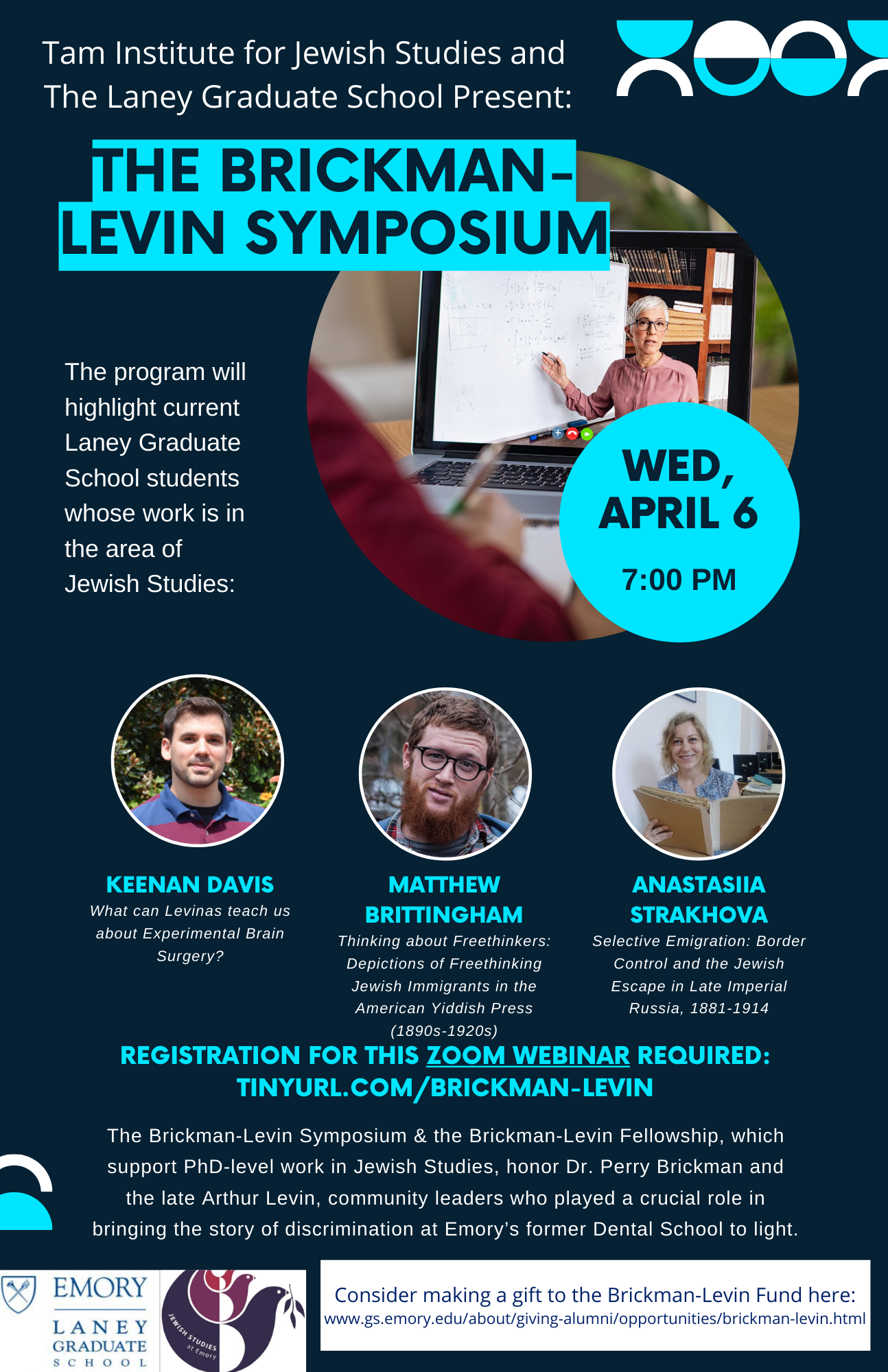
Graduate student Anastasiia Strakhova will present on her research at the upcoming Brickman-Levin Symposium, organized by the Tam Institute for Jewish Studies and Laney Graduate School. Strakhova’s talk is titled “Selective Emigration: Border Control and the Jewish Escape in Late Imperial Russia, 1881-1914.” The symposium will take place via Zoom on Wednesday, April 6, at 7pm.
Update – Find a recording of the event here: “The Brickman-Levin Symposium.”
Camille Goldmon to Present at Southern Historical Association’s Junior Scholars Workshop
Doctoral candidate Camille Goldmon will present a paper as part of the Southern Historical Association’s Junior Scholars Workshop (via Zoom) on March 17, 2022, from 4-5pm. Goldmon’s paper is titled “Shades of Radicalism: The History of Radical Agrarian Organizations in Alabama.” Connie Lester (UCF) and R. Douglas Hurt (Purdue) will offer brief commentary.
