Undergraduate student Emily Sharp, who is a double major in history and English, will present her history honors thesis at the inaugural Richard Macksey National Undergraduate Humanities Research Symposium at Johns Hopkins University in April. Her thesis is titled, “Roy Cohn’s America: Conservatism, Sexual Politics, and Memory in 21st Century America.”
History Major Cameron Katz to Present Paper at Conference in Utah
History major Cameron Katz will present a paper at the National Undergraduate Literature Conference this March. In its 35th year, the conference will take place at Weber State University in Ogden, Utah. Katz’s paper is entitled, “‘Fear in a Handful of Dust’: Alienation in T.S. Eliot’s The Waste Land.“
Strocchia Appointed Francesco de Dombrowski Visiting Professor at Villa I Tatti, the Harvard Center for Italian Renaissance Studies in Florence
Congratulations to Dr. Sharon T. Strocchia, Professor of History, on her appointment as the Francesco de Dombrowski Visiting Professor at Villa I Tatti, the Harvard Center for Italian Renaissance Studies in Florence. Strocchia will be in residence at I Tatti from April to June. While in Florence, she will continue to develop her current project, “Tobacco and the Making of Atlantic Italy, 1600-1700.” Strocchia is the author, most recently, of Forgotten Healers: Women and the Pursuit of Health in Late Renaissance Italy (Harvard UP, 2019).
Department of History Workshop to Feature Crais’s New Book Project

Dr. Clifton Crais, Professor of History and Director of the Institute for African Studies, will present at the Department of History workshop on Friday, February 21, in the Major Seminar room in Bowden Hall. Crais will be sharing the introduction to his new book project, tentatively titled “A Global History of the Present, 1750-1914.” Lunch will be provided. RSVP to Becky Herring at becky.herring@emory.edu.
In Le Monde, Lesser Offers Commentary about Bolsonaro’s Recent Attacks on Japanese Diaspora in Brazil
Dr. Jeffrey Lesser, Samuel Candler Dobbs Professor of History and Director of the Halle Institute for Global Research and Learning, was interviewed by Le Monde about race and politics in Brazil. The article chronicles how Brazilian president Jair Bolsonaro has recently levied racist attacks against Thais Oyama, a Brazilian of Japanese descent who published a critical account of the Bolsonaro administration. Lesser, who has published two monographs and an edited collection about the Japanese diaspora in Brazil, provides historical context for Bolsonaro’s rhetoric. Read the article (paywall prohibitive) at Le Monde: “Les Nippo-Brésiliens, nouvelle cible des injures du président Jair Bolsonaro.”
History Department Event on February 5 Celebrates Publication of Suddler’s ‘Presumed Criminal’

Assistant Professor Carl Suddler published Presumed Criminal: Black Youth and the Justice System in Postwar New York with NYU Press last year. The Emory History Department will celebrate the publication of Suddler’s work this upcoming Wednesday, February 5, with an event at the Jimmy Carter Presidential Library. The book event from 7-8:00pm will be followed by a reception at Manuel’s Tavern. Read more about Presumed Criminal and Suddler, who joined Emory’s faculty last year, via the New Faculty Q&A with Dr. Carl Suddler.
[googlemaps https://www.google.com/maps/embed?pb=!1m18!1m12!1m3!1d3316.7805219473753!2d-84.35849368494328!3d33.766336980684684!2m3!1f0!2f0!3f0!3m2!1i1024!2i768!4f13.1!3m3!1m2!1s0x88f5040297c94b9f%3A0xfffeb89a0564191f!2sJimmy%20Carter%20Presidential%20Library%20and%20Museum!5e0!3m2!1sen!2sus!4v1580607464718!5m2!1sen!2sus&w=600&h=450]
Allitt Provides Historical Context for ‘Megxit’ on GPB’s ‘On Second Thought’
Dr. Patrick N. Allitt, Cahoon Family Professor of American History, was recently a guest on Georgia Public Broadcasting’s On Second Thought. Allitt joined Lisa Respers France, a senior entertainment writer for CNN, to discuss the history and context behind Prince Harry and Meghan’s withdraw from public life as “senior” royals. Listen to the conversation, which is hosted by Virginia Prescott, here: “The Racial And Historical Context Behind Prince Harry, Meghan’s ‘Megxit’.“
Tom Chaffin (PhD, ’95) Captures Friendship Between Jefferson and Lafayette in ‘Revolutionary Brothers’
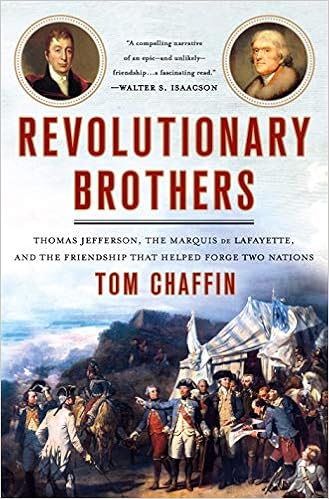
Congratulations to Tom Chaffin (PhD, ’95) on the publication of his new book, Revolutionary Brothers: Thomas Jefferson, the Marquis de Lafayette, and the Friendship that Helped Forge Two Nations (St. Martin’s Press, 2019). Steeped in primary sources, Revolutionary Brothers casts fresh light on the remarkable, often complicated, friendship between Jefferson and Lafayette. The Wall Street Journal describes Chaffin’s book as “A gripping narrative that offers a revelatory perspective on the combined origins of two nations . . . compelling drama and instructive history.” Read more about Chaffin’s work on his website.
Rachel Shapiro (MA and MPH, ’18) Co-Authors Article for ‘Maternal and Child Health Journal’
Rachel Shapiro, who received both an MA in history and MPH degree at Emory in 2018, has published an article in Maternal and Child Health Journal that developed out of her graduate studies. Titled “Comparison of Women from Georgia and Contiguous States Who Obtained Abortions in Georgia, 1994–2016,” the piece examines aggregate, vital statistics data in order to analyze abortion and demographic trends for Georgia and contiguous state residents (Alabama, Florida, North Carolina, South Carolina, and Tennessee) obtaining abortion services in Georgia between 1994-2016. Shapiro co-authored the article with Blake Erhardt-Ohren (MPH, ’18) and Roger Rochat, Professor of Global Health and Epidemiology, Emory University Rollins School of Public Health.
Jason Morgan Ward Speaks on C-SPAN Panel ‘Reinterpreting Southern History’
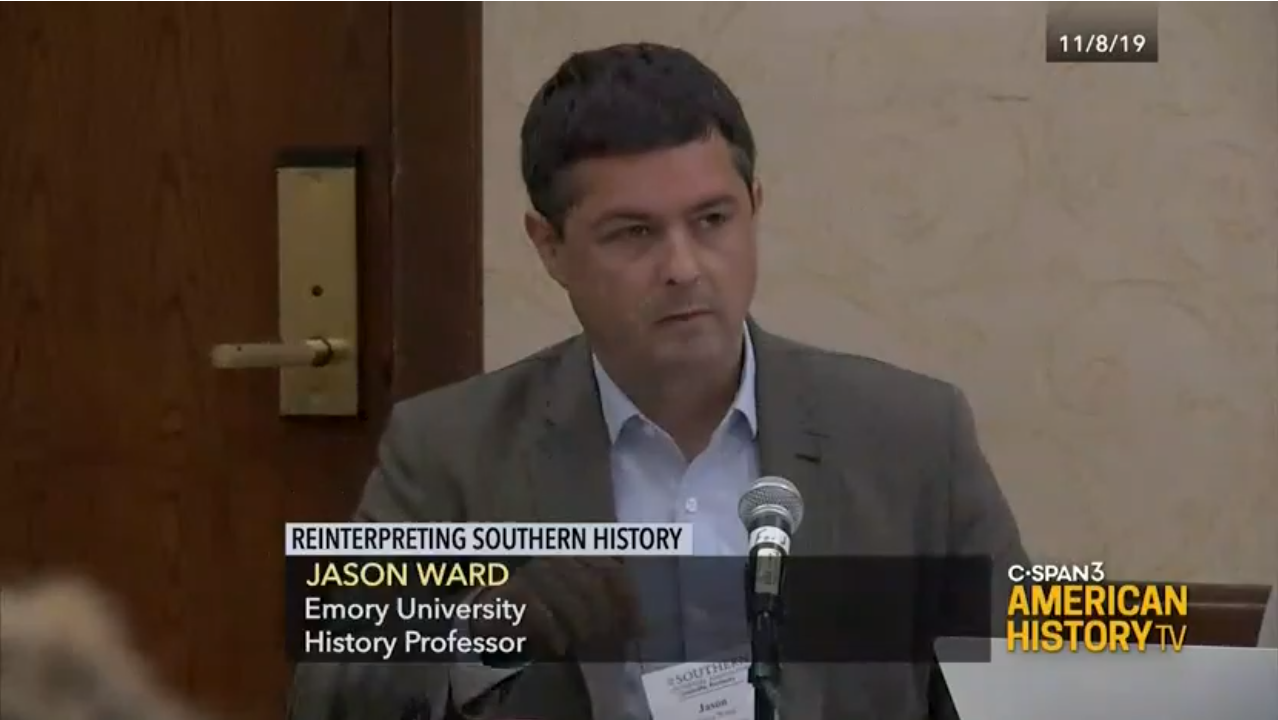
Dr. Jason Morgan Ward, Professor of History and Director of Graduate Studies, recently contributed to a panel on C-SPAN about new approaches to understanding the history of the South. The panel, which took place at the 2019 Southern Historical Association annual meeting, included Ward along with other authors from the upcoming edited volume Reinterpreting Southern Histories: Essays in Historiography (LSU Press, 2020). Find video of the full panel at “Reinterpreting Southern History.”