Emory History Department Well Represented at Decatur Book Festival

Emory History Department faculty, alumni, and current students are among the presenting authors at this year’s AJC Decatur Book Festival, the largest independent book festival in the country. 2018 marks the first year that Emory University is a presenting sponsor. See the presentations of authors associated with the History Department below, and explore the full schedule here.

  • Joseph Crespino, Jimmy Carter Professor of History and History Department Chair. “Atticus Finch: A Biography.” Sept. 2, 3:45-4:30 p.m., Decatur Presbyterian Sanctuary.
  • Ruby Lal, Professor of South Asian History, Middle Eastern and South Asian Studies and Associated Faculty in History. “Empress: The Astonishing Reign of Nur Jahan.” Sept. 1, 3-3:45 p.m., Marriott Conference Center B.
  • Hank Klibanoff, Professor of Practice, Creative Writing. “Understanding our Painful Past: Investigating the Impact of Lynchings Through Voice and Prose.” Sept. 1, 5:30-6:15 p.m., Decatur Presbyterian Sanctuary.
  • Edward Hatfield, Managing Editor of the “New Georgia Encyclopedia.” Hatfield will introduce Joseph Crespino. Sept. 2, 3:45-4:30 p.m., Decatur Presbyterian Sanctuary.
  • Michelle Oppong-Ampofo, Poet, Emory College Junior, and History Department Work-Study Student. Oppong-Ampofo will read her poetry on Sunday, Sept. 2, 4:40-6 p.m.

Carol Anderson in ‘The New York Times’: “Brian Kemp, Enemy of Democracy”

Charles Howard Candler Professor and Chair of African American Studies Carol Anderson recently authored an opinion piece in The New York Times. Anderson discusses the record of voter suppression by Brian Kemp, Georgia’s secretary of state since 2010 and currently the Republican nominee for governor. Read the full article: “Brian Kemp, Enemy of Democracy: An expert on voter suppression, he will help keep Georgia red.”

Senior History Major Alexa Palomo Helps Coordinate Volunteer Programs Against Homelessness at Atlanta’s Gateway Center

Alexa Palomo, a senior history and anthropology major, has spent her summer as an engagement coordinator and fundraiser at Atlanta’s Gateway Center. The organization focuses on ending homelessness in Metro Atlanta “through therapeutic programs and community collaboration.” Read more about Palomo in a recent Emory News Center article, “The change agent: Alexa Palomo.”

Alumni Update: Fulbright ETA Andrew Shifren (’17 College) Teaches English in Indonesia

The Emory History Department welcomes updates from alumni. Below, 2017 graduate Andrew Shifren describes his recent arrival in Indonesia on a Fulbright English Teaching Assistantship.

andrew-shifren-indonesia

I’ve now spent about a week in my placement, Labuan Bajo, Indonesia, where I will be living for the next 10 months. So far Indonesia has defied many of my expectations. It is isolating, but also incredibly eye-opening and motivates me to learn the language (Bahasa Indonesia) like nothing else could.  My town is the launching point for tours of the Komodo Islands and the surrounding coral reefs. In my free time I hope to snorkel and dive. The politics and history of Komodo National Park is fascinating and something I hope to learn more about. The teaching is going to be difficult, but I am looking forward to it. I teach eight 35-person classrooms per week with very little organizational help from the school. Most of the students hope to secure the well-paying tourism jobs that are popping up as hotels are built in the town and more and more tourist come to tour the Komodos; English is really the key to their futures.

Ashley Parcells (PhD, ’18) Publishes Article in ‘The Journal of African History’

Dr. Ashley Parcells, Assistant Professor of History at Jacksonville University, published an article in the July 2018 edition of The Journal of African History. The piece is titled “Rural Development, Royal History, and the Struggle for Authority in Early Apartheid Zululand (1951-4).” Parcells, a former student of Clifton Crais, graduated in the spring of 2018. Check out the article abstract below and read the full piece here.

“From 1951, apartheid officials sought to implement soil rehabilitation programs in Nongoma, the home district of Zulu Paramount Chief Cyprian Bhekuzulu. This article argues that these programs brought to the surface fundamental questions about political authority in South Africa’s hinterland during the first years of apartheid. These questions arose from ambiguities within native policy immediately after the passage of the 1951 Bantu Authorities Act: while the power of chiefs during the colonial and segregationist era in Zululand had been tied to their control of native reserve land, in Nongoma, these development interventions threatened that prerogative at the very moment apartheid policy sought to strengthen ‘tribal’ governance. In response, the Zulu royal family in Nongoma called on treaties with the British from the conquest era, colonial law, and the very language of apartheid to reassert chiefly control over land, and more importantly, to negotiate this new apartheid political order.”

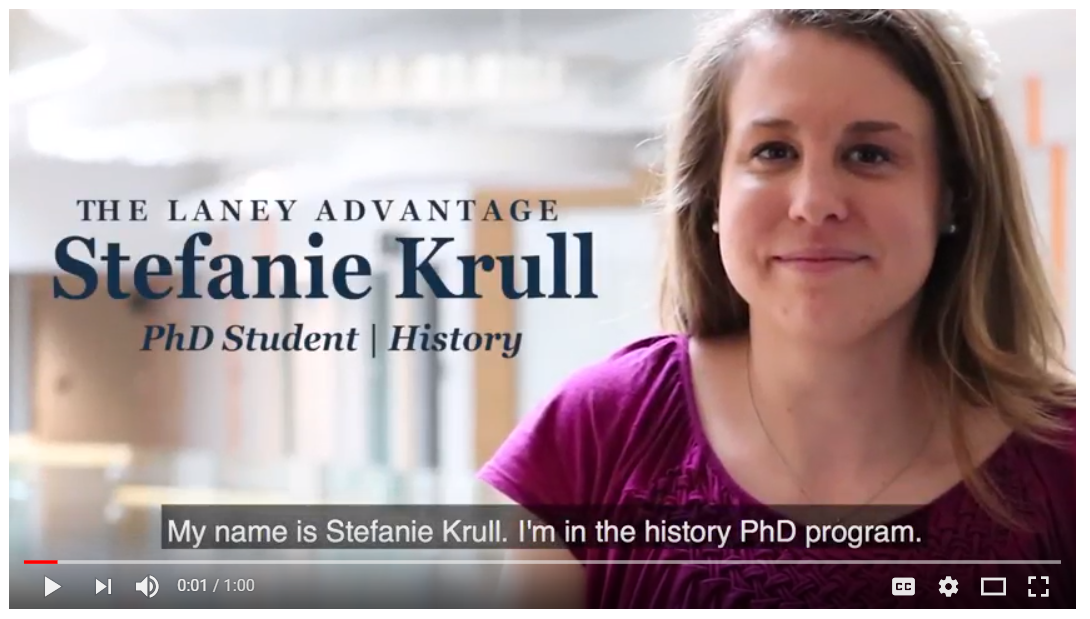
Laney Graduate School Profiles PhD Candidate Stefanie M. Krull

steffi-krull

The Laney Graduate School recently published a profile of PhD candidate Stefanie M. Krull on their homepage. Krull’s core research interests are Central Europe, Modern Germany & Poland, nationalism & ethnicity, and migration/diaspora. Her dissertation, titled “’The Latecomers’: Resettlers from Poland & their Integration into West Germany, 1970-1990,” is advised by Astrid M. Eckert. View the video profile of Krull and read more about her research.

Dawn Peterson Receives Georgia Author of the Year Award

Congratulations to Assistant Professor of History Dawn Peterson for being named the 54th Annual Georgia Author of the Year in the category of History/Biography. Peterson received the prize for her monograph Indians in the Family: Adoption and the Politics of Antebellum Expansion (Harvard University Press, 2017). The award committee offered the following appraisal of Peterson’s work:

Indians in the Family is an important and compelling history that explores the adoption of Native American youth by whites during the period of antebellum expansion, unveiling how Natives, and the whites who ultimately sought to displace them, used adoption to achieve divergent agendas. Peterson’s eloquent account draws upon archival records to piece together the various motives that inspired this phenomenon. Indians in the Family’s readers will find stories about whites who adopted Native children, and Native families and communities—stories that uniquely illuminate how “family,” nation-building, race-making, slavery, resistance, and expansion, factor in this this little-known chapter in America’s history. In the end, Peterson concludes, “For U.S. whites, the politics of adoption in post-Revolutionary North America was a family story that sought to mask the violence of U.S. territorial expansion, Indian dispossession, and African American servitude” while “For Native people, the placement of children within white homes was a way to support indigenous families and maintain indigenous sovereignty.”

Read about other Georgia Author of the Year award winners here. Also check out a recent interview Peterson gave for the History Department website.

‘The New York Times’ Reviews Crespino’s Biography of Atticus Finch

Journalist Howell Raines published a review of Jospeh Crespino’s newest book, Atticus Finch: The Biography—Harper Lee, Her Father, and the Making of an American Icon (Basic Books, 2018). Crespino, who is the Jimmy Carter Professor of History, specializes in twentieth-century U.S. history and the history of the South since Reconstruction. Read Raines’ review, “Harper Lee and Her Father, the Real Atticus Finch,” here.

Michael Dublin, ’01 College Alumnus and History Major, was 2018 Commencement speaker

Emory alumnus and former History major Michael Dublin was the 2018 Commencement speaker at Emory in May. Dubin described the value of his time in Bowden Hall: “As a history major, or really as a major in any of the liberal arts, you are trained to be a great writer and to think clearly, and those are both skills that are incredibly important in business.” Read more about his Dubin and his commencement address here.

Graduate Students Alexander Cors and Shari Wejsa Publish Blog Entries for HASTAC

Second-year graduate students Alexander Cors and Shari Wejsa are the two 2017-18 HASTAC Scholars at Emory’s Fox Center for Humanistic Inquiry. Cors and Wejsa recently published entries on the blog of HASTAC, which stands for the Humanities, Arts, Science, and Technology Alliance and Collaboratory. Check out links to their recent posts and read their HASTAC biographies below.

Alexander Cors

My research interests broadly encompass transatlantic history in the early modern period, from 1450 to 1850. Geographically, my focus is on Latin America and Europe. I am particularly interested in colonial Louisiana, the circum-Caribbean, and Bourbon Spain.

My current project investigates migration and settlement patterns, immigration policies, and discourses on foreigners in eighteenth-century Louisiana. I am particularly concerned with questions of ethnicity, integration, and identity in the early modern transatlantic empires of France and Spain. I am also interested in Digital Humanities, especially the use of GIS technology to create ethnolinguistic maps of the eighteenth-century Mississippi Valley.

Shari Wejsa 

As a PhD student in Latin American history, I study the experiences of Angolan and Mozambican immigrants and refugees in Brazil in the postcolonial period. I examine how their migratory experiences have shaped their identities as they adapted to Brazil while remaining connected to their countries of origin. I also explore how international human rights law and evolving immigration policies have affected the lives of these migrants. My research interests are an extension of my Fulbright Commission-sponsored work on Brazil’s National Truth Commission, which investigated the human rights violations committed during Brazil’s military dictatorship (1964-1985), and the inequities of educational access for Afro-Brazilian girls and women in Bahia. As an educator, I seek to cultivate critical thinking on issues of human rights and social justice while advocating for active engagement as transformative power.