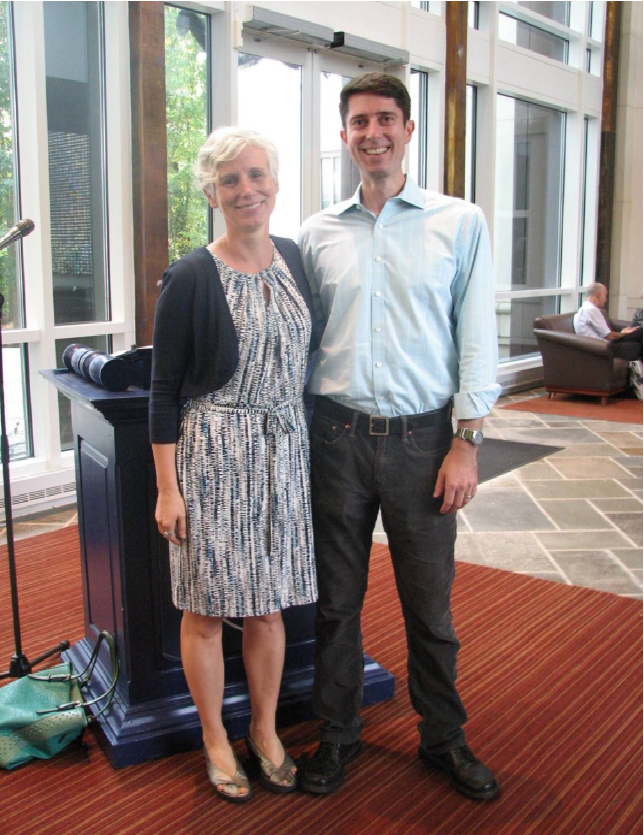
Yannakakis and Rogers Honored with Named Chair Professorships

yy_tdr

Congratulations to Dr. Yanna Yannakakis and Dr. Thomas D. Rogers for receiving named chair professorships. Associate Professor of History and a specialist in colonial Mexico, Yannakakis received the Winship Distinguished Research Professorship in History for the 2018-2021 term. Rogers is Associate Professor of Modern Latin American History and will serve as the NEH/Arthur Blank Distinguished Teaching Professor for the same period. Read more about these named chairs below, and view others available to Emory Faculty here.

The Winship Distinguished Research Award is given to tenured faculty who demonstrate singular accomplishments in research. Such recognition should honor achievement and further scholarly research and research-based teaching. Awarded for a three-year term.

The Arthur Blank/NEH Chair in the Humanities and Humanistic Social Sciences is given to tenured faculty in the humanities and/or humanistic social sciences with a record of exemplary teaching and a commitment to pedagogical rigor and innovation. Appointees are expected to organize programming designed to enhance pedagogy and curricular development in the College, and continue teaching in her/his department(s), including at least one introductory level course each year. One leadership function of the NEH professors will be to serve on a newly formed advisory committee on Pedagogy and Curriculum. Awarded for a three-year term.
 

Rogers’ “A History of Hunger” Featured as Innovative Course for Spring 2018

The Emory News Center recently highlighted the Spring 2018 History Department course “A History of Hunger” as innovative. The course is designed and taught by History faculty member Tom Rogers. Rogers is Associate Professor of Modern Latin American History and is currently working a book project titled Agriculture’s Energy: Development and Hunger During Brazil’s Ethanol Boom. “A History of Hunger” was one of 16 “cool” courses identified by the News Center and offered at undergraduate and/or graduate levels this Spring. Read more about this course and the other compelling offerings here.

Allen Tullos on Alabama’s Special Senate Election in ‘El País’ (Spain)

Professor of History Allen Tullos recently commented on the special senate election in Alabama for an article in Spain’s largest newspaper, El País. Tullos, who also serves as the Senior Editor of Southern Spaces and Co-Director of the Emory Center for Digital Scholarship, is the author of Alabama Getaway: The Political Imaginary and the Heart of Dixie (University of Georgia Press, 2012). Amanda Mars authored the piece, “Por qué el viejo sur dio la espalda a los republicanos.” See the excerpt below and read the full article.

“Alabama arrastra una larga y vergonzosa historia de falta de apoyo a la educación pública que resulta en una postura reaccionaria y desinformada a las políticas de raza, de género o de bienestar social y, por supuesto, persiste un racismo blanco que cae muy fácilmente en la demagogia de políticos como George Wallace, Donald Trump o Roy Moore”, afirma Allen Tullos, historiador de la Universidad de Emory. 

Innovative Teaching and Learning in Crespino’s “History 385: Right-Wing America” Culminates in “Documenting the Right” Student Film Festival

Students in Dr. Joseph Crespino‘s fall 2017 class, “History 385: Right-Wing America,” produced short documentary films that were screened on November 29 at the “Documenting the Right” Student Film Festival. Students took advantage of Emory’s rich library holdings in crafting videos whose themes ranged from racism in the career of George Wallace to Atlanta’s motto as the “city too busy to hate.” Read more about the project on the Emory Center for Digital Scholarship Blog: “Emory history class uses digital storytelling to study political movements.”

President Jimmy Carter Visits Dr. Tehila Sasson’s “Origins of Human Rights”

President Jimmy Carter recently visited Prof. Tehila Sasson’s class, “Origins of Human Rights.” The students engaged the President on foreign policy, civil rights, decolonization, the Camp David Accords, and the Cold War. President Carter answered questions ranging from the hostage crisis in Iran, women’s rights, North Korea, to human rights in the age of Trump.

Daniel LaChance Makes Appearance on Al Jazeera

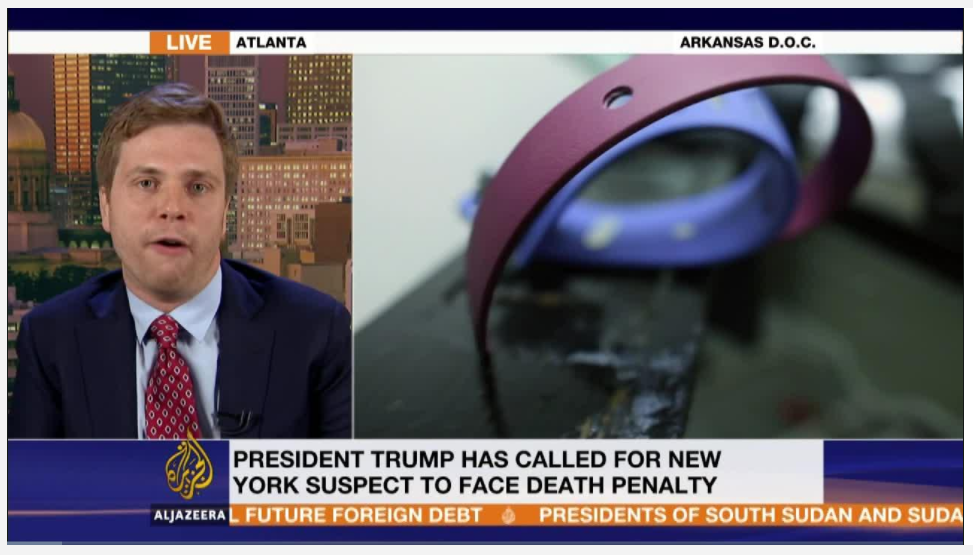
Assistant Professor of History Daniel LaChance recently made a television appearance on Al Jazeera. He discussed President Trump’s tweets calling for the “death penalty for the NY terrorist attacker.” LaChance is a specialist in the history of capital punishment and author of  Executing Freedom: The Cultural Life of Capital Punishment in the United States (University of Chicago Press, 2016).

aljazeera_lachance

Mark Ravina Publishes ‘To Stand with the Nations of the World: Japan’s Meiji Restoration in World History’

Mark Ravina, Professor and a specialist in Japanese history, has published a new book with Oxford University Press: To Stand with the Nations of the World: Japan’s Meiji Restoration in World History. Released in advance of the 150th anniversary of the 1868 Meji Restoration, Ravina’s new work is also the first one-volume study of the event in 45 years. Daniel Botsman of Yale University described it as “essential reading for anyone seeking a fuller understanding of Japan’s place in the modern world. Tracing the confluence of global and local forces of change, as well as the impact of lessons remembered from the deeper past, it offers an impressively broad-ranging account of this most consequential of historical moments.”

Illustrated Excerpt of Peterson’s ‘Indians in the Family’ in ‘Southern Spaces’

Dawn Peterson, Assistant Professor of History, published an illustrated excerpt of the introduction to her newest book in Southern Spaces. The book is titled Indians in the Family: Adoption and the Politics of Antebellum Expansion and published by Harvard University Press this year. As explained on the Southern Spaces page, the book “looks at a group of white slaveholders who adopted Southeast Indian boys (Choctaw, Creek, and Chickasaw) into their plantation households in the decades following the US Revolution. While these adoptions might seem novel at first glance, they in fact reveal how the plantation household—and the racialized kinship structures that underpin it—increasingly came to shape human life for American Indians, African Americans, and Euro-Americans after the emergence of the United States.” Check out the piece on Southern Spaces, which includes a fascinating series of images that range from a Catawba deerskin map (1724) to a photo of Pupils at Carlisle Indian Industrial School (circa 1900).

Claudia Kreklau (PhD Candidate) Wins Essay Prize from German Studies Association

Claudia Kreklau

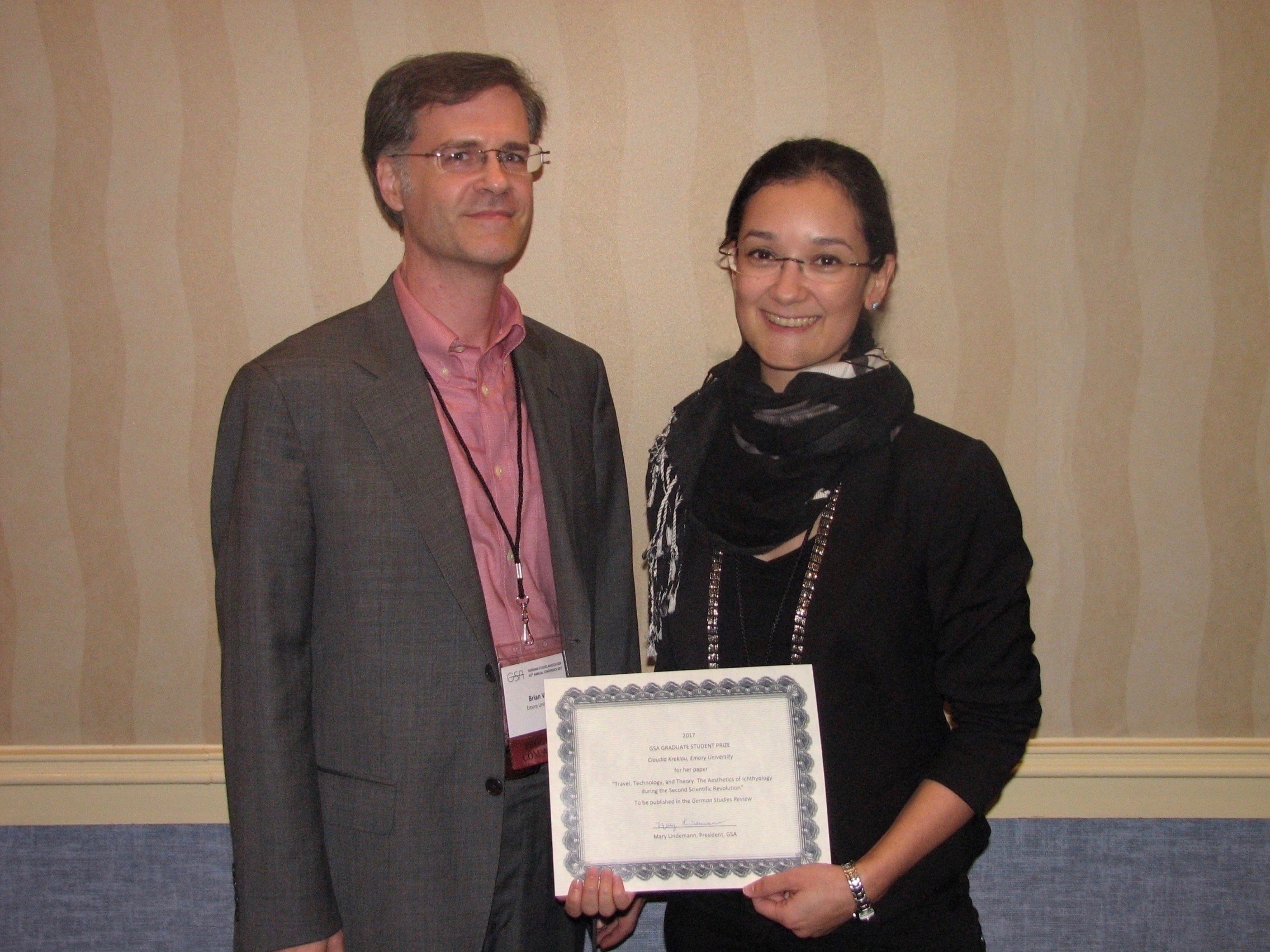
Claudia Kreklau and her faculty advisor Dr. Brian Vick.

Big news! Congratulations to Claudia Kreklau for winning the 2017 Graduate Student Essay Prize of the German Studies Association for her paper “Travel, Technology, and Theory: The Aesthetics of Ichthyology during the Second Scientific Revolution.” The prize jury thought that the essay “stood out for its clear organization, its accessible, lucid writing, and its deep level of research.” As part of the Prize, the essay will be published in the German Studies Review. As the laudatio indicates, “whether one comes from the angle of the historian, or literary scholar, or naturalist, this essay offers innovative and persuasive perspectives on the intersection of the natural world with technology and human intervention.” Congratulations, Claudia, on this major achievement!