Professor Joseph Crespino on Georgia Public Broadcasting’s “Political Rewind”

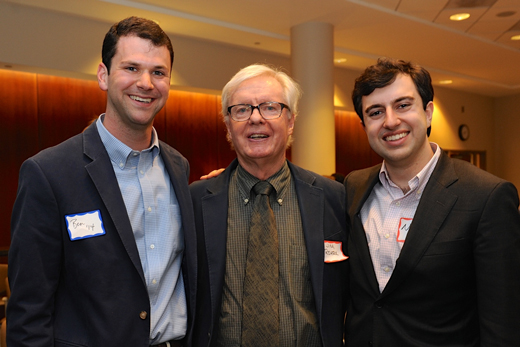
Photo of

Joseph Crespino, Department Chair and Jimmy Carter Professor, recently joined Georgia Public Broadcasting’s “Political Rewind” for a conversation about echoes between past and present presidential races. Hosted by Bill Nigut, the segment was titled “Historical Parallels Between the 2016 Campaigns and Past Races.” You can find the full audio for the show at this link, and below is a plug elaborating on one part of their conversation:

We take a close look at “Confessions of a Republican,” a remarkable 1964 TV commercial that questions the fitness of the Republican presidential nominee Barry Goldwater to serve in the Oval Office. Crespino says the spot could easily be transplanted into today’s race as Democrats raise questions about Donald Trump’s preparedness and temperament to be president.

First-Year Graduate Students End Semester with Hi-Five Research Presentations

The first-year cohort from the PhD program recently capped off the semester by presenting their research at the department’s annual Hi-Five event. The Hi-Five helps students develop their academic, presentation, and research communication skills and is based on the Three Minute Thesis (3MT®) competition that originated at The University of Queensland (UQ), Australia. The format is also used by the Laney Graduate School for those students completing their Ph.D. dissertations. In presentations to the department, each student must adhere to the following rules:

  • Presentations must be five minutes or less. Presentations will be cut off after five minutes.
  • A single static PowerPoint slide is permitted (no slide transitions, animations or ‘movement’ in the slide, and the slide is to be presented from the beginning of the oration).
  • No additional electronic media (e.g. sound and video files) are permitted.
  • No additional props (e.g. costumes, musical instruments, laboratory equipment) are permitted.
  • Presentations are to be spoken word (e.g. no poems, raps or songs).
  • Presentations are to commence from the front of the room and must be done while standing.
  • Presentations are considered to have commenced when a presenter starts their presentation through movement or speech.

Participating students and the titles of their papers are as follows:

Oskar Czendze – “Old Homes Made New: The Reinvention of Landsmanshaftn in the United States”

Mary Grace Dupree – “The Golden Chalice: Vision and Prophecy in the Narrative of Perpetua of Carthage”

Cheng-Heng Lu – “Double-edged Sword: The History of the Shi Clan in the Qing Empire”

Luke Hagemann – “Imperial Clementia in Late Roman Law”

Anthony Tipping – “A Coercive Public Health Campaign in Rio de Janeiro: The benevolent elite, the ignorant masses, and the revolta da vacina of 1904″

Alexandra Lemos Zagonel – “Secret Agent Men: Spying at Brazilian Universities in the Twilight of Military Rule”

Tim Romans – “Under the Vermillion Seal: Japan’s Forgotten Tokugawa Pirates”

Anthony Sciubba – “Ancient Arbitration: Conflict Mediation in Late Antiquity”

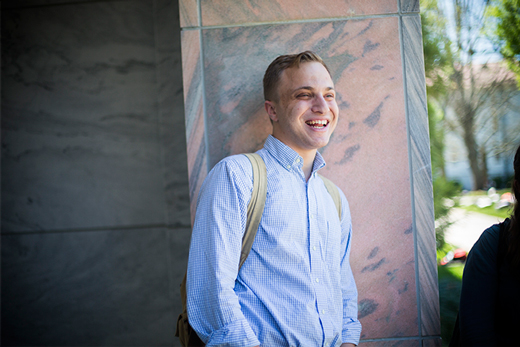
Graduating History Major, Ami Fields-Meyer, Named Emory College Class Orator

Story image

Following the university-wide commencement ceremony on May 9, senior history major Ami Fields-Meyer will speak to his fellow graduates as the class orator at the Emory College diploma ceremony. The Los Angeles native arrived at Emory with sights set on a career in politics as an elected official. A history class early on changed his perspective and led him to a major in History (along with a minor in African-American studies) instead of political science.

“[H]e took a history class focused on the history of inequality in the United States. Fields-Meyer discovered life as a self-described news junkie took on greater depth when he understood the historical context of current events.”

Fields-Meyer also highlights his experience in the Georgia Civil Rights Cold Cases course, co-taught by historian Brett Gadsden and Hank Klibanoff. Gadsden remembers Fields-Meyer fondly from the class: “One thing I’ve really admired is his efforts to bridge the past and the present, to really think about the gap between the two, and understand the echoes of history. That’s testimony to me of a dynamic mind.”

In addition to his accomplishments as a Dean’s Achievement Scholar, Fields-Meyer co-founded TableTalk, an initiative designed to spur conversations between groups at Emory that would not likely otherwise interact.

Read the full profile on Fields-Meyer here.

Dr. Dawn Peterson in ‘Slate’ on “Andrew Jackson’s Adopted Indian Son”

Illustration from John Frost's 1860 biography, A Pictorial History of Andrew Jackson.

Illustration from John Frost’s 1860 biography, A Pictorial History of Andrew Jackson – Internet Archive 

Professor Dawn Peterson was recently interviewed for a piece in Slate by Rebecca Onion. Prompted by discussions following the decision to replace Andrew Jackson with Harriet Tubman on the $20 bill, the article hones in on one piece of Jackson’s life frequently cited by those who defend his legacy: his adoption of a infant Creek boy in 1813. Peterson offers historical context for the adoption of Lyncoya (the name given by Jackson to the orphaned boy) and the practice in southern society more broadly. These insights derive from Peterson’s recent research and especially her forthcoming book Indians in the National Family: Adoption and the Politics of Antebellum Expansion (Harvard University Press in 2017). Read an excerpt from the piece below and check out the full article here.

Though they adopted native children, slaveholders like Jackson imagined “they were assimilating Native people and their lands into the confines of the United States. They believed that what they were doing was a benevolent act, but also understood it as a form of cultural genocide.” 


Graduating History Major Takuya Maeda Profiled for Innovative Scholarship

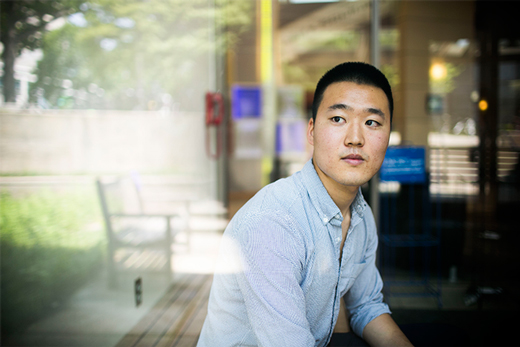
In May of 2016 senior Takuya Maeda will graduate with highest honors in history. Maeda was recently profiled for his research accomplishments at Emory, most especially his work on the use of funds from the Civil Liberties Act of 1988 “set aside for the Japanese-American community to develop educational efforts and awareness about internment” during World War II. Maeda received a grant from the Scholarly Inquiry and Research at Emory (SIRE) program to conduct this research, which his mentor Professor Daniel LaChance described as “groundbreaking.” Maeda plans to continue and expand this project through graduate work in history. Read the full profile on Takuya here.

Story image

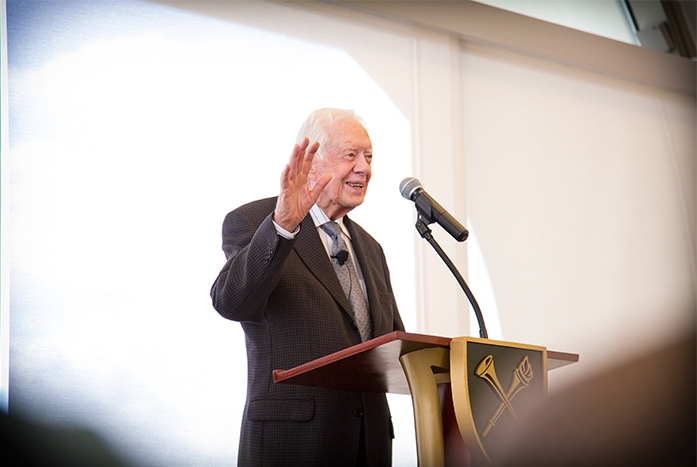
President Jimmy Carter Discusses the Importance of History and Archives with Students from Spring Course Taught by Dr. Joseph Crespino

On April 21 President Jimmy Cater was on Emory’s campus to speak to students in a session titled “Why Archives Matter: Memory, Meaning and History.” Included in the event where students from Dr. Joseph Crespino’s spring undergraduate course on the history of politics and race in the United States. Aside from a lively question and answer period with the attendees, the event served to highlight recent renovations at the Stuart A. Rose Manuscript, Archives and Rare Book Library. Read more about the event on the Emory News Center’s site here.

photo description

Professor Judith A. Miller Consults for the Opera Lafayette’s “Opera and the French Revolution”

“Opera and the French Revolution” debuts on April 29 and May 1 in Washington and New York.  Emory University French historian Judith A. Miller has enjoyed consulting on the production.  The Opera Lafayette will perform the modern world premiere of scenes from Martini’s and Pipelet’s Sapho (1794), as well as Cherubini’s Médée (1797) and Sacchini’s Oedipe à Colonne.   Performances will take place in DC (Lisner Auditorium, GWU) on Fri., April 29, 7:30pm; and in NYC (Jazz at Lincoln Center, Rose Hall) on Sun., May 1, 8pm.  More info and ticket links are on the company’s website.   Emory discounts are available for the DC performance, Code EMORY.  Along with workshops in March in NYC, Professor Miller has contributed to the blog on the production.  An hour before each performance, there will be a panel discussion  featuring Ryan Brown, with stage director Miřenka Čechová and Judith A. Miller.

PhD Alumna Elizabeth Bouldin (’12) Publishes ‘Women Prophets and Radical Protestantism in the British Atlantic World, 1640-1730’

Women Prophets and Radical Protestantism in the British Atlantic World, 1640–1730

Dr. Elizabeth Bouldin, Assistant Professor of History at Florida Gulf Coast University and an alumna of the history graduate program, recently published Women Prophets and Radical Protestantism in the British Atlantic World, 1640-1730 with Cambridge University Press. Check out a summary below and the page for the book on Cambridge UP’s website here.

This book examines the stories of radical Protestant women who prophesied between the British Civil Wars and the Great Awakening. It explores how women prophets shaped religious and civic communities in the British Atlantic world by invoking claims of chosenness. Elizabeth Bouldin interweaves detailed individual studies with analysis that summarizes trends and patterns among women prophets from a variety of backgrounds throughout the British Isles, colonial North America, and continental Europe. Highlighting the ecumenical goals of many early modern dissenters, Women Prophets and Radical Protestantism in the British Atlantic World, 1640–1730 places female prophecy in the context of major political, cultural, and religious transformations of the period. These include transatlantic migration, debates over toleration, the formation of Atlantic religious networks, and the rise of the public sphere. This wide-ranging volume will appeal to all those interested in European and British Atlantic history and the history of women and religion.

Professor Jeffrey Lesser on Brazil’s Political Present and Near Future (Canadian Broadcasting Corporation)

In the wake of an historic impeachment vote in Brazil’s congress on Sunday, Professor Jeffrey Lesser offered historically-informed commentary for a Canadian Broadcasting Corporation article, “Brazil President Dilma Rousseff impeachment crisis: What happens next?” Lesser is a specialist in Brazilian history and currently Research Professor at the Institute for Advanced Studies at the University of São Paulo. Check out an excerpt below and the full piece here.

The vote was just the latest step, but a major step toward impeachment. Despite the vote, Rousseff remains the leader. Now the process moves to the Senate, which will vote on whether the upper chamber should put Rousseff on trial for impeachment. (Local news media report that 45 of the 81 senators have said they will vote to hold the impeachment trial.)

It could be about 40 days before that Senate vote is cast. But timing is very difficult to predict, says Jeffrey Lesser a professor of Brazilian history at Emory University and currently research professor at University of São Paulo,  Rousseff has challenged every step of this process. She had asked the country’s Supreme Federal Tribunal, Brazil’s highest court, to suspend the proceedings, but lost that decision. But she could go to the court again, on the grounds that the accusations are faulty.


Three History Majors Recognized in Woodruff Library Undergraduate Research Award Contest

The panel of judges for the 2016 Woodruff Library Undergraduate Research Award recognized the outstanding scholarship of three History Department majors. Samantha Keng and Zixuan (Armstrong) Li each received $500 prizes for undergraduate research papers. Keng’s paper, sponsored by Professor Carol Anderson, is titled “Model Minority Awakenings: Vincent Chin, Asian America’s Emmett Till.” Li’s work, titled “Doner Kebab: Symbol of German Multiculturalism in the Turkish Immigration Question,” was supported by Dr. Astrid Eckert. A third History Department major, Emily Moore received an Honorable Mention. Titled “‘A Casket Full of Precious Memoirs’: The Town of Washington’s Conception of Its Own History,” Moore was sponsored by Dr. Leslie Harris. Congratulations to these students and their advisers on outstanding work. Descriptions of each piece can be found in the Emory Undergraduate Research Journal (EURJ) from pages 66-69. Also see the news release on the Woodruff library’s Scholar Blog.

From left to right: Emily Moore, Zixuan (Armstrong) Li, Samantha Keng, & Hannah ConwayFrom left to right: Emily Moore, Zixuan (Armstrong) Li, Samantha Keng, & Hannah Conway