Noodles in China and Italy: A Reflection on Food, Culture, Identity, and Love

by Abigail Chin


The noodle is a remarkable culture bearer for China and Italy because noodles reflect and illustrate the unique societal values and identities of both countries and their respective cultures in different ways. Noodles are made from simple ingredients, but the context in which they are produced and consumed within Italy and China imbue the noodle with great meaning and identity beyond the noodle’s simple categorization as a food product.

At the most basic level, the noodle performs the basic function of giving people affordable nutrition in both China and Italy. The base ingredients for noodles are some combination of flour, water, and/or eggs. As such, noodles contain protein, minerals, and carbohydrates, along with some minerals. Noodles in China are considered a staple food, as seen in “Bite of China: Staples Foods.” Noodles are a cereal food, and “cereal food is the main body of the traditional Chinese diet, the main source of energy for the human body, and also the most economical energy food” (Journal of Ethnic Foods, Ma and Zhang 212). Noodles have performed the all-important role of feeding millions of Chinese people for hundreds of years, and China is the largest consumer of noodles in present-day. Italy also relied on noodles as an economical staple food during different times in history. For example, in Let the Meatballs Rest we learn that around 1630, pasta was very popular in Sicily but less so in Naples, where it was still considered a luxury. During that time, Neapolitans suffered from terrible famine and poverty as a result of Spain’s poor governance. There was an extreme shortage of the former staple food meat, and the Neapolitans took advantage of the mechanical pasta maker and made macaroni their new, economical staple food in the place of meat. During that time, they were given the nickname “macaroni-eaters” because of their love of pasta, and in the 1800s Italy as a whole country took on that label (Montanari161-162). Noodles have played an essential part in providing wholesome nutrition to both China and Italy. The rise in popularity of macaroni in Naples is a great example of how different regions of Italy and China experience noodles in different ways, according to different regional characteristics and traditions.

In China, noodles are a staple food, but there are thousands of different noodles varieties throughout the different regions, provinces, and cities of China. Each region of China has its own signature noodle dishes with vastly different preparation methods and flavor combinations. China is a large country with so many different types of climates, so many food traditions remain popular in specific regions in part because their respective geographic environments and climates are conducive for growing and preparing certain foods. However, perhaps just as significant is the fact that certain food traditions arose in a specific region, and people in that particular region care to continue the tradition, or perhaps people in other regions do not have quite the same affinity for the tastes of other regions’ noodle dishes. It has been said Chinese are the most food-oriented people in the world, and food traditions are among the most important traditions that the Chinese people keep. This is illustrated beautifully by the way noodles are prepared and eaten throughout China.

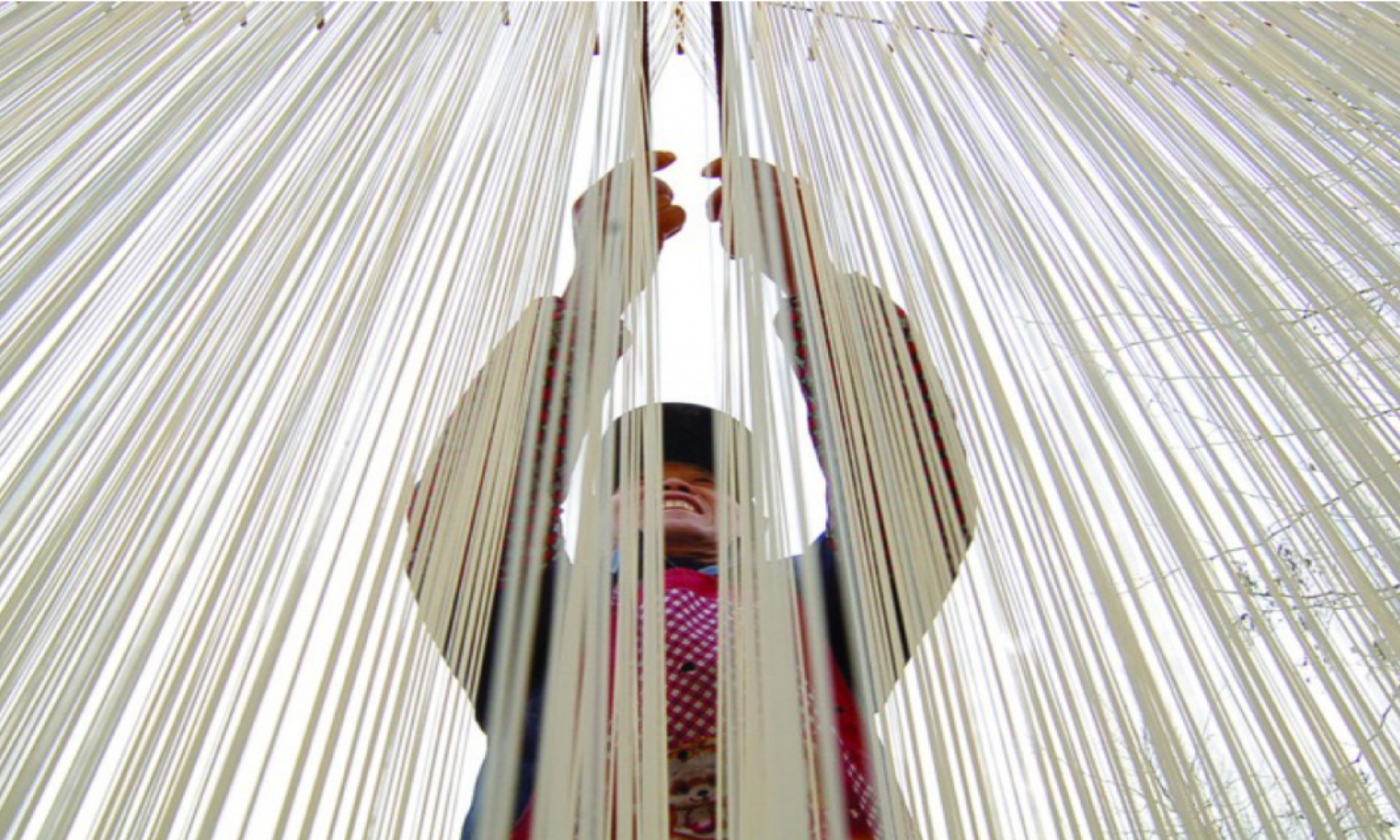
Bamboo pole pressed noodles are a remarkable noodle dish that can only be found in southern China, while pulled noodles are a proud tradition of Northern China. Bamboo pole noodles are made in a small area of China that includes Canton and Hong Kong, while pulled noodles are made throughout a large area of Northern China. The art of making bamboo pole noodles is a strenuous and lengthy process that was invented one hundred years ago and has been passed down between each generation since then (Hsiang Ju Lin 309-311). The art of bamboo pole noodles requires patience, discipline, and precise attention to detail in order to achieve the proper texture and form of noodle. The process of making these noodles is detailed by Hsiang Ju Lin in “Slippery Noodles.” The dough is made by mixing duck eggs straight into wheat without water, and then pole operator must bounce and pivot on the bamboo pole for hours, folding the dough at certain intervals (309-311). A person who makes this type of noodle does so as his or her full-time job or career, because making these noodles properly requires a good amount of training and experience; it seems it is not the type of dish that a person can make at home on a whim. This noodle reflects the culture and discipline of the Southern Chinese people in the Canton and Hong Kong areas, because this process requires an hours-long commitment to excellence and quality in order to enjoy even one bowl of noodles. On an individual level, the bamboo pole operators’ dedication, strong work ethic, and craftsmanship is embodied in these noodles. The fact that these particular noodles have remained popular, and that the art has been passed down over a hundred years shows the value that Chinese culture places on the art of quality food.

On the other hand, pulled noodles give us a window into the cultural fabric of northern China. These noodles have a long history in northern China. While pulling the noodles, the “noodle-maker would give a riveting performance” (Hsiang Ju Lin 312). The fact that noodle-makers would put on a show in a street stall or in a restaurant reveals that they had a ready audience for their noodle-making. The Chinese are a food-oriented culture, and the ready audience for noodle-makers illustrates that Chinese people appreciated and continue to appreciate the artisanship and hard work that goes into making the noodles. This presents a stark contrast to American restaurants, where the chef and cooks most often remain behind the closed double doors of the kitchen, and never come out to show how food is made. In the USA, it seems that at nicer restaurants, it is essential that the process of cooking be hidden from the customer, with a distinct separation between front-end wait staff and back-end chefs and cooks. The emphasis and value are placed on the appearance and taste of the food when it lands on the dining table, but less so in the process behind it. The performance of noodle pullers illustrates that the Chinese, specifically the northern Chinese in this case, value every step of the noodle-making process, not just what ends up in their bowl on the table. Lanzhou pulled noodles are a different type of pulled noodles that were invented by Muslims who settled in the Xian and Lanzhou cities of northern China after they traveled in from the west on the Silk Road (Hsiang Ju Lin 313-314). This dish marries traditional Muslim beef soup with pulled noodles native to northern China. The soup was made from green parsley, red pepper oil, white noodles, radish, coriander, beef, spice blends, and a signature clear broth. The clear broth of this noodle dish is very different from the rich and heavy sauce that is often served with pulled noodles in northern China (314-315). This particular noodle dish is a great example of how other cultures could influence and contribute to the noodle culture in China. Lanzhou pulled noodles are a direct result of the Silk Road and how the Silk Road changed and influenced Chinese culture in the northern region.

In Italy, the noodle is a wonderful symbol of the entire Italian culture and more specific regional traditions. The earlier example of the Neapolitan development of a macaroni culture reveals an important aspect of Italian culture. When discussing Italian culture, it is important to recognize that each region of Italy has a distinct history. Each region was conquered, occupied, and liberated multiple times by different rulers and countries, and during different time periods. Some regions of Italy did not interact with other regions for hundreds of years at a time, so each region developed its own cultural identity and food culture. In addition, different regions of Italy have geographies that are suited to raising different kinds of crops and livestock, furthering the regional difference in cuisine. While pasta is now recognized as the signature food of Italy, each region has a very different history with pasta. In the Middle Ages, Sicily “was the region of Italy where industrialized dry pasta first took hold” (Montanari 161). Up to this point, Sicilians were known as “macaroni eaters” (161). However, around 1630 after pasta became an economical staple food in Naples following a period of famine, Neapolitans became known as “macaroni-eaters” (162). It wasn’t until the nineteenth century that the entire country of Italy was known as “macaroni-eaters” (162). Since this date coincides with the unification of Italy in 1861, I imagine that perhaps the unification enabled pasta in all its forms to travel and become widespread throughout the entire country, rather than stay confined within specific regions.

In addition, the example of cappelletti and tortellini further illustrates the different food traditions in the different regions of Italy. In the present-day region of Emilia-Romagna, the noodle dishes of cappelletti and tortellini are filled differently (Montanari 42). In Romagna, cappelletti are filled with cheese as a result of the sheep culture in the region. On the other hand, in Emilia tortellini are filled with meat as a result of the native pork culture 42). Both regions incorporate filled pasta dough into their regional cuisine, but the different fillings are a nod to their separate histories of occupation. While the landscape differences between Emilia and Romagna contributed to this difference, the fact that the Longobards occupied Emilia and the Byzantines ruled Romagna is a likely cause of different food traditions illustrated by these stuffed pasta dishes (42-43).

The noodle is an important cultural element of both Italian and Chinese societies and their respective cultures. Both the Chinese and Italians demonstrate their commitment to high quality food made with love and expert-level care through noodles. In the article “Noodles, Traditionally and Today”, we learn that there are thousands of noodle varieties in China (Zhang and Ma 210). These noodles are crafted with great care and hard work, such as with bamboo pole noodles and hand pulled noodles. Within Italy, there are hundreds of varieties of noodle shapes, from capellini to bucatini to the classic spaghetti. There must be thousands of unique pasta dish varieties after accounting for sauce varieties. The overwhelming variety of noodle shapes and forms indicates that both Chinese and Italian culture truly value the art and form of noodles. In Italian culture, “different shapes of pasta, although alike in substance, produce different effects on the taste buds” (Montanari10-11). There is an understanding in Italian culture that the form of food, such as pasta, will profoundly affect the taste or flavor of a dish. With this belief, the number of pasta shapes that have been created over the years clearly illustrates the Italian commitment to seeking excellent taste and flavor in food. In Chinese culture, the value of the balancing of the five flavors in conjunction with the hard work in making noodles illustrates the Chinese dedication to quality food.

Noodles play an important role in Italian culture because pasta is the food most associated with Italian food culture by both Italians themselves and by people throughout the world. The traditional pasta and tomato sauce is a great example of the signature of Italian cuisine. Italians, perhaps more than any other culture in the world, perfected the art of drawing from a variety of gastronomical cultures to create superb food. There is great debate over which part of the world first invented noodles, and we may never truly know if China or Italy or the Middle East created the first proper noodle. Regardless, the Italians took the noodle tradition and perfected the production and drying of noodles and pasta. Tomatoes and tomato sauce were brought to Italy from the Americas, and they are not native to Italy. However, because of the masterful Italian cooking techniques, pasta and tomato sauce will forever be associated with Italy’s cultural identity. Pasta is the perfect “metaphor for the unity and variety of Italian alimentary styles” (Montanari 160). The Italians’ ability to draw from different gastronomical cultures is an important part of Italian food culture, and the noodle personifies this ability more than any other food.

Noodles have an incredibly important position in Chinese food culture because of the Chinese are an incredibly food-oriented culture. Food is interwoven into all of the significant Chinese customs, rituals, life events, and holidays. Noodles in China are especially imbued with customs and meaning. For example, many noodle dishes have other names that reflect their place in Chinese culture rather than the food in the dish Qishan minced noodles are also known as “sister-in-law noodles” because it is said that a poor student was able to pass his civil service exam only because of the great noodles his sister-in-law prepared for him. Later, many people tried to cook the same noodle dish to seek success for their sons in their exam. So, the noodles also took on another epithet of “ashamed son noodles,” in reference to parents’ shame when the same noodle dish did not lead to their son’s success. The naming of noodle dishes shows that many noodles dishes are linked with other aspects of life, and the food is always connected to other aspects of life. There are many other noodle dishes that are forever linked with certain traditions or customs in Chinese culture. For example, longevity noodles or long-life noodles, are served at birthday parties. In “Bite of China: Staples Foods”, we see that there is a beautiful noodle tradition that is performed at a 70th birthday celebration in one village in China. Since long noodles are associated with a long life, every member of a village is served a bowl of noodles upon arriving at a birthday party. Each person picks the longest noodle out of his or her bowl, and places it in the bowl of the man who is celebrating his birthday. The birthday celebration can only be complete after the man eats the bowl of the longest noodles. Here, the noodles symbolize the love and good wishes from every member of the community to this man. It is clear that noodles in Chinese culture are much more than the ingredients, they are a special food that represents love and can guide one through both big and small life events.

Both Italian and Chinese cultures emphasize the importance of eating meals with loved ones. In China, it is incredibly important to eat food with family. In Italy, a big part of the Mediterranean diet tradition is eating with others, whether that be friends or family. The amount of hard work, care, and attention to detail that goes into selecting, preparing, and eating noodles is more than the sum of its parts: it is love. There is love that goes into preparing noodles well in both Italian and Chinese culture. In the story “Crossing the Bridge”, a family chef labored over many noodle dishes and experimented with many techniques and styles of cooking until he found the perfect technique to keep noodles warm for the beloved son in the family (Durack 182-183). In the “Art of the Feast”, we see the time and care the women in an Italian family put into shaping hundreds of little tortellini by hand. In the same episode, we see two men go around to several different shops over the course of a whole day to collect the perfect ingredients for just one noodle dinner, as is common in Italian culture. Making noodles with pride and care for others is an act of love. In “A Bite of China: Staple Foods”, a cameraman named Bih-Bo lives in Beijing with his wife, while his two daughters, parents, and parents-in-law live far away in the countryside. He is only able to see his parents and twin daughters once a year, at the Spring Festival celebration. He mentions that his favorite dish is his mother’s braised noodles. He explains that the traditional noodles and jaozi that his family makes together during this time will remain a “seed planted in [his children’s] soul” that they can always remember and think of as a happy memory with family. All of these examples stand in stark contrast to the American culture of fast food, where speed and hunger gratification are valued highest, and there is much less emphasis on the source of ingredients or what it actually takes to bring wonderful food to the table.

What is the noodle/what are noodles?

The noodle is a combination of flour and some liquid that can be shaped into hundreds of shapes, with varying thickness and hundreds of textures, by a variety of methods such as pulling, pressing, and casting with molds. The noodle provides a healthy form of nutrition and sustenance for all people across the world’s many cultures. It is a nutritious, wholesome food that comes from a global gastronomic tradition of quality, care, wholesome nutrition, and love. Throughout human creativity and hard work, society has created thousands of different noodle dishes.

Noodles have fed people for hundreds of years, during times of prosperity and times of desperation. They can convey nonverbal messages such as well-wishes, good luck, celebration, and love. When the noodle is prepared with love, it can bond families, build friendships, and strengthen communities.


Interview Michael Cheng

Questions:

  1. When and why did you go to US?
  2. Do you like noodles, do you cook noodles?
  3. Do you remember experience about noodles when you were a kid?
  4. Did you still eat noodles after you went to US?
  5. Besides Chinese noodles, did you also eat other kinds of noodles?
  6. When and why did you come back to China?
  7. After you come back, did you notice any changes about noodles?
  8. Do you still eat Mac and chees now?
  9. Why?
  10. Many thing changes, what does not change?

The name of my interviewee is Ms. May. She was born in Beijing but she spent seven years in the U.S to work and study. Just like most of the Chinese, she considers noodle as a key part of her diet and the Chinese food culture. She has experienced the changes of the noodle culture of China in the past 40 years. It is a great pleasure to have Ms. May as my interviewee and her story reflects the cultural changes of Chinese food.

Ms. May was born in the 60s. When she was a child, China was still greatly undeveloped, where the both the type and quantity of food were spare. Because of that, the government need to manipulate the quantity of food purchased by each individual. Under such circumstances, there was no noodle sold in grocery stores. Instead, each family bought flower and handmade noodles themselves. Unlike potatoes and Chinese cabbage which is plenty in quantity, flower was spare and expensive, and is consider as luxury food. Because of that, the product of flower – noodle was not something you were able to eat every day, and the noodle made by each family tended to be short. Only during spring festival or birthday was Ms. May able to taste such luxury food. Thus, noodle was associated with happiness for Ms. May in her childhood. Much like that for Ms. May, during the undeveloped era of China, noodle is luxurious and was often associated with happiness and holiday spirits for most people.

As the economy of China became more and more developed, the status of noodle in food culture changes gradually. Although still associated with special occasions, noodle was no longer consider rare and luxury. The excitement you got when your family was making noodle faded. Noodle officially became a key part of Chinese people’s common everyday diet. As noodle became more and more common, people were able to buy fresh noodle at grocery stores like other food. During the 70s and 80s, China started to become industrialized. A lot of product that was used to be made by hand started to be able to be produced by machine, including noodle. The noodles that were sold in stores were often made by machine.   Also because flower supply grew, noodle was able to be made longer and longer. People started to associate long noodle with long life. During people’s birthdays, they eat exceptionally long noodle name ‘Long-Life Noodle’, which carries the wishes of having a lone life. As an essential part of the Chinese people’s food culture, noodle is also associated with other Chinese traditional holidays. Every year’s Summer Solstice, Ms. May’s mom would made noodle for the whole family. It’s a tradition that Chinese people eat noodles on Summer Solstice.

During the 90s, Ms. May went to the United States for career reason. During the time she was in the U.S, her habits of eating noodles changes. In the United States, it was hard for Ms. May to buy fresh handmade noodles, so instead she bought dry Chinese noodles. It is a kind of fast food that you can get in Chinese supermarket. Although not as tasty as fresh handmade noodle, according to Ms. May, dry noodles can be preserved longer and is more convenient. During her stay in United States, Ms. May’s diet was also affected by American culture. A new kind of noodle was introduced to her for the first time – Mac and Cheese. She started to make Mac and Cheese for her sons and they liked it. The habit of eating macaroni preserved after she came back to China but was modified. Ms. May found that macaroni is more delicious with Chinese sauce, so she often ask her mom to make Chinese egg and tomato sauce with macaroni. It’s an interesting kind of combination of two different cultures.

As China became more and more developed, the food culture changes once again – people not just pursue the taste of the food but started to value the healthiness. In the past, Chinese people preferred fine noodle that is made by white processed flower. ‘Only rich people were able to afford white noodles’ according to Ms. May. However, after she came back from the U.S., Ms. May found that people started to consume more and more whole wheat noodles. As the quality of Chinese people’s daily life rises, they start to consume more healthy food. Grocery stores start to sell potato noodles or whole wheat noodles. Ms. May found that the healthy noodles are just as tasty as the white noodles.

Over the past 40 years, China changes a lot. Accordingly, Chinese people’s food culture changes a lot. The way noodle is treated changes over time. However, no matter what changes, noodle is still and always will be a key part of Chinese food culture.


Interview Youtube link: https://youtu.be/q7qmSwL5VgA

Suman Atluri’s Noodle Narrative with Gloria Mi

Fusion

For this project, I decided to interview Gloria Mi, a close of friend of mine. Gloria just completed her first year at Oxford College of Emory University and is double majoring in Business and Computer Science. While I have many friends who are familiar with Chinese and/or Italian cuisine, I specifically asked Gloria for the opportunity to interview her because of her extensive knowledge of Chinese cooking and culture. In addition, I had spoken to Gloria on several occasions about the experiences of Chinese immigrants in America, and I was very interested to hear about her own experience alongside her thoughts on how specific foods (such as noodles) affect the immigrant journey from China to the United States. Because Gloria is interning in Minnesota for the summer while I am in Dallas, we decided that an interview over Skype would be best.

Gloria first reflected on her background, stating that she was “born in Xi’an China, but moved to the United States when [she] was two.” She quickly followed up with the fact that her “family is fairly traditional, so [she] grew up attending Chinese school over the weekends that had math, drawing, and [Mandarin language] classes. Even though [she] didn’t visit China very often as a kid, [she] always had relatives over every summer, and [she] thinks that’s probably the reason [her] mandarin is near perfect despite being an “abc” (American born chinese).” This idea of “ABC” that Gloria discussed made me think about the idea of a possible binary between immigrants from China and those Chinese-Americans who are born in the United States. I was curious to learn more about what Gloria thought about this possible divide and see if she had any insight into how food helped her to keep in touch with her Chinese culture while still living in the United States.

When discussing how her Chinese heritage blended with her being raised in China, Gloria explained that “[her] parents moved to America to pursue the “American Dream”, so they always encouraged [her and her sister] to assimilate into the culture, but at the same time remember [their] roots.” When asked about whether there was ever a disconnect between the way she interacted with family at home and with non-Chinese friends outside of the house, Gloria reflected that “this caused some confusion for me as I was growing up, it felt like I was stuck in the middle of two cultures, neither of which fully accepted me.” I was intrigued by this disconnect, as I know firsthand that many first-generation Americans feel this way. While immigrant parents often attempt to have their kids keep in touch with the culture of the parents’ country of origin, many students feel lost when navigating through the schools and other systems in America. When Gloria touched on this, I was immediately interested to learn more about how food helped her ease this disconnect.

Gloria identified food as being one of the main ways in which she bridged the cultural gap between Chinese and American cultures and cuisines. She stated that “in elementary and middle school, kids weren’t super open to different types of food, and Asian food would fall in the category of “weird and smelly” … Even among friends, it was better to find a food that was more socially acceptable for everyone. I feel like the younger me was ashamed of my culture because others pointed out that I was different. Nowadays, I think that people are generally more open and respectable. Food is a global way to connect people, something that everyone can understand.” She also described how her relationship with Chinese food evolved since she was younger. When she was young, she often had noodles on her birthday because her family believed that if one ate long noodles, that they would live a longer life. Other than that, she didn’t consider any underlying meaning to the staple ingredient in Chinese cooking. She stated that however, as she got older, “[she] came to realize it has significance beyond that. The amount of love that went into preparing the noodles, making the dough, hand crafting the noodles, was a silent way for [her] parents to show how much they cared.” In addition, she again identified the noodle as being an example of a food that helped her stay in touch with her Chinese culture.

As I was wrapping up the interview, I was curious to learn more about how Gloria’s growing up in the United States impacted her views on specific types of food. When asked about this, Gloria stated that “I think that growing up in America has definitely broadened my views on food. It’s a melting pot/salad of cultures coming together which means that there are many chances to experience different types of cuisine and cultures. I think that if my family had stayed in China, my life would have been very different, and my experiences with food would also have been very different.” She credited American cuisine to the diversity of different cultures that exist within America and added that while growing up in America has made her grow closer to her culture, it has also piqued her interest in learning more about other cultures and the cuisines that lie within.

My interview with Gloria helped me analyze the immigrant experience in America. I delved into topics such as first-generation Americans’ connection with food and how it helps bridge the gap between connecting with heritage and grasping an American identity. Gloria’s interview also provided me more insight into how the noodle serves as a vehicle for storytelling, not only a major food used in Chinese cooking. Perhaps Gloria summed up the noodle best, in saying that “noodles can represent family, caring, love, harmony  not only in Chinese culture, but other cultures as well.” Noodles and food, as a whole, serve as a connector between people, their cuisines, and their experiences.


https://youtu.be/fcB4fG8eAAQ

Individual Project: Noodles Narratives by Andy Chen of Ah-Ma’s Taiwanese Kitchen Atlanta

Introduction

I had the pleasure of interviewing Andy Chen, a chef and restaurant owner of Ah-Ma’s Taiwanese Kitchen in Midtown Atlanta. The restaurant has been around since 2014; Taiwanese-American chefs have been pushing the boundaries of the cuisine in incredibly compelling ways. Born and raised in Alabama, Andy shares his story of being raised in the South and tying back to his Taiwanese roots, what his restaurant’s cultural DNA is, and how that DNA is dissolved in his noodle dishes.

Interview:

The full interview can be viewed here.

Interview Questions:

1. What is your name?

2. What is your background?

3. Did you pick up cooking from your father?

4. Tell me about how Ah-ma’s Taiwanese Kitchen got started.

5. What made you choose metro-Atlanta as the location of your restaurant? What did you aim to achieve, and what were your reasons?

6. What are your top-selling dishes?

7. What is your restaurant’s cultural DNA?

8. How is the cultural DNA manifested in your noodle dishes?

9. How have noodles influenced you? What is your philosophy behind your food?

10. What’s next for Ah-ma’s Taiwanese Kitchen?

11. What is the process of making the bund from scratch? What inspires you to put in so much work?

Reflection:

Understanding Taiwan’s food culture begins with tracking the evolution of its society. Historically, Taiwan was ruled by a succession of five colonial regimes from 1624 to 1945; occupation by the Spanish, Dutch, and Japanese ensued over the centuries. Today, the island’s international status is uniquely ambiguous: Taiwan functions as an independent democracy but referenced as a territory of China. “We are what we eat” — similar to its intricate history, Taiwan’s food culture is somewhat complicated. Based on Fujian’s Weinan food culture,  it combines the characteristics of food culture around mainland China to form a colorful food culture. A notable Japanese influence also exists due to the period when Taiwan was under Japanese rule.

So here’s a million dollar question: How does a Taiwanese-American chef born in Alabama and raised in Atlanta approach the American palate? In recent years, Asian-American chefs have been taking over the food scene celebrating their multi-ethnic mastery of bold flavors and daring cooking techniques. The details of their biographies are different, but the sense of duality is shared. When asked about his background, Andy answered, “I did not just grow up Taiwanese. I grew up American as well.” Three and half years of planning went into Ah-Ma’s Taiwanese Kitchen; for two years, Andy and his brother were set on a crêpes business but scraped everything because “something did not feel right.”

The primary challenge was to reconnect with the Taiwanese culture while making the dishes approachable for the Americans. Cross-cultural culinary mash-ups have come a long way, but authenticity lacks in some restaurants; Ah-Ma’s may seem strictly traditional, and yet there are hints of the South. What is the common denominator of the Southern soul food and Taiwanese food? Answer: Noodles and Baos. In the South, we have Mac and Cheese. We also have southern BBQ sandwiches. “It is easy to make people like noodles,” Andy said.

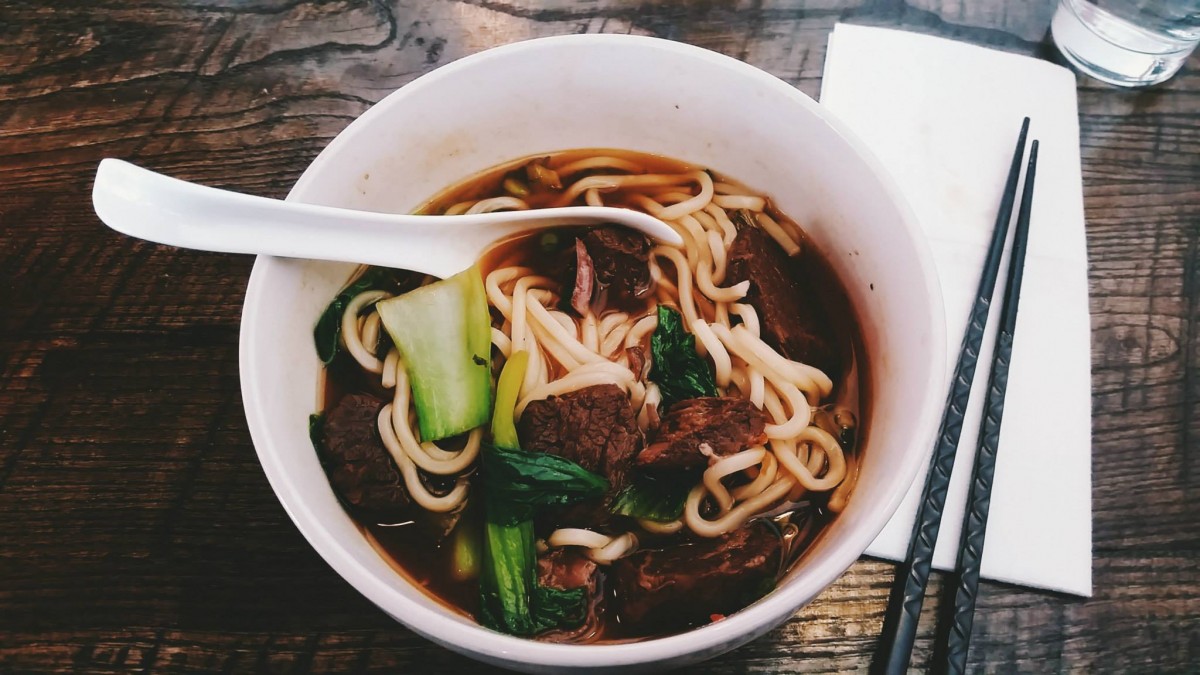
Noodles are omnipresent; people around the world enjoy noodles, and it is familiar. Noodles are also versatile; noodles can be served as a stir-fried family-sized dish, but also as an individual noodle soup. Beef noodle soup is the quintessential Taiwanese comfort food and widely considered to be Taiwan’s national dish. Each bowl has chunks of slow-cooked flank steak, noodles, veggies, and a rich broth.

Noodles set the tone for homely, comfort food. Similarly, Baos bring in resemblance to burgers. As an ethnic restaurant operating in the middle of metro-Atlanta, finding common ground with American culture is important. Ah-Ma’s top-selling ‘Dirty Bird Bao’ combines the southern element of fried chicken, mayo, and pickles with house-made Baos. Therefore, noodle at Ah-Ma’s is a gateway to the ethnic dishes, one that brings in familiarity to the American palate, but stays true to its roots.

While interviewing Andy, his food philosophy resonated with me. “Here, we focus on balancing the flavors. I think how one seasons the food is related to one’s lifestyle. Balance.” His answer was insightful and convincing — we are what we eat. Modern Taiwanese food melds indigenous and imported flavors strongly influenced by the food of mainland China and Japan but with a flavor identity all its own. Balancing the different layers of flavor is part of realizing Ah-Ma’s cultural DNA. Noodles are not seasoned strongly because it needs to be harmonious with the broth and beef. No single ingredient sticks out too much. Baos, similarly, are made in-house because Andy felt that outsourced Baos broke the balance of flavors. For Ah-Ma’s, balance is their secret of success. Serving both street food and classic home dishes, the harmony of dishes is essential. Noodles allow Ah-Ma’s to express the balance and harmony — from small eats to classic home dish, noodles act as a template to introduce all the different flavors. Noodle also represents memories tied to the mother country.

Andy expresses an identity arising out of his multi-ethnic upbringing; noodles are his Silk Road to interlocking culinary traditions while staying true to the roots. His restaurant in the middle of Atlanta is symbolic of one way in which Asian American identity can be found outside of highly racialized binaries. Because you know what,  who doesn’t love a bowl of ugly delicious noodles?

Noodles Narrative with Sandy Lin – Christina Chang

Noodles Narrative

Sandy Lin, a rising sophomore student at Emory, has been part of diverse cultures as a half-Taiwanese and half-Korean. Although she considers Seoul, South Korea to be her hometown, she has lived in several cities, including Nanjing, Shanghai, and Atlanta. Moving around from one place to another, Sandy has been part of myriad societies, cultures, histories, and food, especially noodles. I thought that interviewing Sandy would be a great idea since she can talk a lot about the differences that she sees in the cultural DNA and about the myriad types of noodles that she had first-handed experiences to.

Sandy has been part of both cultures, Korean and Chinese, in celebrating special occasions, and following traditions. Sandy and her parents, despite their ethnicity, grew up in South Korea, which also led them to celebrate both. For example, Sandy talked about the noodles that represent the longevity of individual’s life, mentioned in several class readings, and how she followed the Chinese tradition of eating them for birthdays and New Years. It was unprecedented and fascinating for me to hear it from Sandy that she follows this tradition as I have only encountered this in the readings. Comparing Korean noodles and Chinese noodles, Sandy believed that Chinese often had special occasions where they would have to eat specific noodles, as mentioned earlier, while for Koreans, noodles were mainly eaten on a daily basis regardless of occasions. The tastes are drastically different; jajangmeon is a dish that is present in both Korea and China. It is read as Jajangmeon in Korean while the Chinese call is Jajangmian; almost of the same pronunciation. Although they may look similar, they taste drastically different as the Chinese version is salty and meaty, while Korean version is sweet and more vegetable-based. As Sandy has experienced the myriad cultures, noodles, and traditions I believe that this led her to become the open-minded and multicultural individual that she is today.

There is plethora of countries that have special traditions regarding noodles. As observed from the similarities in Jajangmeon of Korea and China, the cultural DNA and noodles of China have had significant impact from Korea and vice versa. Such phenomenon arises largely due to the numerous invasions, wars, and trades that have been happening between two nations since millenniums ago. Through these encounters, cultural exchange also took place vibrantly leading to such culinary parallelism. Thousands of Korean independence activists during the Japanese occupation in early 20th century resided in China to remotely fight for Korea’s independence. Upon the end of Japanese occupation, they returned back home with much patriotism and various Chinese dishes which exist to now as “Koreanized Chinese dish”. Nevertheless, with her first-hand experience on both Korean and Chinese culinary culture, Sandy is indeed the living example of the historic noodles exchange who encompasses both Korean and Chinese cultural DNA. Seen in readings for class regarding regional differences in pasta for Italy that were due to the invasions from different countries, leading to the cultural changes in the regions, I believe that Sandy’s thoughts can be parallel to these occurrences.

To Sandy, noodles, in general for Chinese and Koreans, are a main sustenance and can represent most eating habits of Asians, along with rice. Regarding the dietary aspects of noodles, Sandy believes that noodles can be a balanced meal. Compared to rice, where it can just be eaten alone, Chinese noodles are mostly eaten with sides, such as vegetables and meat. These combinations can be seen to give you a balanced meal, as a bowl of noodles can give you the amount of nutrition that you would need. These sides that provide the healthy aspect in noodles can also be a factor of showing the socioeconomic class of individuals. For example, years ago, when noodles were even more common than rice, as rice was expensive, the sides would mostly be local and seasonal vegetables for lower socioeconomic class. As society started to change and China became more prosperous, there were different sides that came along with noodles, such as the noodles accompanied by shark fin soup, indicating a higher socioeconomic class. The noodles that were eaten in the past would have been a less balanced meal that those that are eaten today, served with difference sources of protein and fiber.

In the interview, Sandy mentioned that Lanzhou ramen is her favorite noodle dish. Lanzhou ramen has a sentimental value for her as it was a local dish that she ate with her friends when she was in school back in China. It holds a special place in her heart as there are countless memories with her friends grabbing lunch from the store. As she ate the same dish in Atlanta with the same friends whom she shared the bowls of Lanzhou ramen with back in her childhood, the tastes were similar to the ones that she ate back in China; yet, there were subtle differences due to the access of ingredients that were added to the ramen. Although she went with same group of friends to eat ramen that taste very similar, she prefers the noodles that were eaten when she was younger. I believe that this may be due to the atmosphere and accessibility of the noodles. The atmosphere of the noodles is completely different from a street vendor selling their specialty to a fine Americanized-Chinese restaurant with endless air-conditioning. As opposed to her childhood times when Lanzhou ramen was a to-go-to place for daily school lunch, she does not have the same accessibility here in Atlanta, leading to her differing perspectives on the noodles from China to United States.

After interviewing Sandy, I have received a lot of insight from a person who has been influenced by multiple cultures. Sandy’s cultural DNA is rather unique, which can be seen from her interview and experiences that she had until now. From her perspective, I learned about the similar but different cultural noodle distinctions of Chinese noodles in China, Korea, and United States. If given the opportunity, I hope to go and see the differences myself by trying Lanzhou ramen and jajangmian.

Interview Questions –

What is your name and how would you identify yourself ethnically?


Where have you lived? And where is your hometown?


How have the noodles been different in places you have lived?


When and how often did you eat noodles with your family?


Did your family cook noodles often? Is there a family traditional dish that y’all cook?


What does noodles mean to you?


How did noodles affect you culturally?


How do you think noodles affect your diet?


In China what do you think the role of noodles are?


How did the changes in the Chinese society reflect in the noodle dishes in China?


In the span of 20 years that you have been alive, do you think that there were changes in noodles? What do you think have caused these changes? Did these changes affect your diet?


What is your favorite noodle dish and why? Does it have a special meaning or place in your family?


What do you think about the Americanized Chinese noodles? Do you think they are represented well in America? Why or why not?


Do you think that other cultures have impacted the cultural DNA and the noodles itself? Why or why not?


Since you are half Chinese and half Korean, do you think that there are big differences in Chinese noodles and Korean noodles?


JaJangmeon is a Korean version of Chinese noodles. Is it a good representation of Chinese noodles? Why or why not?


If were you were to eat your favorite noodle dish that you mentioned before in China, Korea, and US, how different would they be?


https://www.youtube.com/watch?v=WgCe6AdEV_0&feature=youtu.be


Willi Freire’s Individual Project: Uncovering a Whole New Fresh Perspective with Giuseppe

Giuseppe Derubertis Interview

I had the absolute pleasure of interviewing Giuseppe Derubertis, a renowned, retired chef, who specializes in Italian and French cuisine. Giuseppe is an Italian himself, born in Campobasso, then migrating to Montreal, Canada, where he completed his culinary education at Académie Culinaire. He described Italian cuisine as highly optical, in which he was able to translate over when mastering French cuisine, since it is not as optical as Italian dishes. Throughout his career, Giuseppe describes his yearning to absorb the riches of each cuisine as its own entity—avoiding meshing cuisines as one. He has worked in the Grand Cayman, Bermuda, Mexico and has even served diplomats in China. However, Giuseppe emphasizes how his occupations gave him “an eye to the world, while opening conversation.” I found this statement extremely powerful because it clearly conveys just how many doors food can open for humans allowing them to piece their personalized definition of the world.

Moreover, he proceeds to claim that food is a common foundation for everyone, despite demographics; thus, throughout his journey, he attempted to “understand everyone’s food.” He gave a beautiful example of what he meant by understanding a certain group’s food: He characterizes Italy as a country of many distinct tastes and nuanced versions of pasta. While the base remains the same, the Northern part of Italy tends to be a bit more adventurous with their pasta sauces in comparison to central Italy for instance, which prioritizes simplicity across the board when making sauces to complement their pasta. By understanding everyone’s native quirks and remaining open-minded, Giuseppe stresses how he was so immersed in his cooking experiences across Italy that he picked up each region’s respective dialect. Deepening his relationship with each culture allowed him to further enhance his exposure and refine his cooking accordingly—ultimately reaching new heights. Hence, Giuseppe characterizes Italian-American food as sauce-heavy, but he was very careful in emphasizing that it does not signify a bad thing—one slogan he referenced is “to each their own.” I found this incredibly telling of how Giuseppe is keen on never pointing fingers and being as open as possible when examining and learning other styles of food, even when they are clearly “inspired by other cuisines.” It is this mentality that Giuseppe instilled in himself, allowing him to fully prosper as a chef in America.

Naturally, Giuseppe highlighted some important differences between Italian cuisine and Italian-American cuisine. Throughout the course, we’ve emphasized synergies and distinctions amongst cuisines, no matter how related or unrelated. Giuseppe pointed out that many restaurants in Italy and across Europe have daily crafted menus. He emphasized how clearly this corresponds to freshness of food. From his own proper experience, he worked at restaurants with 50+ items on the menu. He attests that as one might think these restaurants don’t typically have the capacity and capital to serve fresh food. Giuseppe says, “the costs are just too high […] it simply does not make sense.” So, Giuseppe says it’s common to find restaurants in Europe with a “menu du jour,” containing about 4-5 appetizers, 2-3 entrée plaits, and 5-6 main dishes. He then stated that pasta dishes usually are part of the “entrée plaits” section. Pasta in Italy is usually not consumed as a main dish, but rather, a “dish in between dishes.” This solidified an important concept for me: One must reconsider the way they examine dishes across cultures— of course, there are many similarities between Italian-inspired dishes here in the U.S., but there are also many nuances across the purpose of these different dishes. While in the U.S. the purpose is for the pasta dish to be served as a main dish in adapted quantity, style and overall composition, in Italy pasta dishes may often follow specific weight guidelines and are usually intended to transition between the appetizer and the main course. How astonishing is it to be able to comprehend how these nuances add a whole another layer of contrast?

Moving on to homemade pasta, Giuseppe and I shared the discussion we had in class regarding the prominence of homemade pasta between Italians and Italian-Americans. I mentioned to him our dilemma pertaining to whom homemade pasta is a must in terms of making pasta. Though Giuseppe certainly agreed that many Italian-Americans hope to reconnect with their culture and traditions by making pasta from scratch, he wholeheartedly did not endorse the thought that Italians as a group are shifting away from homemade pasta. He claimed: Though many hub cities like “Milano e Roma” are undoubtedly deprioritizing homemade pasta, the countryside does not follow this trend. As soon as one hits the exterior, they will come across “pride.” Giuseppe boldly exclaims that “pride is homemade” and that the countryside and many families in rural areas refuse to ever compromise their pride, alluding to the connection between homemade pasta and pride. I found this particularly strong because I myself have only seen Italian pasta through the lenses of tourists, which often seem to reflect urban-like restaurants with many options, oftentimes in the very well-known cities. Furthermore, he described the little towns as places where “old lad[ies] are still cooking,” essentially, he means that the values of the countryside still remain, despite the ever changing nature of Italian cuisine as a whole. After this conversation, I am beyond inspired to study this dynamic more closely. What are the tensions between developed cities in Italia versus the countryside? Are there any substantial implications on Italian culture overall from “rapid Americanization” in central metropolitan cities?

Lastly, I wanted to conclude by sharing some pieces of miscellaneous tidbits that Giuseppe so kindly included during our interview. First, he commented on his grandmother’s traditional cooking and the fact that “from nothing she can make a meal.” He claims that her homemade tomato sauce is exceptional and easy to digest because it is made with a food mill. I love how he mentioned digestion, as this was a common theme we came across when studying Italian culture. To further leverage class concepts, Giuseppe also mentioned the difficulty in replicating certain dishes when temperatures are different and the environment in which these dishes are created tend to always be quite distinct. Interestingly enough, he added that there is some grey zone between this concept nowadays because of the liberalization of trade and the boom in the exporting industry. I found this to be a very impactful perspective because from one point of view there is a lot more interconnectivity in today’s times, but I wonder to what extent this connectivity actually translates to more synonymous dishes across borders? I personally hypothesize that there are still inherent limitations because many intricacies cannot be transported over because of the cultural element that is often jeopardized across borders. Whether it be the lack of language or a vital component that is not written or outlined in a recipe, these are some of the nuances I suspect are worthy of consideration. Additionally, Giuseppe contrasted Alfredo sauce versus rosé sauce, which are both considered lighter sauces. Rosé sauce in Italy is actually not made of cream, but simply butter fat and Romano cheese; whereas, in the U.S., cream is used and blended with parmesan to yield the typical, American white sauce. Lastly, he reiterated several times that semolina is the magic wonder behind great pasta.

Thus, I have learned wonders throughout this hour long interview with Giuseppe Derubertis. Overall, Giuseppe considers himself a pasta chef, who has surpassed the threshold in truly comprehending the rich complexities of the noodle. To conclude, I finish off with a paraphrased thought by him: Politics, journalism and now, food are all mixed, and thus, the original foundation is hard to find anymore—“unmask the beautiful product.”

Thank you,

Willi Freire

Noodle Narrative-Ruiyue Hong


The person I interviewed is the chef in Bank of China, Shanghai. I chose to interview him because he has always been the chef in my mom’s company. I remembered when I was young, whenever I was early from school or during the summer vacation, I would go to my mom’s office and went to have lunch in their cafeteria. In my memory, the food in their company was really diverse and delicious. There are all kinds of staple dishes like noodles, rice, fried rice with eggs and dumplings etc. Moreover, their chef always surprised me with his variety of dishes. For example, there are crab powder with Toufu(蟹粉豆腐), Shanghainese smoked fish(熏鱼), Borscht(罗宋汤) and Shanghai bok choy etc. When it’s in the right season, they would also provide the employees with crayfishes, and steamed crabs. In additions to these dishes, their cafeteria also had great dessert, including fried rice patties(粢饭糕), Radish crisp cake(萝卜酥)and egg tarts(蛋挞). Without doubt, my mom’s cafeteria was the dining place that brought me up. I had a strong affection towards their cafeteria as well as their chef who cooked all these wonderful meals. Therefore, i thought this interview provides me with a great opportunity to actually meet with the chef whom I enjoyed his cooking from a little child and ask him questions about cooking.


In our interview, he mentioned that he is born and raised in Shanghai, China. He has been the chef for Bank of China for almost twenty years. He mainly chose to become a chef because of his father’s opinion. At that time, it was around 1980s. China has just opened its door towards foreign companies and embraced the idea of market economy. Tour guide, chef and hotel managers are all popular for people who did not manage to go into universities. Among these careers, he chose to become a chef because Chinese culture values eating a lot and Chinese people could not live without food. Therefore, he became a chef and got a relatively high salary compared to other workers at that time. He told me that after he became a chef, he learned to cook a lot of different dishes. Among these, his best dishes are shredded pork with fish flavor(鱼香肉丝), Kung Pao Chicken(宫保鸡丁), Stir fry shrimps and crab powder with Toufu (蟹粉豆腐) too. When I asked him about his relationship with Chinese noodle, he told me that his most unforgettable noodle was Yibing burning noodles(宜宾燃面). When he was young, his friend had a bet with him about whether the burning noodles could actually burn. He took the bet without hesitation because he believed it was impossible for a person to set the noodles on fire. However, he lost the bet because that night, his friend took him to a restaurant and the Yibing noodles did burn amazingly. After he consulted with the chef, he learned that the Yibing burning noodle had a secret in cooking that is the chef need to put less water while cooking. Therefore, when it was served on the table, it could be set on fire immediately and tasted stretchy and spicy. From Yibing burning noodles, he saw the diversity of Chinese culture because before the burning noodle, he would never know that Chinese had so many cooking styles for noodles. Yibing noodles opened his horizon and made him marveled at Chinese knowledge in cooking. Moreover, he taught me his little tricks of cooking noodles. He would normally prepare a delicious soup that might get from chicken soup or pork bone soup. Then he would cook the noodles with lots of water and wash it in cold water twice. He told me that only in this way, the noodles would be stretchy and smooth.


When I asked him about the meaning of noodles in his mind, he answered this question with a saying in China that goes “Eat dumplings for returning home and eat noodles for going away from home.” Therefore, this person could remember that his family member missed him as always. From this quote, people could see that noodles in China is not just a food. It has lots of culture aspects inside of it. It may contain a person’s love and wishes in noodles.


At last, I asked him to compare the difference of Shanghai noodles he had in childhood and the noodles he had nowadays. He told me that the noodles he had in childhood was rather plain. There were not much ingredients inside. There was no meat of vegetables because at that time, China was lacking food. There were not such variety of foods for citizens. However, with the development of China, people had more and more to eat. And Shanghai experienced a lot of western influence on food too. Therefore, the taste of noodles in Shanghai is different nowadays, and the ingredients people put in noodles are different too. For example, people will add shrimps, tomatoes, pepper and beef into the noodle so that the noodles are more nutritious and more diverse. Thus, from the development of noodles, people could discover how China have grown over the twenty years. Moreover, it also reflected Shanghai’s inclusive culture because it can combine both the western and Chinese influence on food into one dish. In addition, although the difference in noodles is notable, people still preserve the basic routine of cooking noodles. For example, people would also add scallions into the noodles and always use cold water to wash noodles. Therefore, Chinese people would feel the combination of culture, tradition and innovation in the society within in one noodle dish.

Interview Questions:

  1. Hi,Could you introduce yourself, including your relationship with food?
  2. Why did you choose to become a chef?
  3.  What are some of your best dishes?
  4. Could you describe the most memorable story with you and noodles?
  5. How many different kinds of noodle can you cook?
  6. How would you normally cook noodles?
  7. To you, what are the meanings of noodles?
  8. Do you think there is a big difference between the noodles you had in childhood and the noodles you have nowadays?
  9. What are aspects of Chinese culture you can see from noodles?
  10. What do you think is the essence of Chinese food and Shanghainese food?

And here is my youtube video for my interview


Interview Project_Jeeyoung Kim

I interviewed my friend Christine Leung, who is a Chinese. I met her sophomore year at my high school in Tacoma, Washington. My high school was a boarding school with the proportion of international students from all over the world. Among those students from different parts of the globe, I always thought Christine was the most multicultural and special person because she recognizes and embraces different cultures because she lived in various places such as Chengdu, Hong Kong, Tacoma, and now in California. Also, she is particularly interested in food. She used to cook at night before studying, and we would eat noodles together after school in my room. She is currently a rising sophomore studying nutrition science at UC Davis. In that regard, I thought she would be the best fit for my interview since she has multicultural perspective and passion for food. The goal of this interview is to show the importance of noodle in her culture and family.

Christine was born in Hong Kong and raised in Hong Kong. She also moved to Chengdu, China. Later, Christine decided to study in the United States for her high school education, so she moved to Tacoma, Washington in her sophomore year. Counting a year at UC Davis, she has been living in the United States for four years. She spends most of the year in California but goes back to China during winter break and summer break to spend time with her family.  Though she spent her childhood in different places, Christine defines herself and culture as Chinese, and especially collectivistic culture of China is strongly associated with her.  From her experience, she stated that her culture is different from western culture, which, in her words, is more individualistic.  For instance, in China, families including grandparents, parents, and siblings will often all live together in a house or the same community, but in western culture, the form of family is often a nuclear family.

As we discussed during class and read from the reading assignment, regarding Christine’s culture, noodle represents longevity. Typically, on birthday, a person would get a bowl of one strand of noodle, which its length is a symbol of how long the person would live. Also, noodle reflects the diversity in China.  As China has many ethnic groups, every noodle has different flavors.  Among the types of noddle she explained, the sweet noodle was interesting to me because usually sweetness is related to desert and noodle is the main dish.  I was fascinated that two different elements would harmoniously merge to create one dish.

Christine did not like noodles as much as rice when she was young because her first impression of noodle was spicy. As long as she remembers, the first noodle she had was in elementary school years with her grandparents.  The first noodle she had was called Su Jiao Jia Jiang Mian, noodles with spicy pepper and spicy pork. Since her grandparents are from Chengdu, a city known for spiciness and numbing flavor, the noodle she tried was too spicy that she could not enjoy as a child.  However, after studying abroad, she often misses the spiciness and the noodle because the noodle reminds her of home.

The diverse culture of China is represented through Christine’s dinner table. Since Christine’s family is from both Chengdu and China, she would have both Cantonese style light dishes and Szechuan style spicy dish at the same time.  Also, when her family eats noodle, her parents will have chewy and hard noodle while Christine will have soft noodles.  Her family thinks the texture of the noodle is an essential part of experiencing and tasting noodles. Therefore, though they share the same soup and sauce, her mom will boil Christine’s noodle for a longer time.

Moreover, the diverse culture of China is displayed in Hong Kong. Hong Kong is a special place with a combination of both traditional Chinese culture and western culture, and such aspects are reflected on the noodle. In Hong Kong, breakfast called pasta with spam and egg is favorite menu today.  This dish is an Italian pasta cooked in Chinese style. As a student who studies both Italian and Chinese noodle, I found it interesting because they are two different styles of noodle but merged into one dish.

Not only in China, but Chinese food and noodle are also popular all around the world, so I asked her opinion about Chinese dish sold in other counties. She thinks that Cantonese restaurants in the United States usually taste similar to the one in Hong Kong, but the Szechuan dish sold in the United States tastes different from the ones in Chengdu. She thinks that the Szechuan food is too spicy that it is adjusted to the local people’s palate. Moreover, I asked her opinion about the modified version of Chinese food such as Orange Chicken and Black noodles in Korea. She does not consider them Chinese food.  Though they are called Chinese food, she thinks Black noodles and Orange Chicken is part of the United States and Korean culture.

Christine believes that the crucial value in food and noodles is health and unforgettable memories.  The main reason why she is studying nutrition science at UC Davis is her firm belief in a healthy diet.  She thinks that balanced diet can cure disease such as cancer. She also mentioned that the time she misses her family and home the most is during Chinese New Year and the moment shared food with her family to celebrate. Though she cannot celebrate Chinese holidays such as Chinese New Year with her family at home since it is during a school year, she would still go to Chinese restaurant in the United States with her friends to celebrate.  The food during such holiday is a comfort for her.

At the end of the interview, I asked her to define noodles in three words. She answered that noodle means culture, family, and diversity to her. I also think the way she feels and this is why I wanted to interview her. As international students and who lived far away from family for a significant time, the food is a memory of love, myself and variety.  Through this interview, I wanted to show how meaningful and representative of one’s culture and life.

Noodle Narrative of the Owner of Youda Noodle Restaurant (Qiulun Li)

Introduction

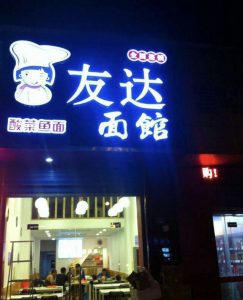
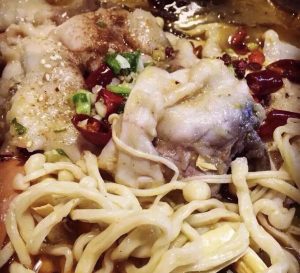
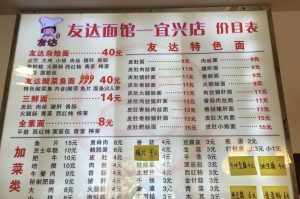
In recent years, I notice that there is a very popular restaurant called Youda Noodle Restaurant in my hometown– Yixing, and people have to wait for over one hour on weekends at lunch time to get noodles there. This noodle restaurant is famous for noodles in pickled cabbage and fish pot, which is a novel noodle dish I never had before. Pickled cabbage and fish pot is a Chongqing style dish and it has been popular in China since 1990s. The main ingredients for this dish is grass carp and pickled cabbage. When they are stewed together, the dish has both spicy and sour flavors. It is a dish people normally have for lunch or dinner and it hardly has any relation to noodles. I immediately got interested in this noodle dish when I first heard it, and I was also very curious how would such a new combination taste. Therefore, I decided to interview the owner of Youda Noodle Restaurant.

Youda Noodle Restaurant is a chain noodle restaurant in China and my interviewee – Miss Luo – opened this restaurant in Yixing in early 2013. In her mind, noodle is very significant in Chinese culture, and noodles in different areas manifest the local culture. The noodle she had most often is Jiangsu style noodle and it could remind her the taste of home every time she had it. Noodles influence her culturally in the way that she gets more familiar with the local culture. Miss Luo found the combination of fish pot and noodles is very innovative and she believed that such a noodle restaurant would be lucrative. Therefore, she decided to join Youda chain Noodle Restaurant and open the first one in Yixing. During the interview, she introduced the noodle in pickled cabbage and fish pot in details and compared it to traditional Jiangsu style noodles. The noodle itself has no difference from traditional noodles – noodles immersed in soda water used in both. The only difference is that pickled cabbage and fish pot will never be a side dish in traditional Jiangsu style noodle. Traditionally, people in Jiangsu Province have noodles for breakfast or as a staple food supplemented with other dishes for dinner. A bowl of noodle in pickled cabbage and fish pot is too much for breakfast and too less for dinner.

Influence of Social Changes on Noodle Dishes and Dietary Habits

The noodles in pickled cabbage and fish pot is a fusion of Chongqing style dish and Jiangsu style noodles, and this noodle dish itself manifest the influences of social changes in China on noodle dishes. The first Youda noodle restaurant is opened in Nanjing, while the interesting fact is that pickled cabbage and fish pot is not a typical Jiangsu style dish but a famous dish in Chongqing, which is a city 1500 miles away from Nanjing. The spread of food dish over such a long distance is the result of modern technology. Due to the advanced public transportation in China such as the high-speed railway, people are able to move around and there is an increase in the immigration population. As the result of the increase population mobilization, food, as a carrier of local culture, spread to other areas over time.

Besides, people’s diet also changes with respect to social changes. Initially, Miss Luo changed the recipe of the noodle in pickled cabbage and fish pot according to the local cuisine in Yixing. Little or no pepper is used in the local cuisine and local people favor the sweet flavor. Therefore, Miss Luo made her noodle dish less spicy than the original taste and add more sugar. In recent years, as the Sichuan and Chongqing style food gets highly popular in Yixing, people get used to the spicy taste and find it more delicious than plain food. As a result, Miss Luo altered the recipe again and added more pepper and spice this time. In all, social changes in China, especially the advancement of modern technology, change people’s diet and lead to alters in the noodle dish recipe.

Immersion of Other cultures into the Noodles

The modern technology makes communication possible oversea and globalization is an unavoidable trend. Thus, people have more opportunities to keep in touch with other cultures, and noodles in pickled cabbage and fish pot is influenced by them.  No matter where noodles come from, the side dish people can add to noodles are similar across the country, such as ribs, animals’ some internal organs and vegetables. Despite these traditional side dishes, some food from other cultures, such as bacon, luncheon meat and rice cake with cheese, can also be added to noodles in Youda Noodle Restaurant. After people get more touch with other cultures, they have wider range for food choice and there is a change in their diet. Miss Luo figured out a way to integrate food from other cultures into noodles she served. She expanded the range of side dishes and people now can have exotic food such as bacon in their noodles. She believed that there is no conflict between Chinese culture and other cultures. While we maintain the Chinese culture, we can still learn and absorb some useful points from other cultures.

Conclusion

In a conclusion, noodle as a carrier of local culture in China is very significant to my interviewee – Miss Luo. Noodles could remind her of the taste of home and help her be more familiar with local culture. She serves a special noodle dish in her restaurant, which is a fusion of different cuisine. This noodle dish itself could show how social changes influence noodles. Also, changes in its recipe over time manifest the influence of social changes in people’s diet. At last, Miss Luo integrates other cultures into her noodles under the trend of globalization.

Interview Questions:

Q1: What’s your name, age, occupation, hometown and education experience?

Q2: Why would you like to serve this kind of noodle in your restaurant?

Q3: What do you think is the traditional Chinese noodle and what is the cultural significance of noodles in China? How do noodles influence you culturally?

Q4: Could you please introduce what kind of noodle you serve in your restaurant?

Q5: What are some differences between traditional Chinese noodles and noodles your serve?

Q6: Actually, there are many noodle restaurants serving noodles in pickled cabbage and fish pot. What makes the noodle in your restaurant different from others?

Q7: How has people’s dietary habit changed since you opened the restaurant, and how did you change your noodles to cater to people’s dietary habit?

Q8:  In your opinion, what’s the key factor of American food, and how does it different from Chinese food?

Q9: How is western culture manifested in your noodles?

Q10: How do you think about the question whether restaurants should cook noodles in traditional Chinese style or make noodles Americanized?


Summons of family

Oh son, come back! Don’t go out for fun all day.

All the chopsticks are on the table, your favorite food is ready.

Flour and starch, all rolled to long strip.

Salty, hot and spicy: this is your fave.

Sirloin boiled soft and juicy.

Shallot piece floating on the soup homemade.

Sliced white radish tangled with white noodles.

Chili oil served on the side.

Your mom and dad sitting face to face, your pet waiting by the side.

Here is your favorite noodles, and here is your warm home.


I choose The Summons of the Soul to imitate. I choose this piece to imitate because the name of the poetry makes me think of my family. I was studying aboard for the most part of the year now. I only stay at home for vacations. When I went back to China, I often went out and spend time with my friends. Every time my mom would ask me if I would have dinner at home. If I said yes, they would prepare dinner for me. Sometimes they will make my favorite Beef soup noodles for me. However, I would often have dinner with my friends at restaurants. My parents will be disappointed if I said no. They want to have dinner with me. Sometimes I feel sorry for that, I should have spent more time with them. When I was imitating Qu Yuan’s poetry, I realized there are some unique things about the culture. 招魂,summons of the souls, is a Chinese traditions. In the past, Chinese believe that people have soul. If people did not died at hometown, their relatives should summon their souls back in order to rest in peace. In my culture, parents will expect children to come back home to have dinner together. Having dinner together is regard as an important family activity to get the whole family a chance to sit down, chat and enjoy the dinner. In Chinese culture, 家, which means family, is very important. A harmony family is regarded as the fundamental for everything else. There is a proverb, 家和万事兴,means that if you have a harmony family, everything will be prosperous.  Qu Yuan embedded some unique Chinese food in the peom. In China, tortoise is served as a kind of delicious food, and he also mention soup of Wu, 吴羹, in his peom.  While I mentioned chopsticks, the Chinese tableware used most commonly. Also, in Chinese peoms, writer tend to use the same sentence pattern. Qu Yuan use lots of repeated patterns, and I used repeated patterns to imitate his peom.