Craig Perry (PhD, ’14) Publishes ‘Slavery and the Jews of Medieval Egypt: A History’


Doctoral program alumnus Dr. Craig Perry has published his first monograph, Slavery and the Jews of Medieval Egypt: A History, with Princeton University Press. Perry’s book reconstructs the social history of slavery in Cairo at a pivotal period in the city’s history, showing how the slave trade and slavery shaped everyday life, state diplomacy, and the formation Jewish and Arab-Islamic culture.

Dr. Arnold Franklin, Associate Professor at Queens College, City University of New York, describes Perry’s book as “a major contribution to historians’ understanding of one of the most pervasive and consequential institutions in the medieval Islamic world.” David Eltis, Robert W. Woodruff Professor Emeritus at Emory, describes the work as “a brilliant reconstruction of slavery and slaveowners in the Jewish community of medieval Cairo drawing on the vast but highly fragmentary records of a synagogue.”

Perry received his doctorate in 2014. He is assistant professor in the Middle Eastern and South Asian Studies Department at Emory. Read the full abstract of Slavery and the Jews of Medieval Egypt below and find more on the Princeton UP book page.

In this book, Craig Perry mines a remarkable cache of fragmentary documents preserved in an Egyptian synagogue to write a new history of slavery and the slave trade in the medieval Middle East. These documents—which range from the everyday correspondence of traveling merchants to legal queries sent to Jewish jurists—provide the richest surviving archive for the social history of slavery during the centuries when Cairo was an imperial and commercial capital at the intersection of the Mediterranean and Indian Ocean worlds. Perry draws on this archive, known as the Cairo Geniza, to shed new light on such crucial topics as the slave trade in state diplomacy, the entanglements of gender and household slavery, and the lives of the enslaved.

Perry chronicles a protean slave trade that trafficked enslaved people from Europe, Africa, and India to the Egyptian market. His account cuts across different scales of analysis, from the macro-level of imperial rule to the micro-level of the family kitchen. Along the way, he upends the traditional story of Passover; medieval Jews, he writes, could explain slavery to their children by pointing to the enslaved people who served the holiday meal. When freed, some former slaves converted to Judaism and became the parents of Jewish children. Perry’s narrative reveals a world, long hidden from historians, in which enslaved people made their way through the alleys of Cairo, toiled in the workshops of apothecaries, and found ways to evade the surveillance of their owners. With this book, Perry writes enslaved people into the social and economic life of medieval Islamic society.

Camille Goldmon (PhD, ’22) Publishes ‘Black HiSTORIES’ Series on TikTok and IG


Dr. Camille Goldmon (PhD, ’22), Assistant Professor at the University of North Carolina, is publishing a series of stories on Instagram and TikTok for Black History Month. Titled “Black HiSTORIES,” the series broaches topics ranging from early efforts by Carter G. Woodson to celebrate Black history to the lives and work of seminal figures like Ida B. Wells-Barnett and Fannie Lou Hamer.

Goldmon’s research centers on twentieth-century United States history, Southern history, and agrarianism. She completed her dissertation, “On the Right Side of Radicalism: African American Farmers, Tuskegee Institute, and Agrarian Radicalism in the Alabama Black Belt, 1881–1940,” in 2022 under the advisement of Dr. Carol Anderson.

Find the series via her handle camigoldmon on Instagram and TikTok.

Claudia Kreklau (PhD, ’18) Publishes ‘The Making of Modern Eating’


Dr. Claudia Kreklau, an alumnus of the Emory history doctoral program, has published The Making of Modern Eating: How the German Middle Class Forged the Way We Eat, 1780-1910 with Berghahn Books. In this, her first monograph, Kreklau traces the origins of modern foodways and culinary practices in central Europe in the nineteenth century and explores how an array of individuals expressed self-understandings through food.

Jim Brophy, Francis H. Squire Professor of History at the University of Delaware, describes The Making of Modern Eating as “a tour de force that promises to be a field-defining work.” Kreklau, he continues, is “a historian with a capacious and bold historical imagination…a rising star in our field.”

Kreklau is Honorary Lecturer in Modern European History at the University of St Andrews, and she is the three-time prize-winning author of seven academic articles. She completed her PhD in 2018 under the advisement of Dr. Brian Vick.

Wiggins’s ‘Black Excellence’ Named Finalist for AAIHS’s Pauli Murray Prize


The African-American Intellectual History Society has named the finalists for its annual Pauli Murray Book Prize, and Dr. Danielle Wiggins (PhD, ’18) was short-listed for her newly-published monograph Black Excellence: Atlanta and the Making of Modern Black Liberalism (University of Pennsylvania Press, 2025). Named for pioneering lawyer, scholar, activist, and theorist Pauli Murray, the prize recognizes the best book concerning Black intellectual history published in the preceding year.

Described as a “provocative new history of modern black liberalism,” Black Excellence has already received notable praise. For instance, George Derek Musgrove, co-author of Chocolate City: A History of Race and Democracy in the Nation’s Capital, writes: “Beautifully written and wonderfully insightful, Black Excellence is a must read for anyone who wants to understand both the liberatory and disciplinary history of black liberalism in the post–civil rights era.”

Wiggins is Assistant Professor of History at Georgetown University. She completed under doctoral work under the advisement of Dr. Joe Crespino, Jimmy Carter Professor of History and Interim Dean of Emory College of Arts & Sciences.

Read the abstract of Black Excellence below, and learn more about the other nominees for the 2026 Murray prize.

Black Excellence offers a provocative new history of modern black liberalism by situating the seemingly conservative tendencies of black elected officials in the post–civil rights era within neoliberal American politics and an enduring black liberal tradition.

In the 1970s and ’80s, cities across the country elected black mayors for the first time. Just as these officials gained political power, however, their cities felt the full brunt of white flight and deindustrialization. Tasked with governing cities in crisis, black political leaders responded in seemingly conservative ways to the social problems that austerity worsened. Nowhere was this response more evident than in Atlanta. In the nation’s preeminent black urban regime, black leaders such as mayors Maynard Jackson and Andrew Young employed the power of policing and the private sector to discipline black Atlantans, hoping they would equip vulnerable communities with the tools to manage the volatility of the era.

Danielle Wiggins shows that these punitive responses to the problems of crime, family instability, and unemployment were informed by black liberalism’s disciplinary impulse: an enduring tendency to reform behaviors believed to threaten black survival in a white supremacist nation. Forged in response to the violence of Jim Crow, the disciplinary impulse relied upon notions of pathology and its inverse, black excellence. Wiggins identifies several black liberal efforts to cultivate excellent black communities, families, and workers in the post–civil rights era, including community policing, corporate-sponsored family initiatives, and black entrepreneurship.

In embracing disciplinary strategies, however, black liberals often focused on behavior at the expense of addressing structural inequality. Consequently, their approaches dovetailed with those of the “New” Democrats, whose post–Great Society social policies were informed by urban black liberals. 
Black Excellence reveals thus how urban black liberals not only reshaped black politics but, as Democrats, also helped build the neoliberal Democratic Party.

History Alumni Evans and Kim Featured in Emory’s 40 Under Forty

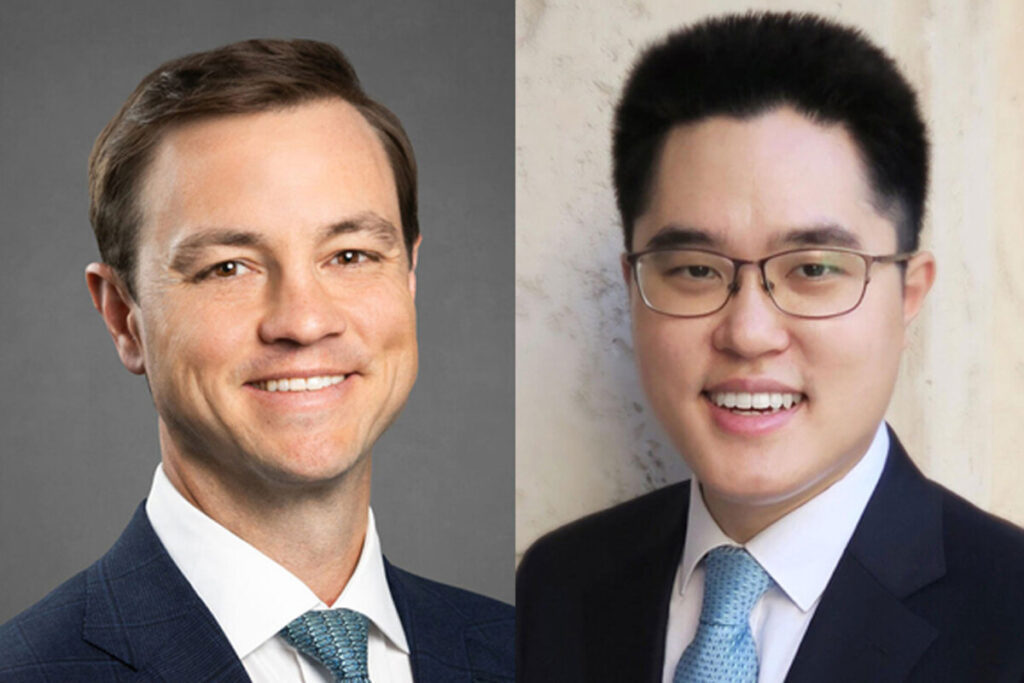
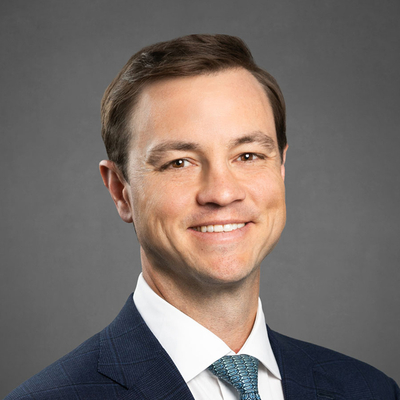
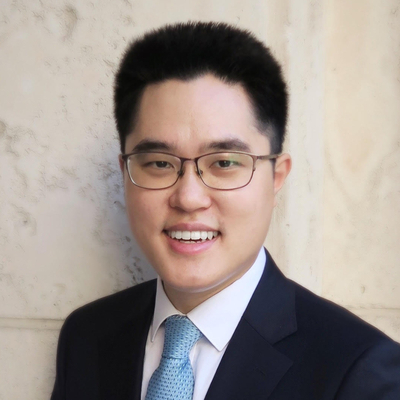
Each year Emory’s 40 Under Forty program features a group of innovative alumni creating positive change throughout the world. The 2025 cohort includes two former history majors doing remarkable work in business, law, and academia: Jeremy Evans (09C) and Matthew Kim (10C, 10G).

Read profiles of Evans and Kim published by the Emory 40 Under Forty program below, and browse all the members of this year’s outstanding cohort.


Jeremy Evans 09C is a partner in the Financial Restructuring Group at Paul Hastings LLP, where he advises some of the world’s largest asset managers and hedge funds. He structures complex financing transactions and restructurings across industries and asset classes, approaching challenging situations with creativity and strategic insight to achieve successful outcomes for his clients. Evans studied history and religion and was deeply engaged in campus life.

Read more


A student-athlete, he was a four-year member and three-year captain of the Men’s Golf Team, served on the Varsity Athletic Committee, and was recognized as a Georgia Collegiate Athletic Association All-America Scholar Athlete and University Athletic Association All-Academic honoree. He went on to earn a law degree, graduating magna cum laude from the University of Miami School of Law.

Jeremy has been recognized as a New York Metro Super Lawyers Rising Star, named to the Best Lawyers Ones to Watch list, and honored with the Turnarounds and Workouts “Outstanding Young Restructuring Lawyers” award in 2024. 

His time at Emory instilled in him the discipline, perspective, and drive that continue to guide his professional and personal success.


Matthew Kim (10C 10G) is an assistant professor at the University of Florida Levin College of Law, where he combines his passions for research, teaching, and public service to shape the development of the law. His scholarship, which focuses on criminal law and civil procedure, has appeared in leading law reviews, including The Ohio State Law JournalFlorida Law Review, and Texas A&M Law Review.

Read more


His academic journey began at Emory College, where he majored in international studies and history, building a strong foundation that informed his graduate and professional studies in law, international relations, political science, and statistics.

Through his teaching and research, Kim continues to explore complex legal questions while mentoring a new generation of lawyers and scholars.

Emory Magazine Features Pulitzer-Winning ‘COMBEE’ by Fields-Black


Emory Magazine has published a feature of Dr. Edda L. Fields-Black’s most recent book, COMBEE: Harriet Tubman, the Combahee River Raid, and Black Freedom During the Civil War. The book won the 2025 Pulitzer Prize in History and the Gilder Lehrman Lincoln Prize and was a finalist for the James Rawley Prize from the Organization of American Historians. COMBEE offers the first detailed account of the dramatic campaign to free nearly 800 enslaved people led by Harriet Tubman on the Combahee River in South Carolina in 1863. Fields-Black is herself a descendant of one of the participants in the raid.

Read more about COMBEE and Fields-Black’s extraordinary and varied work, along with the feature in Emory Magazine: “The Civil War Raid That History Almost Forgot.”

Fields-Black received her undergraduate degree in history and English from Emory and her PhD from the University of Pennsylvania. She is Professor of History at Carnegie Mellon University.

Students Win Departamental Clio Prizes for Historical Research


The History Department annually awards its Clio Prizes to the best paper in a Freshman History Seminar and the best research paper in a junior or senior History Colloquium. This year, we are pleased to recognize outstanding work by Emma Rose Ceklosky and William Wainwright.

Ceklosky received the prize for the best paper written in a freshman seminar for her work, “From Exotic Blossoms to Budding Women in Science.” Ceklosky completed this paper in Dr. Judith Miller`s spring 2025 freshman seminar “The World of Jane Austen.” About the course, she writes: “I loved the stories I discovered about horticulture and how it empowered 19th-century women. Dr. Miller’s class brought history to life for me. I recommend her to everyone and am honored that she nominated me for this prize.” Ceklosky plans to double-major in English and Creative Writing and Psychology.

Spring 2025 graduate William Wainwright received the prize for the best research paper written in a history junior/senior colloquium for his work “Recentering the Black Sea,” which he completed in Dr. Michelle Armstrong-Partida`s course “Europe: Merchants-Pirates and the Slave Trade.” Wainwright graduated summa cum laude with a BA in International Relations (highest honors) and History in the spring 2025. Reflecting on the prize and his experience as a major, he writes: “Thank you so much for this. I am honored and grateful to receive this prize. The Emory history department, and Dr. Armstrong-Partida’s class in particular, have been hugely important for my academic development. I look forward to continuing to stay in touch with the professors and staff who have made it possible. Thank you again.”

Christopher Snyder (PhD, ’94) Named William L. Giles Distinguished Professor at MSU

MSU President Mark E. Keenum is pictured with William L. Giles Distinguished Professor Christopher Snyder, center, and MSU Provost and Executive Vice President David Shaw. PHOTO: Emily Grace McCall | MSU Public Affairs

Dr. Christopher Snyder, a 1994 graduate of the Emory History doctoral program with a concentration in medieval history, has been named a William L. Giles Distinguished Professor at Mississippi State University. The Giles professorships award outstanding research, teaching, and service and are among the highest honors given to faculty at MSU.

Snyder is a professor of history and director of British studies in the Judy and Bobby Shackouls Honors College at MSU, where he served as the college’s founding dean. He has authored ten books and numerous articles in the fields of archaeology, history, literary criticism, ethics, and medieval studies. His most recent book is Hobbit Virtues: Rediscovering Virtue Ethics through J.R.R. Tolkien’s The Hobbit and Lord of the Rings (New York and London: Pegasus/ Simon & Schuster, 2020).

Snyder’s graduate work at Emory was advised by Tom Burns and Steve White.

Danielle Wiggins (PhD, ’18) Publishes ‘Black Excellence: Atlanta and the Making of Modern Black Liberalism’


Dr. Danielle Wiggins, a 2018 graduate of the U.S. History doctoral program, has published her first monograph: Black Excellence: Atlanta and the Making of Modern Black Liberalism (University of Pennsylvania Press, 2025). Framed by Atlanta in the 1970s and ’80s, Black Excellence “offers a provocative new history of modern black liberalism by situating the seemingly conservative tendencies of black elected officials in the post–civil rights era within neoliberal American politics and an enduring black liberal tradition.” Marcia Chatelain, author of Franchise: The Golden Arches in Black America, describes Wiggins’ work as a “richly researched and beautifully written analysis of the role of Black liberals, a complicated group of scholars, activists, and leaders, who sought racial justice while holding onto antiquated, moralistic, and harmful views of the Black communities that needed justice the most.” Wiggins recently joined the history department at Georgetown University as an assistant professor. She completed her dissertation under the advisement of Dr. Joseph Crespino, Senior Associate Dean of Faculty and Divisional Dean of Humanities and Social Sciences and the Jimmy Carter Professor of History. Read more about Black Excellence via University of Pennsylvania Press.

Crespino Offers Historical Perspectives on U.S. Senate in Briefing to Congress

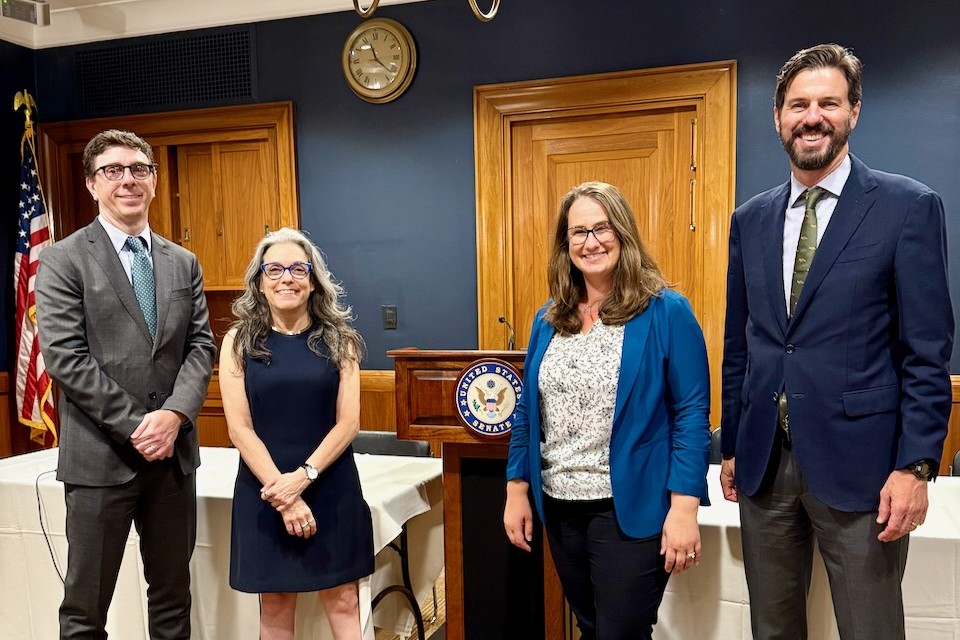
Daniel S. Holt (Senate Historical Office), Joanne B. Freeman (Yale Univ.), Sarah Weicksel (Briefing Moderator & AHA Executive Director), and Joseph Crespino.

Dr. Joseph Crespino, Senior Associate Dean of Faculty and Divisional Dean of Humanities and Social Sciences and Jimmy Carter Professor of History, recently participated in a Congressional Briefing organized by the American Historical Association (AHA) focused on how the U.S. Senate has changed since its establishment. The briefing took place on Thursday, July 24, in the Dirksen Senate Office Building. Other presenters included Dr. Joanne B. Freeman (Yale Univ.) and Daniel S. Holt (Senate Historical Office). AHA executive director Sarah Weicksel served as moderator.

The AHA’s Congressional Briefings series seeks to provide Congressional staff members, journalists, and other members of the policy community with the historical context essential to understanding contemporary issues. The sessions are strictly nonpartisan and avoid advancing particular policy prescriptions or legislative agendas.

Crespino and Becca Flikier (C ’17)

While in D.C., Crespino also had the chance to say hello to former History major Becca Flikier, who is now Deputy Chief of Staff for Florida Congresswoman Lois Frankel. Flikier graduated in 2017 with honors, receiving highest honors for her thesis, “The Fall of the Child Savers, The Rise of Juvenile Lockdown, and The Evolution of Juvenile Justice in Twentieth-Century America.” Her thesis chair was Daniel LaChance. Flikier was also a Political Science minor.