Anderson Quoted in ‘WaPo’ Article on Black Voters’ Responses to Trump’s Baseless Fraud Claims

Dr. Carol Anderson was recently quoted in a Washington Post article titled “Anger builds in Black community over Trump’s claims of voter fraud in big cities.” The piece analyzes how Black voters have responded to Donald Trump’s accusations of voter fraud in cities with high populations of Black residents, such as Philadelphia, Detroit, Atlanta, and Milwaukee. Anderson is Charles Howard Candler Professor of African American Studies and Associated Faculty in the History Department. Read an excerpt from the article quoting Anderson below along with the full piece.

“It’s as vile now as it was during Reconstruction, when Democrats believed that Republicans were illegitimate and that Black voters had no right to be voting, and they did all of these terrorist activities to block African Americans from voting,” said Carol Anderson, professor of African American studies at Emory University. “It’s a very narrow, slippery slope, from saying ‘illegal votes’ to ‘illegal voters,’ so this attack on Black voters is real.”
Lipstadt Condemns Yad Vashem Nomination in ‘The New York Times’

Deborah E. Lipstadt, Dorot Professor of Modern Jewish History and Holocaust Studies and associated faculty in the History Department, was recently quoted in an article in The New York Times titled “Israel’s Pick to Head Holocaust Memorial Stirs International Uproar.” In the piece, Lipstadt condemns the nomination of Effie Eitam, a retired general and far-right politician, to head Irael’s official Holocaust memorial, the Yad Vashem. Read an excerpt of the piece below along with the full article.

“This is more than a colossal mistake — it’s a tragedy,” said Deborah E. Lipstadt, a professor of modern Jewish history and Holocaust studies at Emory University in Atlanta who has written several books on the subject. “Appointing Eitam to this position would be a blot on Yad Vashem’s reputation and Yad Vashem’s record.”

Debjani Bhattacharyya (PhD, ’14) Publishes “Almanac of A Tide Country” for SSRC’s ‘Items’

Dr. Debjani Bhattacharyya, Associate Professor of History at Drexel University and a 2014 graduate of the PhD program, recently published an article in the Social Science Research Council’s digital publication Items. Published as a part of Items‘s “Ways of Water” series, the piece analyzes visual and historical representations of the tides of the Hooghly River in Kolkata. Bhattacharyya’s Empire and Ecology in the Bengal Delta: The Making of Calcutta (Cambridge University Press, 2018) won the 2019 honorable mention award for the best book in urban history from the Urban History Association. Read the Items piece here: “Almanac of A Tide Country.”

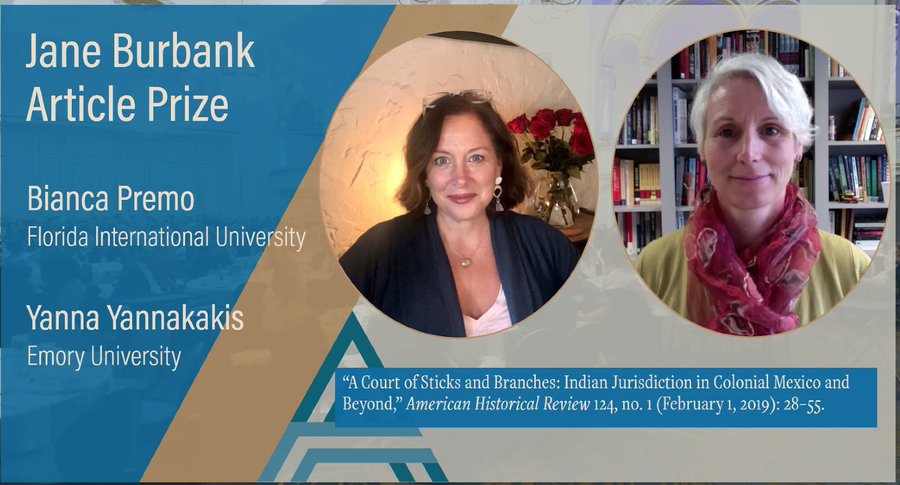
Yannakakis and Premo Win American Society for Legal History Article Prize

Congratulations to Dr. Yanna Yannakakis, 2018-2021 Winship Distinguished Research Professorship in History and Associate Professor, on winning an article prize with co-author Dr. Bianca Premo (Florida International University). The American Society for Legal History awarded their 2019 American Historical Review article, “A Court of Stick and Branches: Indian Jurisdiction in Colonial Mexico and Beyond,” with the Jane Burbank Article Prize. The prize is awarded annually to the best article in regional, global, imperial, comparative, or transnational legal history.

Working Apart, Making History Together

Just like our colleagues from across the globe, the Emory History Department has faced unprecedented challenges in the age of COVID-19. Though working apart for much of this year, our faculty, students, and staff have shown remarkable adaptability and spirit. They have continued to produce and share innovative, publicly-engaged histories in virtual classrooms and beyond, all the while supporting each other in extraordinary times. As we near the end of the fall 2020 term, we invite you to take a look back at a few stories of resilience relating directly to COVID-19:

Anderson Quoted in ‘U.S. News and World Report’ Article: “Stacey Abrams’ Legacy: A Democratic South?”

The 2020 election saw a majority of Georgians vote for a democrat for president for the first time since 1992. Dr. Carol Anderson, Charles Howard Candler Professor of African American Studies and Associated Faculty in the History Department, analyzed the years of grassroots organizing and coalition building that led toward this shift in a recent U.S. News & World Report article. Anderson discusses Stacey Abrams’ role in turning Georgia blue along with the prospect that other states in the U.S. South may see similar shifts in future elections. Read an excerpt below along with the full piece: “Stacey Abrams’ Legacy: A Democratic South?

“What we have here in Georgia is incredible grassroots mobilization and organizing,” says Anderson, chair of Emory’s African American studies department and author of “One Person, No Vote: How Voter Suppression is Destroying Our Democracy.” Abrams may have had a high profile, Anderson says, but an army of behind-the-scenes workers were just as invaluable, and the coalition they built included advocacy groups for Asian Americans and Latinos.

“They’ve been doing the work for years, and I mean years,” Anderson says. “Not just two years or three years. I mean, years,” including a decade for Abrams, who started when she was in the Georgia General Assembly – “and it is long, hard work. That is not glamorous. It takes long, hard, sustained effort.”

Lipstadt Joins ADL in Condemning Yad Vashem Post

Deborah E. Lipstadt, Dorot Professor of Modern Jewish History and Holocaust Studies and Associated Faculty in the History Department, was recently quoted in an article in The Atlanta Jewish Times. The piece discusses Lipstadt’s opposition to the controversial nomination of former far-right politician and military commander Effi Eitam to head Yad Vashem, Israel’s official memorial to the victims of the Shoah or Holocaust. Read the excerpt below along with the full article: “ADL and Lipstadt Condemn Yad Vashem Post.”

“Yad Vashem is one of the jewels in the crown of Israeli institutions,” said Deborah Lipstadt, Emory University Dorot Professor of Modern Jewish History and Holocaust Studies. She said that, given Eitam’s “fringe views, views that separate and divide rather than unite,” his nomination is a “colossal mistake.” She told the AJT that she plans to voice her opposition to the controversial nomination.

Anderson Pens Op-Ed in ‘The Guardian’: “Democracy won’t die on our watch”

Dr. Carol Anderson, Charles Howard Candler Professor of African American Studies and Associated Faculty in the History Department, has published an opinion editorial in The Guardian. Titled “Millions of Americans have risen up and said: democracy won’t die on our watch,” the piece outlines how U.S. citizens responded to efforts at voter suppression by casting an unprecedented number of ballots in the 2020 elections. Read an excerpt below along with the full article: “Millions of Americans have risen up and said: democracy won’t die on our watch.”

While the forces arrayed against the United States looked formidable, they were not invincible. Instead, they ran into something that is even more powerful than a president, a senate, or the US supreme court. The American people themselves and their belief in and devotion to democracy.

Anderson Analyzes 2020 Election for ‘Democracy Now’ and ‘The New York Times’

In the lead up to and shortly following the 2020 election, Dr. Carol Anderson contributed political analysis and historical context to two major media organizations. Four days before the election, Anderson was a guest on the Democracy Now segment, “‘Fighting for Democracy’: Carol Anderson on Voter Suppression & Why Georgia Could Go Blue.” Her prediction that Georgians may vote for a democratic presidential candidate for the first time since 1992 seems likely to come true. Three days following the election, while officials in Georgia and other battleground states continued to count votes, Anderson offered historical context for The New York Times on the links between U.S. slavery and the Electoral College. Read an excerpt from that article below along with the full piece: “The Electoral College Is Close. The Popular Vote Isn’t.” Anderson is Charles Howard Candler Professor of African American Studies and Associated Faculty in the History Department.

“We look at a map of so-called red and blue states and treat that map as land and not people,” said Carol Anderson, a professor of African-American studies at Emory University who researches voter suppression. “Why, when somebody has won millions more votes than their opponent, are we still deliberating over 10,000 votes here, 5,000 votes there?”

Strocchia’s ‘Forgotten Healers’ Awarded 2020 Marraro Prize

The Society for Italian Historical Studies (SIHS) has awarded the 2020 Marraro Prize for the best book in Italian history to Prof. Sharon Strocchia’s Forgotten Healers: Women and the Pursuit of Health in Late Renaissance Italy (Cambridge, MA: Harvard University Press, 2019). The prize committee offered the following appreciation of Prof. Strocchia’s work:

“Drawing on extensive work in Florentine archives, Strocchia develops a sophisticated and incisive investigation of the manifold roles women played as protagonists in Renaissance health practices. Her case studies illuminate the contributions of convent pharmacies and pharmacists, of aristocratic women who prepared and employed household remedies, and of the poor young women who worked as nurses in the pox hospital. More suggestive than conclusive, this pioneering work opens up inviting pathways for further investigation.”

Read our Q&A with Dr. Strocchia about Forgotten Healers from earlier this year: “New Books Series: Q & A with Sharon T. Strocchia about ‘Forgotten Healers.’”