Update from Thomas E. Mullen

Thomas E. Mullen, Ph.D. 1959, has many memories of the Emory History Department from the 1950s.  He had J. Russell Major’s course on early modern Europe as well as his seminar on the Estates General of 1614.  He writes that, “Had I not already chosen to concentrate on a later period with Matthews for both thesis and dissertation, I could have very happily worked with Major.”  (His 1959 dissertation was entitled “The Role of Henri de Blowitz in international affairs, 1871-1903.”)  Dr. Mullen held several assistantships in one or another office in the department for his first three years of graduate school at Emory, then he was off to the army in South Carolina and Germany for 21 months before spending a year in England at the University of London.  From there he returned to Emory as a TA for one year. Remembering Bell Wiley, Dr. Mullen passed along this anecdote: “I think it was during that year that I heard Wiley cussing himself out, literally and loudly, for not sitting down and starting to WRITE.  I had thought my off-color vocabulary had been sufficiently broadened while in the army, but Wiley enriched it a lot more.”

Along with fellow graduate student, Charles Le Guin, he knew Russell Major well, as well as Joseph Mathews, Harvey Young, Jack Rabun, Bell Wiley, Francis Benjamin, George Cuttino, among others. Fellow Emory graduate student—and later associate dean of Emory College—Irwin Hyatt was kind enough to act as best man in Dr. Mullen’s wedding in 1957. Dr. Mullen joined the Wake Forest University History faculty in 1957 and served as dean of the college from 1968 until 1995. In 1995, he was honored with Wake Forest University’s Medallion of Merit.
Update from Marisa Chappell

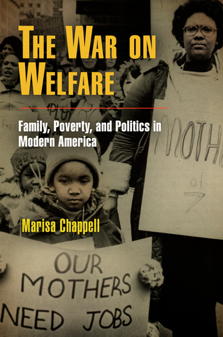
Marisa Chappell published The War on Welfare in 2010.

Marisa Chappell (Marisa Schreihofer), B.A. 1991, just earned tenure and promotion to Associate Professor at Oregon State University in Corvallis, Oregon, where she teaches twentieth-century U.S. history. She recently published two books. The War on Welfare: Family, Poverty, and Politics in Modern America (University of Pennsylvania Press, 2010) is a monograph based on her Northwestern University dissertation (2002), and Welfare in the United States: A History with Documents (Routledge, 2009), co-authored with Premilla Nadasen (Queens College) and Jennifer Mittlestadt (Rutgers) is a short analytical history of the Aid to Families with Dependent Children Program with forty primary source documents intended for undergraduate teaching. She is currently researching a project on community organizing for economic justice in the last third of the twentieth century. She lives in Corvallis with her husband, Patrick Chappell (91C, Psychology), who is an Assistant Professor in the College of Veterinary Medicine, and her thirteen year old son, Everett.

Update from Miriam C. Davis

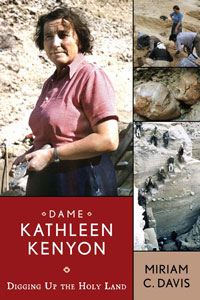
Miriam C. Davis published Dame Kathleen Kenyon: Digging Up the Holy Land in 2008.

Miriam C. Davis, B.A. 1986, spent a year studying history and archaeology at the University of St. Andrews on a Robert T. Jones Scholarship after her graduation from Emory. She then earned an M.A. in Medieval Archaeology from the University of York as a Fulbright fellow, before completing her PhD in Medieval History at the University of California, Santa Barbara.

In 2008 Miriam published the enthusiastically received Dame Kathleen Kenyon: Digging Up the Holy Land, a biography of arguably the most important woman archaeologist of the twentieth century in University College London’s Institute of Archaeology series.  Archaeologists are generally known for one of two things: making an important methodological contribution to the discipline, or excavating an exciting site.  Kenyon did both.  In the 1950s she went to the Biblical site of Jericho to look for the walls supposed to have been brought down by Joshua’s conquest. In fact, her excavations pushed back the accepted date of town life by at least 2000 years and resulted in the discovery of the Neolithic portrait skulls — the oldest known examples of realistic human portraiture. Readers at Emory may be interested to know that a few of her small finds are on display at the Carlos Museum. In addition, Kenyon’s excavations were instrumental in spreading what has become known as the Wheeler-Kenyon method to the Middle East, where it has continued to influence archaeological field work to the present day.  Since publishing her book, Miriam has been thrilled to be able to speak at both the British Museum and the Kenyon Institute in Jerusalem.

Since 1995 Miriam has taught at Delta State University in Cleveland, MS. But this past year she traded in her title of Professor of History for that of Research Associate in order to move to Montgomery, AL to write popular history, work as a lecturer on history for Smithsonian tours and cruises in Europe, do some academic editing–and live with her husband who is Dean of Liberal Arts at Auburn University Montgomery. At present Miriam is working on a book about the Axeman of New Orleans, a serial killer who terrorized Italian grocers during World War I.

Update from Kelly Damon

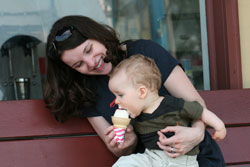
Kelly Damon and her son Will, who she promises did not eat much of that iced cream.

Kelly Damon, B.A./M.A. 2005, writes that after she graduated from the History Department, she earned her Master’s in Education from Harvard’s Graduate School of Education in 2007. She explains that she “went on to teach World History to high school freshmen before I left so my husband and I could start a family.  Raising a child is the most important thing I’ve ever done, and I’m grateful to Emory’s History Department for its part in making me the parent I am.  It was at Emory that I learned how to research a topic, know what questions to ask, evaluate my sources, and know when I need to keep looking.  Thanks to Emory, I get answers to my parenting questions from Psychology journals and peer-reviewed books on parenting, not from about.com or authors with better titles than credentials.  I can write my husband an annotated bibliography on popular sleep books, and when I am worried about some media hype about how we’re raising our kids, I can look for answers with confidence and feel reassured when I’ve reached a decision that it’s an educated and informed one.  And did I mention how much fun it is to travel with a good background in history?  Maybe I got a little too upset about the caption in the White Tower that blamed Richard III so concretely for the deaths of the princes, but my husband claims he enjoys having his own tour guide anyway!”

Update from Fay Yarbrough

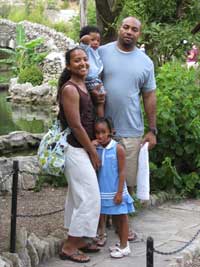
Fay Yarbrough and her family on a trip to San Antonio

Fay Yarbrough, Ph.D. 2003, writes, “A lot has happened since I turned in my dissertation, directed by Elizabeth Fox-Genovese, in the summer of 2003.  I started my career as an assistant professor at the University of Kentucky.  There I taught native and African American history and worked on turning my dissertation into a book.  In 2007 I had the opportunity to move to the University of Oklahoma, which brought us much closer to our families (in Lawton, OK, and Houston, TX) and me to my sources.  Arthur Terry, my husband, has made these moves with much patience and grace.”  Her book Race and the Cherokee Nation:  Sovereignty in the Nineteenth Century came out in 2008 with the University of Pennsylvania Press and was the basis of her tenure and promotion to associate professor in 2009.  She also co-edited with Sandra Slater the essay collection Gender and Sexuality in Indigenous North America, 1400-1850, which just appeared with the University of South Carolina Press in 2011. “But the biggest, most exhausting, and most fun change has been the arrival of our two children:  Wilson Renée in 2006 and Rivers Joseph in 2009,” she writes. “Here is a picture of the family from a recent trip to San Antonio.“

Update from Colin Reynolds

Colin Reynolds is working in 20th-Century U.S. political and social history with Prof. Crespino.

Colin Reynolds is presently a graduate student in the Emory program.  He received his B.A. in History from Grinnell College in 2007 and his M.A. in the Social Sciences from the University of Chicago in 2009.  He is interested in twentieth-century U.S. political and social history, specifically the rise of conservative populism during the second half of the last century.  His advisor is Prof. Joe Crespino, and Colin expects to work closely with both him and Patrick Allitt.  He writes, “My recent work has focused on West Virginia.  My MA thesis was entitled ‘Born Again Solidarity: Conservative Activism and Organized Labor in the Textbook Controversy of 1974.’  I considered how conservative activists and their rhetoric influenced working-class activism in a 1974 protest against public school textbooks.  Most recently I wrote a short history of West Virginia’s Bureau of Negro Welfare and Statistics, considering how this organization operated as part of the state’s government before integration, and how its existence complicates nice distinctions between radical and conservative civil rights activism.”

Update from Alexander Lorenzo Colonna

Alexander Lorenzo Colonna is currently serving at a Combat Support Hospital in Iraq.

Alexander Lorenzo Colonna, B.A. in History, French and Pre-Med, 1998, is a Major in the U.S. Army Reserves. He is presently serving at a Combat Support Hospital in Iraq. Last fall, he wrote, “Well I’m finally all grown up and finished with many long years of medical training.  I went to med school at MUSC in Charleston, did my General Surgery residency at ETSU in Johnson City, TN, and did an Acute Care Surgery fellowship at Wake Forest.  12 years of work in all.”  He is married and his wife, Sarah, did her medicine residency at Wake Forest.  Now she is doing a Hematology/Oncology fellowship at Vanderbilt. Their son, Gabriel, is almost two years old.  Alexander started a general surgery practice outside of Nashville.

Update from Patrick Jamieson

Patrick Jamieson won the 2011 Matthew A. Carter Citizen-Scholar Award.

Patrick Jamieson, B.A. 2011, is pursuing a J.D. at Duke Law School and a M.A. in History from the graduate school at Duke.  His senior thesis, “’The Delicacy of the Subject’: Creating a Proslavery Argument at Antebellum Emory,” received Highest Honors.  He writes, “I hope that the combination of traditional legal education and graduate study of history will allow me to further explore not only the influences of history on the law, but the ways such influences will be relevant in the changing law of tomorrow.  I hope to continue my focus on the nineteenth century U.S. South, perhaps looking to the connections between antebellum property law and the slave trade.”

Update from Kirsten Cooper

Kirsten Cooper enjoys some Sacher-Torte at the Café Sacher in Vienna.

Kirsten Cooper, Class of 2012, is spending the summer of 2011 doing historical research with the SIRE Summer Research Partner Program. She will work 40 hours per week on two projects: one under the direction of Dr. Tonio Andrade and the other an independent pursuit. She has worked with Dr. Andrade over the past year on his comparative exploration of military development in Europe and Asia, looking specifically to see whether or not the Military Revolution was a purely European phenomenon. Her independent research will focus more on military and diplomatic relations between France and Austria, and their consequences on various facets of society and national consciousness over the approximately 250 years leading up to the Diplomatic Revolution of 1756. She will also study the effects that this event had on the two societies. This research will help inform her upcoming honors thesis. She explains that she “is very excited to get the opportunity to work full time on both of these projects and to spend the summer in our amazing city of Atlanta!” Last summer, she went to Vienna with the German Studies program and began learning German (taking 101 and 102 while abroad), which she has continued at Emory over the past year. She writes, “It was an amazing experience and I absolutely fell in love with the city, its culture, and its history.” As part of her work, she conducted an independent survey course of Austrian and Habsburg History with the help of Robert A. Kann’s A History of the Habsburg Empire, 1526-1918. She enjoyed eating in the Naschmarkt, a lovely open air market with great restaurants, and riding the Strassenbahn through the city.  The obligatory tourist stop at the Café Sacher for their famous Sacher-Torte was a special treat.

Update from Kate Armstrong

Kate Armstrong and her family celebrate her May graduation.

Kate Armstrong, Ph.D. 2011, writes that she is thrilled to have completed her doctorate, directed by Professor James Roark. The dissertation is entitled, “Thy Will Lord, Not Mine: Parents, Grief, and Child Death in the Antebellum South.” The research for her project took her to archives in Virginia, North Carolina, South Carolina, and Georgia. It was supported by fellowships from Duke University’s Sallie Bingham Center, UNC-Chapel Hill’s Southern Historical Collection, and Emory. The dissertation investigates the emotions and experiences of planter-class parents of the Old South as they grieved the death of a child, and argues that southern parents’ profound difficulty aligning their feelings of loss with the expectations of their society–particularly the expectation that parents must resign themselves to God’s will–defined their grief. Although Kate is looking forward to revising her thesis for publication, she is also happy to focus on her own, very healthy child for a little while as she figures out her next career move.