Senior History Major Annie Li Wins Prestigious Marshall Scholarship

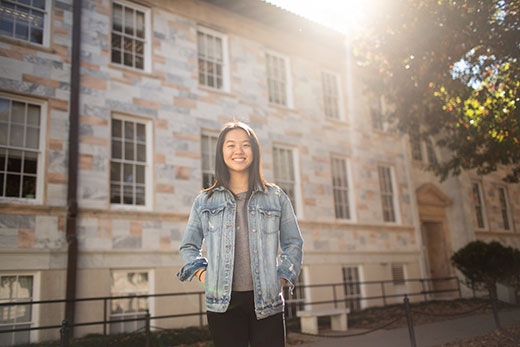
Annie Li in front of Bowden Hall

Congratulations to senior Annie Li, a history and sociology double major, on being selected for the prestigious Marshall Scholarship. Li is one of 41 students selected nationwide for the award, which supports up to three years of graduate study at any institution in the U.K. As the Emory News Report explains, “Li will pursue a master’s of philosophy with a focus on Christian ethics at the University of Oxford, researching the theological motivations behind transnational social movements. The work expands on her honors thesis, which examines the motivations of Chinese-American activists from San Francisco’s Presbyterian Church in Chinatown (PCC) who participated in the Civil Rights Movement in the South and the Asian American Movement in the West.” Li’s honors thesis, “Chinese-American Christians in the Civil Rights Movement, 1963-1968,” was advised by Dr. Chris Suh, Assistant Professor of History. Read more about Li’s award here: “Emory senior Annie Li selected as a Marshall Scholar for study in U.K.”

“Visions of Slavery,” Co-Organized by Walter C. Rucker, Awarded Prestigious Mellon Foundation Grant

The Andrew W. Mellon Foundation has awarded Emory College a $225,000 grant for a year-long investigation of the histories of unfreedom in the Black Atlantic. The grant will support a symposium titled “Visions of Slavery,” which is co-organized by Dr. Walter C. Rucker, Professor of History, and Bayo Holsey, Associate Professor of Anthropology. The event will take place as a part of Mellon’s 2022-2023 Sawyer Seminar series and involve faculty from other university campuses across Atlanta. History Department faculty Mariana Candido and Adriana Chira are part of the working group for the seminar. Read more about the symposium via the Emory News Center as well as the Department of African American Studies.

Dr. Mariana Candido Elected Fellow of the Royal Historical Society

Congratulations to Dr. Mariana Candido, Associate Professor of History, on being elected a fellow of the Royal Historical Society. This honor recognizes Candido’s outstanding scholarship on the history of slavery, the Atlantic slave trade, African history, and women and the African diaspora. The 150-year-old Royal Historical Society is the foremost organization in the UK, representing history as a discipline and historians as a group.

Anderson Interviewed on FAIR’s “CounterSpin”

Charles Howard Candler Professor Carol Anderson was recently interviewed on CounterSpin, the weekly radio show of FAIR (“Fairness and Accuracy in Reporting”). Anderson discusses the relationship between white supremacy and American democracy, past and present. Read an excerpt from the interview below and find the full conversation here: “White Supremacists Were Willing to Hold the United States Hostage“

“what struck me—and this really began to come out for me as I was working on my latest book, The Second: Race and Guns in a Fatally Unequal America, was the way that white supremacists were willing to hold the United States of America hostage in order to advance their white supremacist ideology, in order to embed it into the bedrock foundation of this nation. And that they were willing to destroy the United States if they didn’t get their way. And for that, they should have been held accountable. But instead, they were revered. Instead, they were allowed to walk away. And that lack of accountability, over and over and over, only emboldens the white supremacists, and puts the United States of America and its ideas and this democracy at risk.”

Klibanoff Discusses Conviction of Ahmaud Arbery’s Killers on WABE

Hank Klibanoff, James M. Cox Jr. Professor of Journalism and Associated Faculty in the History Department, was recently interviewed on “A Closer Look,” a program of the Atlanta NPR affiliate station WABE. The interviewed focuses on the guilty conviction of the three men who killed Ahmaud Arbery. Klibanoff dedicated season three of his podcast, “Buried Truths,” to the Arbery case. Listen to the WABE interview here: “Jury Finds All 3 Men Accused of Killing Ahmaud Arbery Guilty of Murder.”

Lipstadt Describes “Surrealistic” Experience Testifying in “Unite the Right” Trial

Dr. Deborah E. Lipstadt, Dorot Professor of Modern Jewish History and Holocaust Studies and Associated Faculty in the History Department, recently recounted what she described as the “surrealistic experience” testifying in the Charlottesville, VA, trial against the organizers of the deadly 2017 “Unite the Right” rally. Lipstadt served as an expert witness for the trial and was cross-examined by one of the defendants. Read an excerpt from the HuffPost’s coverage of the trial below along with the full article here: “Experts Describe ‘Surrealistic’ Process Of Putting Charlottesville’s Nazis On Trial.”

“On the stand, Lipstadt read aloud some of the planning messages sent by the event’s organizers. She testified that she was ‘taken aback‘ by the level of anti-Semitism and the adulation for Nazi Germany evident in the discussions.

“‘On one hand, I could feel like I was in the classroom, teaching about anti-Semitism and teaching about its connection to white supremacy,’ Lipstadt told HuffPost about her experience as an expert witness. ‘This was a call to arms. This was a call to violence. If you read their statements, it’s just overwhelming.
‘”

Anderson Discusses Rittenhouse Trial Verdict on WNYC’s ‘The Brian Lehrer Show’

Charles Howard Candler Professor Carol Anderson was recently a guest on the WNYC program ‘The Brian Lehrer Show.’ The conversation centered on the acquittal of Kyle Rittenhouse, who killed Joseph Rosenbaum and Anthony Huber, and injured Gaige Grosskreutz, during protests in Kenosha, WI, in 2020. Listen to the full conversation here: “Professor Carol Anderson on the Rittenhouse Verdict.”

Anderson Quoted in ‘AP News’ Article about Vigilantism

Dr. Carol Anderson was recently quoted in the Associated Press News article “2 trials, 1 theme: White men taking law into their own hands.” Following the trials of Kyle Rittenhouse and the three men convicted of killing Ahmaud Arbery, the piece examines white vigilantism in historical and contemporary perspective. Anderson’s most recently book, The Second: Race and Guns in a Fatally Unequal America (Bloomsbury, 2021), charts how anti-Black racism shaped the Second Amendment. Read an excerpt from the AP News piece below, along with the full article here.

“So much of this issue about protection and safety is about the safety and the protection of whites or white property,” said Carol Anderson, historian and professor of African American studies at Emory University. “There is a hubris of whiteness. The sense that it is on me to put Black lives back into their proper place.”

Strocchia’s ‘Forgotten Healers’ Wins the Rossiter Prize from the History of Science Society

Dr. Sharon T. Strocchia’s book Forgotten Healers: Women and the Pursuit of Health in Late Renaissance Italy (Harvard UP, 2020) has been awarded the Margaret W. Rossiter History of Women in Science Prize from the History of Science Society. The prize is given annually in recognition of an outstanding book on the history of women in science. Forgotten Healers was also awarded the Marraro Prize by the Society for Italian Historical Studies and the Phyllis Goodhart Gordan Book Prize from the Renaissance Society of America. Strocchia is Department Chair and Professor of History. Read more about the Rossiter Prize and browse the list of past winners here.

Price Cited in ‘The Atlantic’ Article on COVID in Rural America

Dr. Polly J. Price, Asa Griggs Candler Professor of Law, Professor of Global Health, and Associated Faculty in the History Department, was recently quoted in an article in The Atlantic. Titled “Rural America’s False Sense of Security,” the article focuses on the perception and reality of the COVID-19 pandemic in rural parts of the U.S. Read an excerpt from the piece below along with the full article.

People who live in rural areas are also more likely to be Republican, and as COVID-19 became politicized, Republicans grew less likely to get vaccinated voluntarily or to endorse masking and other restrictions. Rural areas and red states issued fewer restrictions, such as mask mandates, throughout the pandemic, so it makes sense that they’d have fewer restrictions now. “This is a very long-standing difference in our country of what sort of pandemic measures we had,” says Polly Price, a law and global-health professor at Emory University. “You had different pandemic experiences depending on where you live.”