Four Emory History majors have been selected as Spring 2021 Fox Center Undergraduate Humanities Honors Fellows. Nayive Gaytán (Spanish and History), Ryan Kelly (History and Art History), Colin Hutton (History), and Cameron Katz (History and English/Creative Writing) will benefit from the Fox Center’s intellectual community next semester as they complete their honors research projects. Read more about the Fox Fellows programs here.
Graduate Student Alexander Compton Wins Article Prize from Southern Historical Association
Congratulations to graduate student Alexander Compton, whose second-year research paper “Decolonize Your Minds! Audre Lorde, Archival Activism, and the Transnational Origins of Black European Consciousness” won the John L. Snell Memorial Prize of the European History Section of the Southern Historical Association. The Snell Prize is given annually to the graduate student who submits the best seminar research paper in European history, written within the past year. Compton’s paper historicizes the processes that led to the rise of Black German and Black European consciousness in the 1980s, particularly the transnational networks forged through the composition, publication, and translation of the seminal Black German feminist anthology Farbe bekennen (Showing Our Colors). The paper was mentored by Prof. Eckert and Prof. Vick.
Yannakakis and Premo Win American Society for Legal History Article Prize
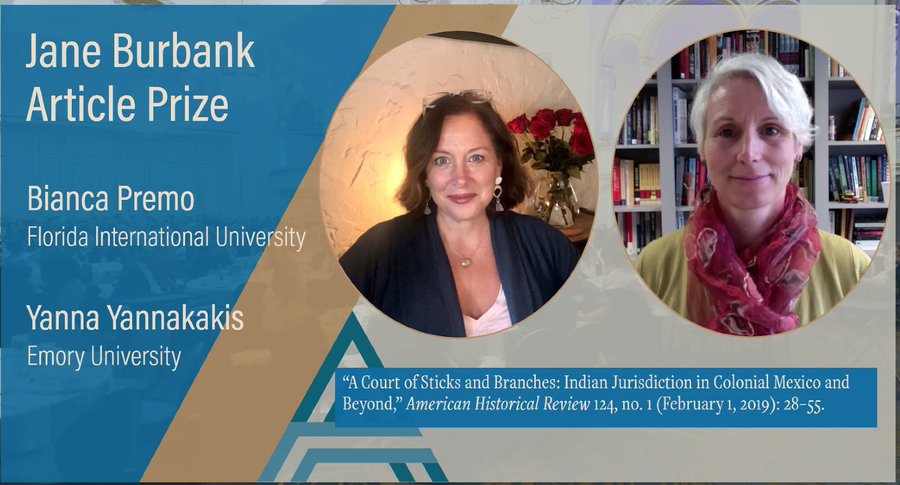
Congratulations to Dr. Yanna Yannakakis, 2018-2021 Winship Distinguished Research Professorship in History and Associate Professor, on winning an article prize with co-author Dr. Bianca Premo (Florida International University). The American Society for Legal History awarded their 2019 American Historical Review article, “A Court of Stick and Branches: Indian Jurisdiction in Colonial Mexico and Beyond,” with the Jane Burbank Article Prize. The prize is awarded annually to the best article in regional, global, imperial, comparative, or transnational legal history.
American Society for Ethnohistory Recognizes 2019 ‘AHR’ Article by Yannakakis and Premo
The American Society for Ethnohistory recognized an article co-written by Drs. Yanna Yannakakis and Bianca Premo (Florida International University) with honorable mention for the the Robert F. Heizer Award. The article, titled “A Court of Stick and Branches: Indian Jurisdiction in Colonial Mexico and Beyond,” was published in the February 2019 issue of the American Historical Review. Read more about the prize here.
Working Apart, Making History Together


Just like our colleagues from across the globe, the Emory History Department has faced unprecedented challenges in the age of COVID-19. Though working apart for much of this year, our faculty, students, and staff have shown remarkable adaptability and spirit. They have continued to produce and share innovative, publicly-engaged histories in virtual classrooms and beyond, all the while supporting each other in extraordinary times. As we near the end of the fall 2020 term, we invite you to take a look back at a few stories of resilience relating directly to COVID-19:
Crespino in ‘The New York Times’: “What Democrats Are Up Against in Georgia”
Jimmy Carter Professor of History and History Department Chair Joseph Crespino published an opinion piece in The New York Times over the weekend. Titled “What Democrats Are Up Against in Georgia,” the article examines how Georgia’s distinctive political culture and history will shape the state’s two runoff elections for the U.S. Senate. Read an excerpt below along with the full piece.
“Mr. Trump’s delusional tweets declaring that he won the election or teasing new revelations of fraud and corruption evoke a similar sense of living in a dream world. The good news for Georgians is that on Jan. 5 they have an opportunity to send a wake-up call. Two Democratic victories would not only give Democrats control of the Senate but could also help turn the page on Donald Trump’s influence in American politics.”
Crespino Comments on Political Polarization and Everyday Life for the ‘AJC’
Dr. Joseph Crespino, Jimmy Carter Professor of History and Department Chair, was recently quoted in the Atlanta Journal-Constitution article “Divided Georgians resort to tiptoeing, avoidance, unfriending.” Written by Matt Kempner, Shelia Poole, and Andy Peters, the piece discusses contemporary political polarization in the state of Georgia, especially in the wake of the 2020 election. Crespino is an expert in the political and cultural history of the twentieth-century United States and of the U.S. South since Reconstruction. Read an excerpt from the article below along with the full piece here.
Today’s bitter partisanshipis boosted by what people are exposed to, from cable TV news sources to personalized advertising on Google and Facebook, driven by algorithms, said Emory University historian Joseph Crespino. “We don’t look at the same sources of information.”
Communities also are much less politically diverse than they used to be, Crespino said. People are surrounded by others who think like them.
“If you live in Decatur, you’ll have very little understanding of how people in the rest of Georgia could vote for Trump,” he said. “If you live in South Georgia, you can’t understand how people could vote for Biden.”
Anderson Quoted in ‘U.S. News and World Report’ Article: “Stacey Abrams’ Legacy: A Democratic South?”
The 2020 election saw a majority of Georgians vote for a democrat for president for the first time since 1992. Dr. Carol Anderson, Charles Howard Candler Professor of African American Studies and Associated Faculty in the History Department, analyzed the years of grassroots organizing and coalition building that led toward this shift in a recent U.S. News & World Report article. Anderson discusses Stacey Abrams’ role in turning Georgia blue along with the prospect that other states in the U.S. South may see similar shifts in future elections. Read an excerpt below along with the full piece: “Stacey Abrams’ Legacy: A Democratic South?“
“What we have here in Georgia is incredible grassroots mobilization and organizing,” says Anderson, chair of Emory’s African American studies department and author of “One Person, No Vote: How Voter Suppression is Destroying Our Democracy.” Abrams may have had a high profile, Anderson says, but an army of behind-the-scenes workers were just as invaluable, and the coalition they built included advocacy groups for Asian Americans and Latinos.
“They’ve been doing the work for years, and I mean years,” Anderson says. “Not just two years or three years. I mean, years,” including a decade for Abrams, who started when she was in the Georgia General Assembly – “and it is long, hard work. That is not glamorous. It takes long, hard, sustained effort.”
Lipstadt Joins ADL in Condemning Yad Vashem Post
Deborah E. Lipstadt, Dorot Professor of Modern Jewish History and Holocaust Studies and Associated Faculty in the History Department, was recently quoted in an article in The Atlanta Jewish Times. The piece discusses Lipstadt’s opposition to the controversial nomination of former far-right politician and military commander Effi Eitam to head Yad Vashem, Israel’s official memorial to the victims of the Shoah or Holocaust. Read the excerpt below along with the full article: “ADL and Lipstadt Condemn Yad Vashem Post.”
“Yad Vashem is one of the jewels in the crown of Israeli institutions,” said Deborah Lipstadt, Emory University Dorot Professor of Modern Jewish History and Holocaust Studies. She said that, given Eitam’s “fringe views, views that separate and divide rather than unite,” his nomination is a “colossal mistake.” She told the AJT that she plans to voice her opposition to the controversial nomination.
Anderson Pens Op-Ed in ‘The Guardian’: “Democracy won’t die on our watch”
Dr. Carol Anderson, Charles Howard Candler Professor of African American Studies and Associated Faculty in the History Department, has published an opinion editorial in The Guardian. Titled “Millions of Americans have risen up and said: democracy won’t die on our watch,” the piece outlines how U.S. citizens responded to efforts at voter suppression by casting an unprecedented number of ballots in the 2020 elections. Read an excerpt below along with the full article: “Millions of Americans have risen up and said: democracy won’t die on our watch.”
While the forces arrayed against the United States looked formidable, they were not invincible. Instead, they ran into something that is even more powerful than a president, a senate, or the US supreme court. The American people themselves and their belief in and devotion to democracy.