Claudia Kreklau (PhD, ’18) Wins Article Prize from Goethe Society of North America

kreklau.png

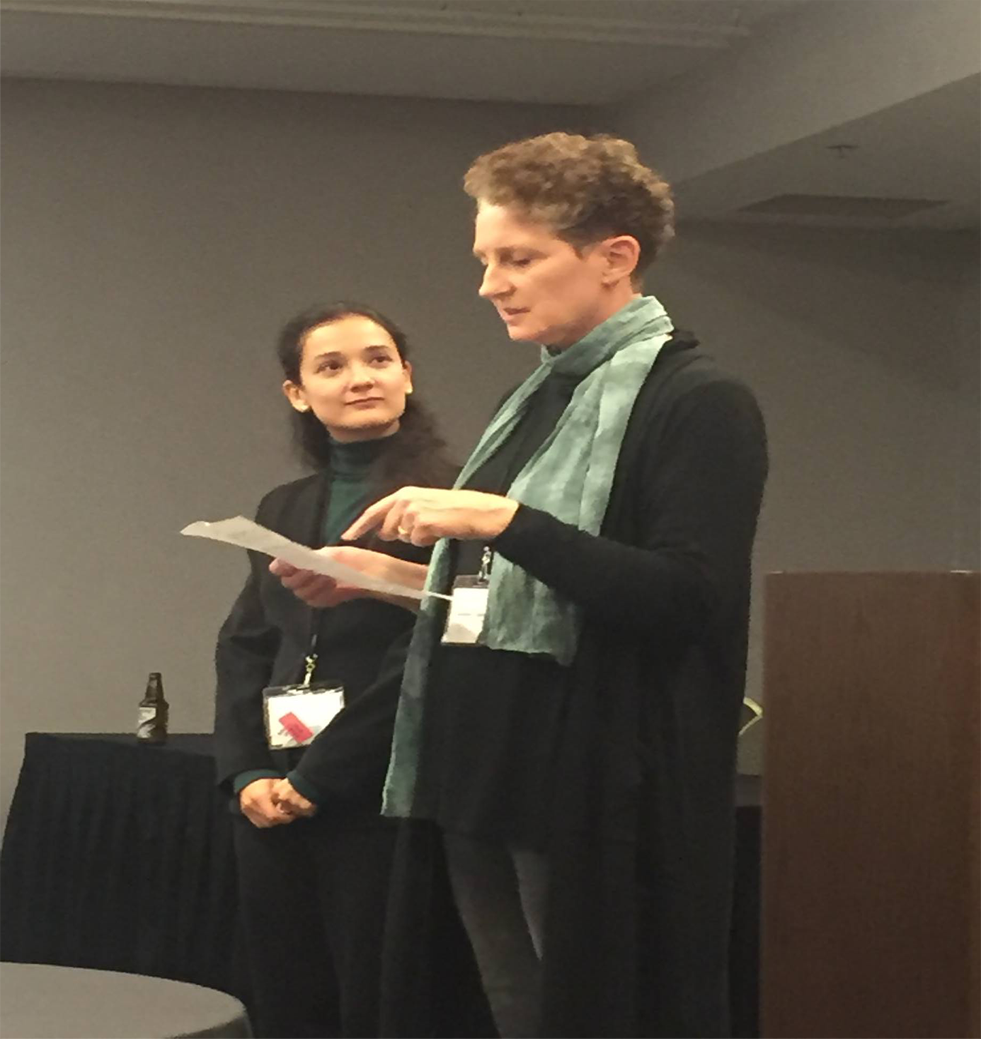
Congratulations to Claudia Kreklau (PhD ’18), who won the Richard Sussman Prize in the History of Science 2019 for her article “Travel, Technology, Theory: The Aesthetics of Ichthyology during the Second Scientific Revolution” (German Studies Review, 2018). The prize is awarded by the Goethe Society of North America and was announced at the German Studies Association 43rd Annual Meeting in Portland, Oregon.

Carol Anderson on Impeachment, Democracy, and White Supremacy in the ‘Washington Post’

Dr. Carol Anderson recently authored an op-ed for The Washington Post, titled “Impeachment is the latest chapter in the battle between democracy and white supremacy.” Anderson, an expert in race, justice, and equality in the U.S., surveys key episodes from U.S. history that contextualize Donald Trump’s reaction to the recently-initiated impeachment investigation. She concludes that “When it comes to a nation held hostage to racism, we have been here before.” Professor Anderson is Associated Faculty in the History Department, Charles Howard Candler Professor of African American Studies, and Chair of African American Studies. She is also the author, most recently, of One Person, No Vote: How Voter Suppression is Destroying Our Democracy (Bloomsbury, 2018). Read an excerpt of the article below along with the full piece here.

“Since the nation’s founding, the refusal to believe in democracy and follow through on the nation’s ideals — equality and freedom — has been the nation’s consistent enemy. Time and time again, white supremacists have sacrificed these principles to advance their own interests and that of their white supporters. Trump has followed suit, adding the disregard for the rule of law to the list. When challenged, he has also invoked the strategy white supremacist leaders have also mastered: threats of violence and extortion.”  – Carol Anderson

Debjani Bhattacharyya (PhD, ’14) Wins Honorable Mention for Best Book from the Urban History Association

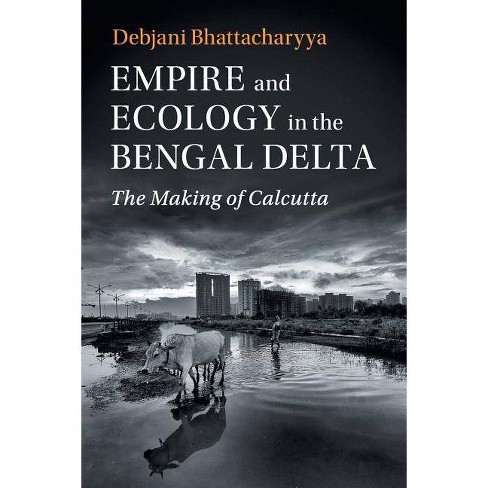
Congratulations to Dr. Debjani Bhattacharyya, Assistant Professor of History at Drexel University and a 2014 PhD, whose first book recently won an award from the Urban History Association. Bhattacharyya published Empire and Ecology in the Bengal Delta: The Making of Calcutta with Cambridge in May of 2018. The Urban History Association awarded the book honorable mention for 2017-18 Best Book in Non-North American History.  Bhattacharyya is currently a Visiting Research Scholar at Princeton University in the Department of History and the Shelby Cullom Davis Center for Historical Studies.

Deborah Dinner Quoted in ‘Washington Post’ Article on Gender Discrimination in the Workplace

Dr. Deborah Dinner, Associate Professor at Emory Law and Associated Faculty in the History Department, recently contributed to an article in The Washington Post. Dinner, a specialist in the legal history of gender and work, discusses gender discrimination in the workplace in advance of a Supreme Court case that will revisit LGBTQ rights at work. Marisa Iati wrote the piece, titled “Supreme Court, set to rule on LGBTQ rights at work, addressed gender discrimination 30 years ago.” Read an excerpt below along with the full piece.

“The stereotype is that a male should dress in a certain way or perform his gender identity in a particular way or should have romantic relationships with women and not men,” Dinner said. “And so by discriminating on the basis of somebody’s gender identity or on the basis of their sexual orientation, what an employer in fact is doing is discriminating on the basis of a gender stereotype.” – Deborah Dinner

Join us for First ‘History Pathways’ Event: “Getting the Most Out of Your Emory History Major”

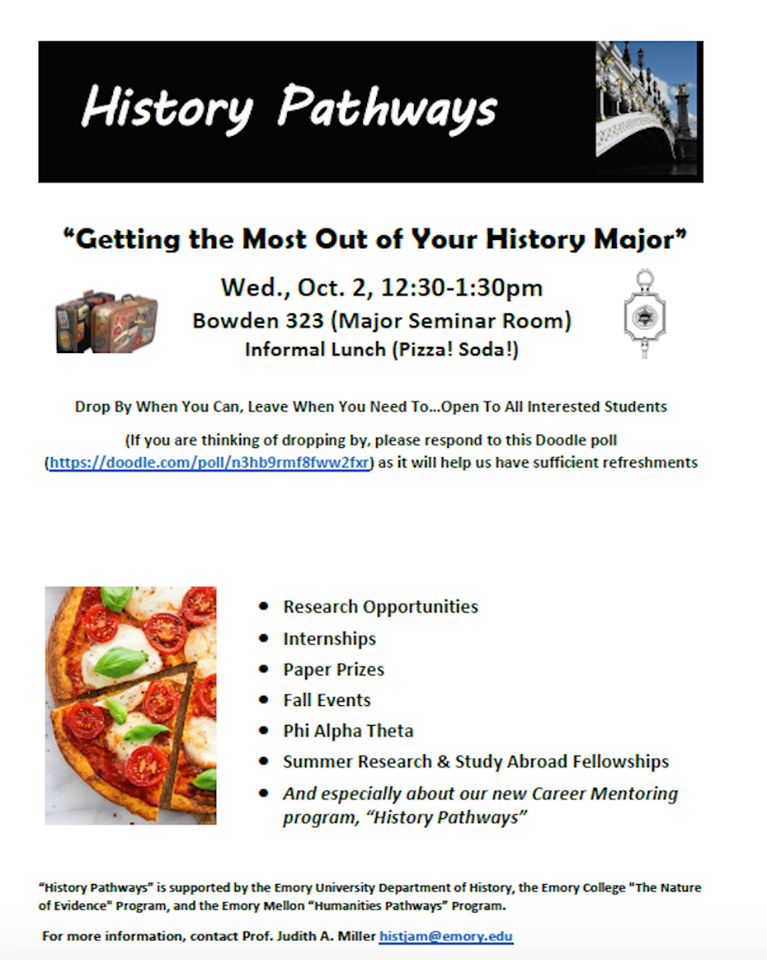
Join us for our first History Pathways event, “Getting the Most Out of Your Emory History Major,” on Wednesday, October 2, from 12:30-1:30pm in Bowden Hall 323. The event is open to all students – from first year through seniors – who want to learn more about Emory’s History Department. The event will include pizza and soft drinks, and we will cover the many exciting opportunities we offer for undergraduates, such as Cuttino Fellowships and Clio Paper Prizes. We will also launch our “History Pathways” program, aimed at developing career mentoring and internship programs. If you plan to attend, please respond to the poll here. Reach out to Professor Judith A. Miller (histjam@emory.edu) with any questions. 71478852_1343103635864184_8628822273870004224_n.png

Alumni Update: Alexander Gouzoules (C’08) Publishes “The Diverging Right(s) to Bear Arms”

Alexander Gouzoules graduated from Emory College in 2008 and subsequently attended Harvard Law School. He recently published an article, “The Diverging Right(s) to Bear Arms: Private Armament and the Second and Fourteenth Amendments in Historical Context,” in the University of Alabama Civil Rights and Civil Liberties Law Review (Vol. 10, 2019). The blog Second Thoughts from Duke University recently featured Gouzoules’ piece in their Scholarship Spotlight series. Read part of their summary below, along with the full article here. Gouzoules is an attorney in New York City.

“The main thrust of the article is to emphasize and explore the nature and scale of change in how private armament was understood between 1791, when the Second Amendment was ratified, and 1868, when the Fourteenth Amendment (which makes the Second Amendment applicable to the states) was ratified. To over-simplify a bit: While private arms-bearing to deter the tyranny of the standing federal army might have made sense in the 1790s, the situation was entirely different by the late 1860s. In showing as much, Gouzoules deepens (and credits) an argument that Akhil Amar made more than a decade before Heller. Gouzoules’ target is not simply the Second Amendment, however, but originalism itself: ‘These radically different understandings can only be reconciled by defining the right to bear arms at such a high level of generality as to overlook the actual intentions of both amendments’ framers, thus undermining the project of originalism to which these contemporary decisions were ostensibly committed.’


Emory Faculty Impact Forum on “The Work of Death” to Feature LaChance and Dudziak

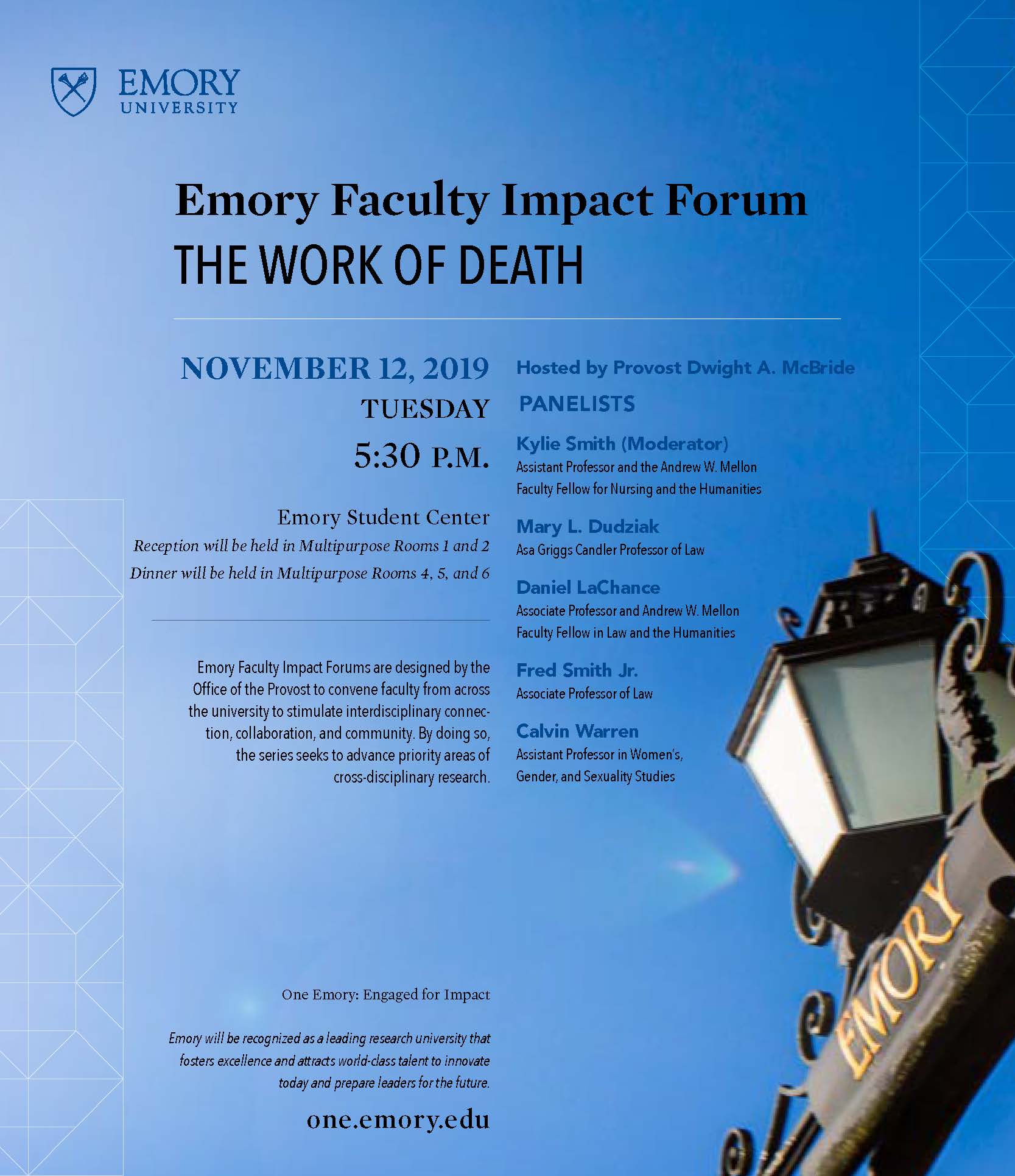
Emory University’s Office of the Provost regularly hosts faculty impact forums to stimulate interdisciplinary connection, collaboration, and community. Provost Dwight A. McBride will host the next forum in mid-November, which will focus on how to understand, conceptualize, and study the sociality of the dead. Two History Department faculty members will participate in the conversation, titled “The Work of Death”: Associate Professor Daniel LaChance and Mary L. Dudziak, associated faculty in the History Department and Asa Griggs Candler Professor of Law. Read more about the event on the flyer below and register here.

20-PROV-PROV-0068-Faculty Forum 2


Daniel LaChance in ‘Process’: “Capital Punishment and the Battle for America’s Soul”

Associate Professor of History Dr. Daniel LaChance recently authored a piece for Process: a blog for american history. Entitled “Capital Punishment and the Battle for America’s Soul,” the article examines official and public stances on capital punishment, especially in the context of cultural wars of the late twentieth and early twenty-first centuries. LaChance, who is Andrew W. Mellon Faculty Fellow in Law and the Humanities, authored Executing Freedom: The Cultural Life of Capital Punishment in the United States with the University of Chicago Press in 2016. Read an excerpt of the Process piece below along with the full article here.

“These days, support for capital punishment is concentrated among whites, Protestants, and Republicans—key demographic constituencies of the conservative side of the late twentieth century culture wars. This may explain the unusual zeal with which the Trump administration has tried to prop up capital punishment despite its declining popularity. The federal government has not executed anyone since 2002, yet Attorney General William Barr recently announced that the Department of Justice would set December 2019 execution dates for five federal death row inmates…

“Given the symbolic value that the death penalty carried in the late twentieth century, Trump’s embrace of capital punishment is politically shrewd. His unapologetic enthusiasm for state killing plays to a white, Protestant, Republican base whose support for capital punishment has not faltered even as crime rates have fallen, perhaps because they see the death penalty as a positive good rather than a necessary evil. If that base shares the sensibility of their culture war forebears, support for the death penalty is not only a tool for controlling crime, but also an expression of allegiance to values—personal responsibility, the sacredness of innocent life, and the firmness of a nation’s convictions—that they feel have degraded in the United States since the 1960s. Trump’s defiant embrace of the death penalty is perhaps a sign to them that their nation is on its way to becoming great again.” 

‘On Middle Ground,’ Co-Authored by Dr. Eric L. Goldstein, Wins Book Prize


The Southern Jewish Historical Association recently awarded the quadrennial book prize to On Middle Ground: A History of the Jews of Baltimore (Johns Hopkins UP, 2018), co-authored by Emory Associate Professor Eric L. Goldstein. Goldstein’s co-author is Deborah R. Weiner. On Middle Ground argues that Baltimore stands out among large U.S. cities in that it is neither fully northern nor fully southern, and that the Jews of Baltimore have shared in this “middle” position. The prize committee noted that the authors “consistently ask the question of how Baltimore differed from comparable communities while still reflecting the broad social and economic patterns with which scholars of American Jewish history are familiar.” Read another committee member comment below and order a copy of the book here.

“[One] committee member wrote that On Middle Ground ‘can stand alone as a history of an important American city as well as a history of Jews who settled there.’ That the authors also manage to accomplish this feat in a manner that has the potential for appeal to a wide readership makes On Middle Ground a volume truly deserving of the SJHS book prize.”

Welcoming New Faculty: Dr. Michelle Armstrong-Partida

In the Fall of 2019 the History Department welcomed four new faculty members, including Associate Professor Michelle Armstrong-Partida. Dr. Armstrong-Partida received her M.A. and Ph.D. from the University of Iowa and joins the Emory History Department from the University of Texas El Paso. Prior to her tenure at UTEP, she held the position of American Council of Learned Societies New Faculty Fellow in the Emory History Department.

Armstrong-Partida-01.png

Armstrong-Partida is a historian of late medieval European history with specializations in the study of gender and sexuality, women’s history, and the sociocultural interactions of Christians, Jews, and Muslims in Iberia and the Mediterranean. Much of her research focuses on the intersection of masculinity, violence, the sexual practice of concubinage, and Mediterranean social customs. Cornell UP published Armstrong-Partida’s first book, Defiant Priests: Domestic Unions, Violence, and Clerical Masculinity in Fourteenth-Century Catalunya, in 2017. The project investigates how long-standing concubinous unions and clerical violence shaped the masculinity of priests two hundred years after canon law prohibited the most visible markers of adult masculinity for men, such as wives, children, and weapons. This book offers an alternative narrative to the effects of the eleventh-century reform movement that imposed celibacy on clergymen in the major orders and challenges the common assertion that celibacy was the defining characteristic of the medieval priesthood. Defiant Priests received three book awards from the Society for Medievalist Feminist Scholarship, the American Historical Association, and the American Catholic Historical Association.

Armstrong-Partida has recently received support from the Institute for Advanced Study (2018-2019) and the National Endowment for the Humanities (2019-2020) for her current book project, titled On the Margins of Marriage. This comparative study of concubinous unions among the peasantry, urban poor, and merchant class across the late medieval Mediterranean reveals how a concubinary relationship could be an important stage of life for both men and women as they transitioned into and out of marriage. The ambitious study is based on archival research in Barcelona and Valencia, Rome, Venice, Lucca, Pisa, and Palermo, as well as Marseille, Perpignan, and Toulouse. The research exposes the significant population of enslaved, single, married women, and widows, who by circumstance or choice, ended up in an informal union to weave the experiences of women at the lowest levels of society into an account of medieval people who remained on the margins of marriage.

Articles written by Armstrong-Partida have appeared in journals such as Gender & History, Journal of the History of Sexuality, and Cahiers de Fanjeaux (among others). She is also the co-editor, along with Alexandra Guerson and Dana Wessell-Lightfoot, of Women & Community in Medieval and Early Modern Iberia (University of Nebraska Press, forthcoming spring 2020). Armstrong-Partida has taught a range of graduate and undergraduate courses at Emory and UTEP, including “Coexistence & Intolerance: Christians, Jews, & Muslims in Premodern Europe,” “History of Women: Gender & Sexuality in Premodern Europe,” and “Religion, Sex, & Violence in Premodern Europe.”