Congratulations to Emory History Department graduate student Timothy Romans, who recently won a prize for his essay “The Merchant, the Pirate, and the Telescope Maker: The Many Heroic Lives of Hamada Yahyōe.” Awarded by the Southeast Conference of the Association for Asian Studies (SECAAS), the prize was announced formally at the annual SECAAS meeting in mid-January 2017 in Oxford, Mississippi.
Dr. Mark Ravina Awarded Japan Foundation Grant for Summer 2017 Workshop

Dr. Mark Ravina, Professor of History, has been awarded a Japan Foundation Grant to host a summer 2017 (May 30 to June 2) workshop, “Japanese Language Text Mining: Digital Methods for Japanese Studies.” The workshop will bring together researchers working across the fields of computational text analysis and Japanese Studies, and will focus on the unique challenges of the digital analysis of Japanese texts. The workshop is part of a collaboration with Hoyt Long (The University of Chicago) and Molly Des Jardin (The University of Pennsylvania) on Japanese text mining. Check out the call for proposals.
Professor Tonio Andrade’s ‘The Gunpowder Age’ Wins Distinguished Book Award
Congratulations to Dr. Tonio Andrade, whose book The Gunpowder Age: China, Military Innovation, and the Rise of the West in World History (Princeton UP, 2016) won a Distinguished Book Award from The Society for Military History. Andrade is Professor of History at Emory University. The Gunpowder Age has received broad critical acclaim, including from the Wall Street Journal, which concluded: “The Gunpowder Age is a boldly argued, prodigiously researched and gracefully written work. This book has much to offer general readers, especially those with a passion for military history, as well as specialists.” Read more about the work and its reception on Andrade’s website.
Allen Tullos Featured in ‘New York Times’ Article on 1986 Voter Fraud Case Lost by Jeff Sessions
In a 1985 edition of Southern Changes: The Journal of the Southern Regional Council, Allen Tullos penned an article on the attempted prosecution of three civil rights activists for voter fraud in West Alabama. Tullos’s article, “Crackdown in the Black Belt,” was recently cited in a New York Times piece about the nomination of Jeff Sessions as Attorney General. Sessions was the United States attorney in West Alabama who pursued and lost the case against the activists in 1986. Check out the excerpt below and read the full Times article, “The Voter Fraud Case Jeff Sessions Lost and Can’t Escape.” Dr. Tullos is Professor of History and Co-Director of the Emory Center for Digital Scholarship.
In Perry County, the polls were only open for four hours in the afternoon, even though nearly one-third of adults worked outside the county and another 15 percent were over the age of 65. White voters used absentee balloting to keep their level of participation high among local residents and also to include some who had moved away. “Letters would go out from white elected officials to a list of people they knew who owned land locally but lived elsewhere: ‘Make sure you vote absentee,’” says Allen Tullos, a historian at Emory University who has written about the Turner case. “The white power structure felt under siege, so there was a sense of ‘We’ve got to call in our friends and families to roll this back.'”
Dr. Tehila Sasson Wins International Research Award
Congratulations to Dr. Tehila Sasson, Assistant Professor of History and a new colleague in the Emory History Department, for receiving the International Global History Research Award for 2016. Given by the The Universities of Basel, Heidelberg and Sydney, the award supports Sasson’s proposed conference, titled “Global Histories of Natural Resources.” Read more about the award, conference, and Professor Sasson’s work here.
“Metropolis, Migration and Mosquitoes” Featured as Timely, Creative, and Cool Course

Photo from the Bom Retiro neighborhood in São Paulo, Brazil, the test case for “Metropolis, Migration and Mosquitoes.” Photo from Wikimedia Commons.
.jpg)
Dr. Jeffrey Lesser, History Department Chair and Samuel Candler Dobbs Professor of History, will co-teach an interdisciplinary course, “Metropolis, Migration and Mosquitoes,” in the spring semester 2017. Recently featured by the Emory News Center as a timely, creative, and cool course, the class will be led by Lesser along with Uriel Kitron, Goodrich C. White Professor and Chair of Environmental Sciences, and Ana Teixeira, Director of the Portuguese Language Program and Lecturer in Portuguese, Spanish & Portuguese. Guest lecturers will include Thomas D. Rogers, Director of Graduate Studies and Associate Professor of Modern Latin American History. Check out the course description below, and browse some of Emory’s other unique offerings this semester.
The course will analyze how “health” has been understood over time by both populations and providers using diverse methodologies, both traditional and novel. Using the Bom Retiro neighborhood of São Paulo as a test case, students will analyze disease patterns and prevention within a historical perspective. They will also analyze how questions of class, race and gender have led to historically different incidences of, and responses to, disease, understanding the relationship between cultural attitudes, exposure to diseases and access to health care.
Eric Goldstein in ‘The Atlantic’
Dr. Eric Goldstein, Associate Professor of History, offered his expertise on questions of American and Jewish history and culture for an article in The Atlantic titled “Are Jews White?” The piece, written by Emma Green, explores how “Trump’s election has reopened questions that have long seemed settled in America—including the acceptability of open discrimination against minority groups.” Check out an excerpt from Goldstein’s contributions to the article below and read the full piece.
“Jewish identity in American is inherently paradoxical and contradictory,” said Eric Goldstein, an associate professor of history at Emory University. “What you have is a group that was historically considered, and considered itself, an outsider group, a persecuted minority. In the space of two generations, they’ve become one of the most successful, integrated groups in American society—by many accounts, part of the establishment. And there’s a lot of dissonance between those two positions.”
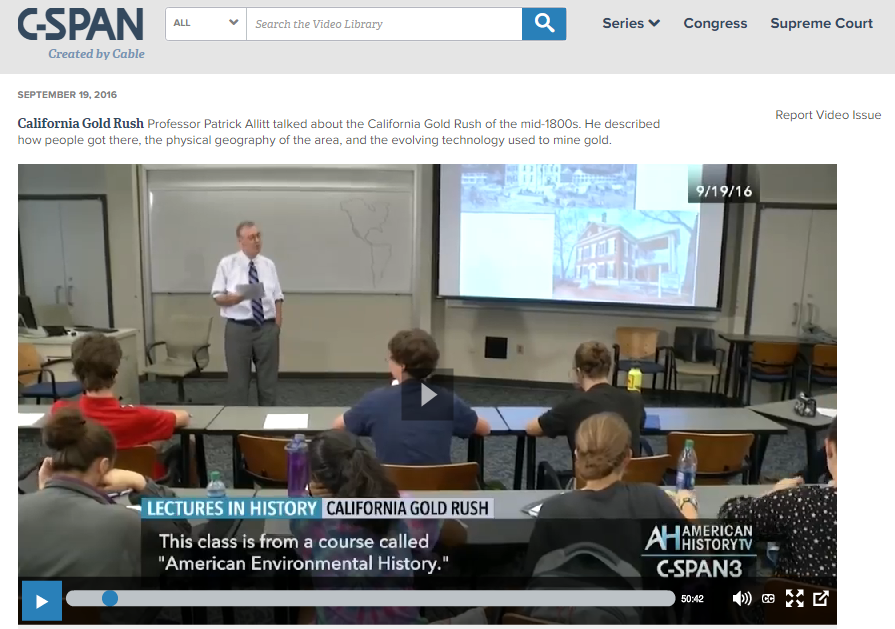
Patrick N. Allitt on CSPAN: American Environmental History and the California Gold Rush
Dr. Patrick N. Allitt, Cahoon Family Professor of American History, recently delivered a lecture on the California Gold Rush of the mid-nineteenth century on CSPAN’s “Lectures in History” program. The lecture comes from a section of the class “American Environmental History” that Allitt gave on Emory’s campus in Atlanta on 19 September 2016. Check out the 50-minute lecture on the CSPAN website.
Alumna Sarah Van Dell on Beijing, UNO, and Serena Williams in ‘Medium’
Emory History Department alumna Sarah Van Dell, a former History major and Chinese Studies minor, recently published a terrific piece on the website Medium. The article, “22 Grand Slams? How I Beat Serena in UNO — at the Beijing airport,” chronicles Dell’s journey to Beijing to cover the China Open – the city’s first major tennis event – shortly after graduating in 2004. Enjoy the article here.
Dr. Belle Tuten (PhD alumna) on “The Mansplaining Hordes”
Dr. Belle Tuten, W. Newton and Hazel A. Long Professor of History at Juniata College, wrote a piece “The Mansplaining Hordes” on the blog Smart Women Talking. Tuten received her PhD from Emory’s History Department in the 1990s with Steve White. Read an excerpt of the post below and check out Tuten’s full post.
“As a college professor I have the luxury of having at least some claim to knowledge about my own expertise on my own turf (although many college students may not consider it knowledge worth having; that is a different problem). But I’m a professor in the humanities. There is certainly a different conundrum for my female and non-binary colleagues and colleagues of color in the social and natural sciences. I cannot help but think that as the humanities have more and more female etc. professors, the humanities get more and more sidelined by the “real” [read: quantitative?] social and physical sciences, from which female and nonbinary students and students of color are dropping out at demonstrably higher rates than straight white male ones. Is that also a statement on the nature of authority?”