Mark Ravina on Posing New Questions through Digital Humanities

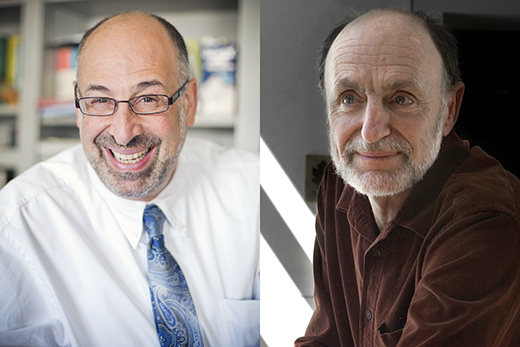
Dr. Mark Ravina recently authored a post on Digital Humanities Now titled “Smooth and Rough on the Highways of France.” Named an “Editor’s Choice,” the post examines how quantitative methods, in this case data visualization, can assist in posing new historical questions. Below is an excerpt from the article, which can be found in full here.

One way to conceptualize this complementarity [between social science and humanistic methods] is John Tukey’s observation that “data = smooth + rough,” or, in more common parlance, quantitative analysis seeks to separate patterns and outliers. In a traditional social science perspective, the focus is on the “smooth,” or the formal model, and the corresponding ability to make broad generalizations. Historians, by contrast, often write acclaimed books and articles on the “rough,” single exceptional cases. These approaches are superficially opposite, but there is an underlying symbiosis: we need to find the pattern before we can find the outliers. 

Brett Gadsden at AJC Decatur Book Festival and in ‘The Christian Science Monitor’

Brett Gadsden, Associate Professor of African American Studies and History at Emory, recently joined best-selling novelist Greg Iles and Emory colleague Hank Klibanoff for a panel at the AJC Decatur Book Festival on cold cases from the Civil Rights era. Professor Gadsden teaches a course that involves undergraduates investigating cold cases in Georgia. The Christian Science Monitor published a feature on the panel and the work of the three panelists. The article can be found here.

When Sugarcane Meets Oil: Tom Rogers’ Summer Research

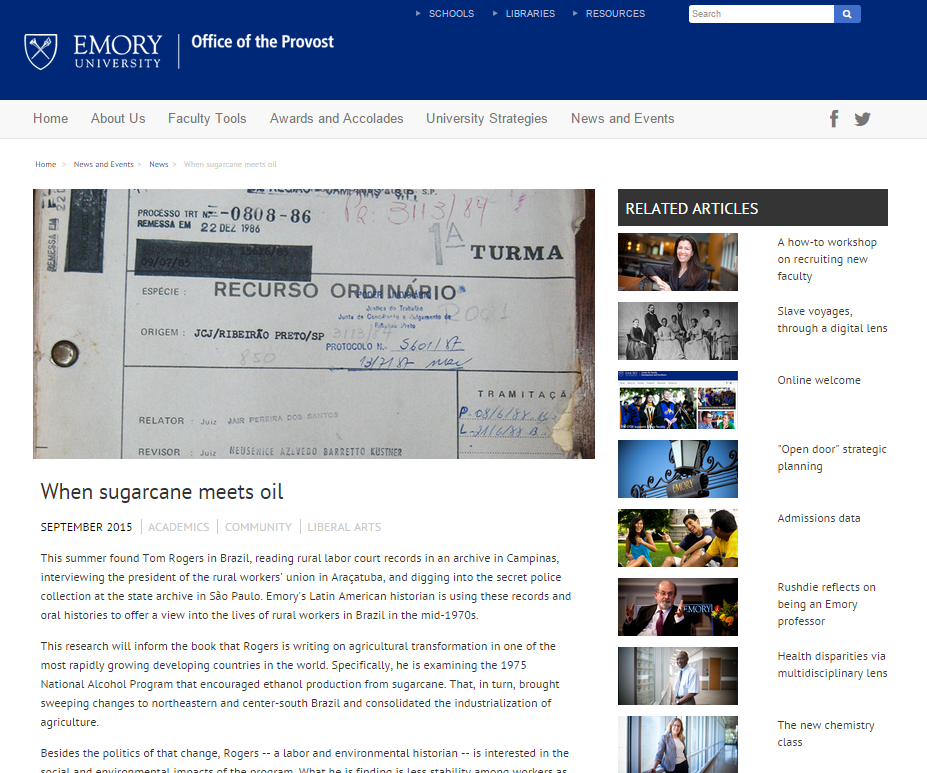
Tom Rogers, Associate Professor of Modern Latin American History, spent the summer of 2015 conducting research in Southeastern Brazil. Rogers’ inquiry spanned from research in secret police and labor court archives to oral histories with local union leaders. The project examines agricultural transformation in late-twentieth-century Brazil with a particular focus on the nation’s 1975 National Alcohol Program that encouraged ethanol production from sugarcane. The Office of the Provost recently profiled Rogers’ research and teaching, which typify Emory’s teacher-scholar model and “focused international activity in Emory’s global strategies.” The article can be read in full here or by clicking on the image below.

rogers

Slave Voyages, through a Digital Lens: Trans-Atlantic Slave Trade Database Receives Recognition and Support

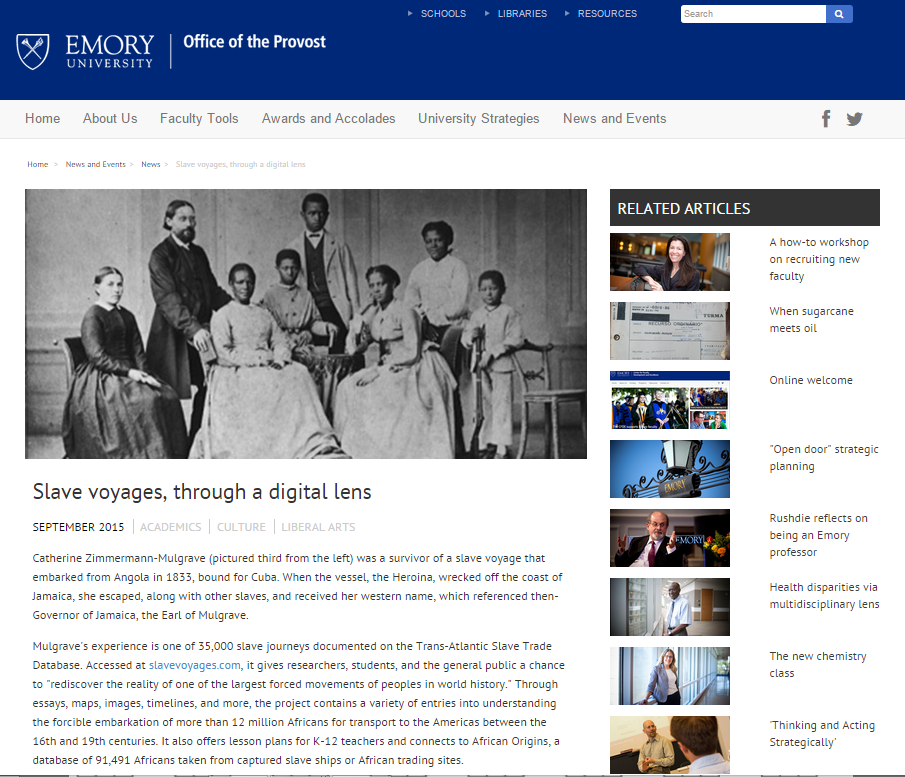
The Trans-Atlantic Slave Trade database, accessible at slavevoyages.com, received a Digital Humanities Implementation grant from the National Endowment for the Humanities (NEH) this year. The international project is lead by Robert W. Woodruff Professor of History Emeritus David Eltis, who teamed up with co-editors at the Emory Center for Digital Scholarship to enhance the website through funds provided by the NEH. The Voyages project was recently featured on the news page for the Office of the Provost at Emory. You can read the full article here or by clicking on the image below.

eltis

Elena Conis at Decatur Book Festival Saturday, September 5

Dr. Elena Conis, Assistant Professor of History, will present at the Decatur Book Festival on Saturday, September 5 from 4:15-5:00pm. Dr. Conis will discuss her most recent book, Vaccine Nation: America’s Changing Relationship with Immunization, at the Marriott Conference Center A. Here is a brief description about the talk and Dr. Conis’ book:

With employers offering free flu shots and pharmacies expanding into one-stop shops to prevent everything from shingles to tetanus, vaccines are everywhere. The past fifty years have witnessed an enormous upsurge in vaccines and immunization in the United States: American children now receive more vaccines than any previous generation, and laws requiring their immunization against a litany of diseases are standard. Yet, while vaccination rates have soared and cases of preventable infections have plummeted, an increasingly vocal cross section of Americans have questioned the safety and necessity of vaccines. In Vaccine Nation, Elena Conis explores this complicated history and its consequences for personal and public health.

Jeffrey Lesser on CNN.com: ‘Brazil Protests: What they Mean’

Dr. Jeffrey Lesser, Samuel Candler Dobbs Professor of History, wrote an opinion piece for CNN.com titled “What Brazil’s Protests Mean.” Lesser, an expert in the history of Brazil and current fellow of the Intercultural Dialogues group at the Institute for Advanced Studies at the University of São Paulo, discusses recent anti-government demonstrations. Here is an excerpt from the end of the piece:

One of the many joys of being a historian is that I do not have to predict the future. But seeing the weekend’s demonstrations close up, one thing was very clear — the use of the street as a location for making political points looks set to continue. And in doing so, it suggests a healthy democracy in Brazil — even during these times of political, economic, and social uncertainty.

Jeffrey Lesser

Alumni Update: Marnie Florin (BA, 2008; MA, 2008)

Marnie Florin, who graduated high honors from Emory in 2008 with both a BA and MA, has been at Google for just under a year working in Finance Operations. Marnie’s real passion, however, has been organizing diversity training sessions. Ze created a Transgender @ Google training that has been given to over 10 different offices worldwide and had over 300 participants since its launch in May. The training was mentioned in the NY Times and USA Today. Marnie is also working to establish monthly meetings where Googlers can meet and discuss sensitive topics, like race in America, in a safe and open environment.

Marnie Florin. Photo Credit Jason Henry for The New York Times

Alumni Update: Belle Tuten (PhD 1997) and James (Jim) Tuten (PhD 2003)

Jim and Belle Tuten, both former PhD students in the Emory History Department, now live in Huntingdon, PA, where they are full professors in the History Department at Juniata College (a liberal arts college of 1600 students). This year they will celebrate 18 years at Juniata. They have two sons, ages almost 16 and 11. Jim is currently writing a biography of Edward Gantt, the highest ranking Confederate officer to change sides during the Civil War. Belle’s research has turned mostly to the history of medicine, and she is working on a long-term project on the history of breast diseases.

Michael D. Thompson (Ph.D., 2009) Publishes ‘Working on the Dock of the Bay: Labor and Enterprise in an Antebellum Southern Port’

Michael D. Thompson (Ph.D., 2009), who recently was tenured and promoted to the rank of UC Foundation Associate Professor of American History at the University of Tennessee at Chattanooga, has published Working on the Dock of the Bay: Labor and Enterprise in an Antebellum Southern Port (University of South Carolina Press, 2015), a study of waterfront work and workers in Charleston, South Carolina, between 1783-1861.  Thompson’s manuscript for this project was awarded the 2011 Hines Prize from the College of Charleston’s Program in the Carolina Lowcountry and Atlantic World (CLAW).

book jacket for Working on the Dock of the Bay