Spring 2016: Graduate Students Design and Teach Courses to Emory Undergraduates

Each semester students from Emory’s History graduate program enter the classroom to teach courses they have designed and developed through the TATTO program. This spring five third-year graduate students are teaching dozens of Emory undergraduates, exposing them to fascinating topics ranging across time and space.

These courses enable graduate students to gain valuable experience teaching subjects directly linked to their own research interests. More broadly, the experience forms part of the History Department and Laney Graduate School’s holistic training that prepares graduate students for careers in teaching and research.

Below are the five courses being taught this semester, along with links to the profiles of each instructor and the syllabi:

Andrade’s ‘The Gunpowder Age’ Reviewed in The Wall Street Journal

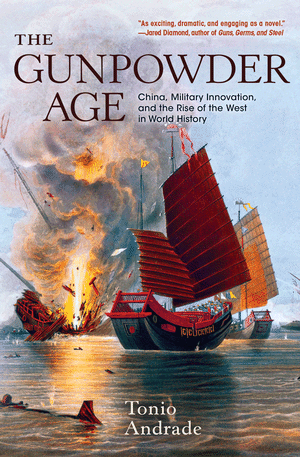
Tonio Andrade‘s The Gunpowder Age: China, Military Innovation, and the Rise of the West in World History (Princeton 2016) was reviewed by Jeffrey Wasserstrom in The Wall Street Journal on January 29, 2016. The article, available here, is titled “Flying Rats and Festive Fireworks.” Wasserstrom’s appreciative review describes the The Gunpowder Age as marking “a major contribution to a significant area of academic concern while opening the eyes of non-specialists.”

The description of The Gunpowder Age from Princeton University Press follows:

The Chinese invented gunpowder and began exploring its military uses as early as the 900s, four centuries before the technology passed to the West. But by the early 1800s, China had fallen so far behind the West in gunpowder warfare that it was easily defeated by Britain in the Opium War of 1839–42. What happened? In The Gunpowder Age, Tonio Andrade offers a compelling new answer, opening a fresh perspective on a key question of world history: why did the countries of western Europe surge to global importance starting in the 1500s while China slipped behind?

Historians have long argued that gunpowder weapons helped Europeans establish global hegemony. Yet the inhabitants of what is today China not only invented guns and bombs but also, as Andrade shows, continued to innovate in gunpowder technology through the early 1700s—much longer than previously thought. Why, then, did China become so vulnerable? Andrade argues that one significant reason is that it was out of practice fighting wars, having enjoyed nearly a century of relative peace, since 1760. Indeed, he demonstrates that China—like Europe—was a powerful military innovator, particularly during times of great warfare, such as the violent century starting after the Opium War, when the Chinese once again quickly modernized their forces. Today, China is simply returning to its old position as one of the world’s great military powers.

By showing that China’s military dynamism was deeper, longer lasting, and more quickly recovered than previously understood, The Gunpowder Age challenges long-standing explanations of the so-called Great Divergence between the West and Asia.

History Honors Students Awarded Fox Center Fellowships

Congratulations to history honors students Adam Goldstein and Takuya Maeda who were awarded Fox Center for Humanistic Inquiry Fellowships (FCHI) for Spring 2016.  Adam was awarded a FCHI Humanities Honors Fellowship and Takuya was awarded a FCHI Sire Fellowship.

Here is  a link with details about both students: http://fchi.emory.edu/home/fellowships/index.html.

Brian Vick Wins Hans Rosenberg Prize from the Central European History Society

Brian Vick, Associate Professor of History, recently won the Hans Rosenberg Book Prize from the Central European History Society. The award honors the best book in central European history published in English by permanent residents of North America. Vick received the award for The Congress of Vienna: Power and Politics after Napoleon (Harvard UP, 2014). Below is Prof. Vick’s description of the project.

“My most recent research explores questions of European culture and political culture at the Congress of Vienna, including the political engagement of women, the development of liberal and conservative politics, and the role of religious revival. This work also sounds the cultural and political meanings of the celebratory spectacle and display surrounding Napoleon’s defeat and the return of peace at the close of the wars against Napoleon, and it spotlights such less-studied but important aspects of Congress diplomacy as the struggles over Jewish rights in Germany, abolition of the African slave trade, and the problem of the Barbary corsairs…Along with related articles and essays, this work reassesses the nature and direction of European culture and political culture in their period of transition between the revolutionary era and the nineteenth century.”

Political Drama in Brazil: Jeffrey Lesser in ‘Time’ Magazine

Dr. Jeffrey Lesser, Samuel Candler Dobbs Professor of History, was recently quoted in Time magazine. Lesser offers commentary on the current Brazilian political crisis and citizens’ attitudes toward the government. An excerpt from the article, “The Dramatic Power Struggle Behind Impeachment in Brazil,” is below.

Cunha’s decision this week to approve impeachment proceedings against Rousseff, on the grounds that she improperly used state bank funds to cover a budget shortfall, is rooted in the pair’s bitter yet symbiotic fight for survival, one that could take them both down. “Brazilians are angry at Cunha as they think he broke the law to enrich himself,” says Jeffrey Lesser, a professor of Brazilian history at Emory University. “But they are angry at Dilma for allowing this to happen, even if she did not herself steal.”

Carol Anderson on the Racial Past of the University of Missouri

Dr. Carol Anderson, Samuel Candler Dobbs professor and chair of African American Studies here at Emory, recently authored a piece in The Conversation titled “The long and troubled racial past of Mizzou.” Professor Anderson’s article draws on her experience as a professor at the University of Missouri (1996-2008), along with her research and teaching expertise on public policy and the ways that domestic and international policies intersect through the issues of race, justice and equality in the United States.

History Faculty and Students Benefit from New Emory Connections in Brazil

In September Emory University teamed up with the São Paulo Research Foundation (FAPESP) to sign an agreement of research collaboration. FAPESP is a highly respected public foundation in the state of São Paulo, Brazil, with numerous international collaborations. Emory also signed an agreement with Fulbright Brazil that establishes a Fulbright Professorship Award for Brazilian Visiting Scholars at Emory. These initiatives will benefit the already-rich community of scholars in the History Department and elsewhere working on Brazil and Portuguese studies. Read the full story from the Office of the Provost here.

Experimental Interdisciplinary Faculty Fellowship Supports Innovative Research Co-Led by Jeffrey Lesser

The Emory News Center recently published a profile of a research project co-led by Jeffrey Lesser, Samuel Candler Dobbs Professor History. Lesser and research partner Uriel Kitron, Goodrich C. White Professor and Chair of the Department of Environmental Sciences, are examining “how the dynamics of human migration, disease transmission and access to health care have impacted a vibrant immigrant neighborhood in São Paulo, Brazil — one of the world’s largest megalopolises.” Check out the full article here.

Story image