Dr. Debjani Bhattacharyya, a 2014 doctoral program alum, was recently awarded a competitive, multi-year grant from the Swiss National Science Foundation (SNSF) for the project, “Climate Risk Management: A Historical Perspective.” The project investigates the role of financial institutions in the making of climate science, including by engaging financial institutions’ archives from the 18th century onward, and addresses the fundamental question, “Why have we overwhelmingly turned to the market to tackle the climate crisis?” The full abstract of the project follows:
This project explores why market-based tools – such as carbon trading, weather derivatives, parametric insurance, and catastrophe bonds – have become central to managing climate risk. Examining insurance archives from the eighteenth century onward, it analyzes how financial institutions shaped meteorological knowledge, risk measurement tools, underwriting policies and enforcement mechanisms. The research aims to explain how the business of risk management influenced evolving conceptions of climate and why market mechanisms, rather than regulation, dominate current climate-risk governance.
Bhattacharyya is Professor of the History of the Anthropocene at the University of Zürich. She is the author of Empire and Ecology in the Bengal Delta: The Making of Calcutta(Cambridge University Press, 2018), which won the 2019 honorable mention for the best book in Urban History. She completed her doctorate under the advisement of Dr. Jeffrey Lesser, Samuel Candler Dobbs Professor of History.
Doctoral alum Claudia Kreklau, Honorary Lecturer in Modern European History at the University of St Andrews, has published a new article in the journal German History. Titled “Vaterland, c.1780–1870,” the piece examines the multiple and shifting meanings of the German-language term meaning “fatherland.” The full abstract follows:
This article analyses the changing semiotics of the term Vaterland between 1780 and 1870 in a variety of German-language discussions by reconstructing specific instances of meaning. It finds that the term Vaterland held multiple meanings due to the range of religious, philosophic and political frameworks and historical frames of reference in which this term operated. A great variety of speakers produced and exercised meanings synchronically and modified them diachronically. Far from being synonymous with better-studied terms such as Germany or Volk, Vaterland meant something different in every instance of usage—and reflected contestations for the fatherland itself in the period examined here.
Doctoral program alumnus Dr. Craig Perry has published his first monograph, Slavery and the Jews of Medieval Egypt: A History, with Princeton University Press. Perry’s book reconstructs the social history of slavery in Cairo at a pivotal period in the city’s history, showing how the slave trade and slavery shaped everyday life, state diplomacy, and the formation Jewish and Arab-Islamic culture.
Dr. Arnold Franklin, Associate Professor at Queens College, City University of New York, describes Perry’s book as “a major contribution to historians’ understanding of one of the most pervasive and consequential institutions in the medieval Islamic world.” David Eltis, Robert W. Woodruff Professor Emeritus at Emory, describes the work as “a brilliant reconstruction of slavery and slaveowners in the Jewish community of medieval Cairo drawing on the vast but highly fragmentary records of a synagogue.”
Perry received his doctorate in 2014. He is assistant professor in the Middle Eastern and South Asian Studies Department at Emory. Read the full abstract of Slavery and the Jews of Medieval Egypt below and find more on the Princeton UP book page.
In this book, Craig Perry mines a remarkable cache of fragmentary documents preserved in an Egyptian synagogue to write a new history of slavery and the slave trade in the medieval Middle East. These documents—which range from the everyday correspondence of traveling merchants to legal queries sent to Jewish jurists—provide the richest surviving archive for the social history of slavery during the centuries when Cairo was an imperial and commercial capital at the intersection of the Mediterranean and Indian Ocean worlds. Perry draws on this archive, known as the Cairo Geniza, to shed new light on such crucial topics as the slave trade in state diplomacy, the entanglements of gender and household slavery, and the lives of the enslaved.
Perry chronicles a protean slave trade that trafficked enslaved people from Europe, Africa, and India to the Egyptian market. His account cuts across different scales of analysis, from the macro-level of imperial rule to the micro-level of the family kitchen. Along the way, he upends the traditional story of Passover; medieval Jews, he writes, could explain slavery to their children by pointing to the enslaved people who served the holiday meal. When freed, some former slaves converted to Judaism and became the parents of Jewish children. Perry’s narrative reveals a world, long hidden from historians, in which enslaved people made their way through the alleys of Cairo, toiled in the workshops of apothecaries, and found ways to evade the surveillance of their owners. With this book, Perry writes enslaved people into the social and economic life of medieval Islamic society.
Jim Brophy, Francis H. Squire Professor of History at the University of Delaware, describes The Making of Modern Eating as “a tour de force that promises to be a field-defining work.” Kreklau, he continues, is “a historian with a capacious and bold historical imagination…a rising star in our field.”
Kreklau is Honorary Lecturer in Modern European History at the University of St Andrews, and she is the three-time prize-winning author of seven academic articles. She completed her PhD in 2018 under the advisement of Dr. Brian Vick.
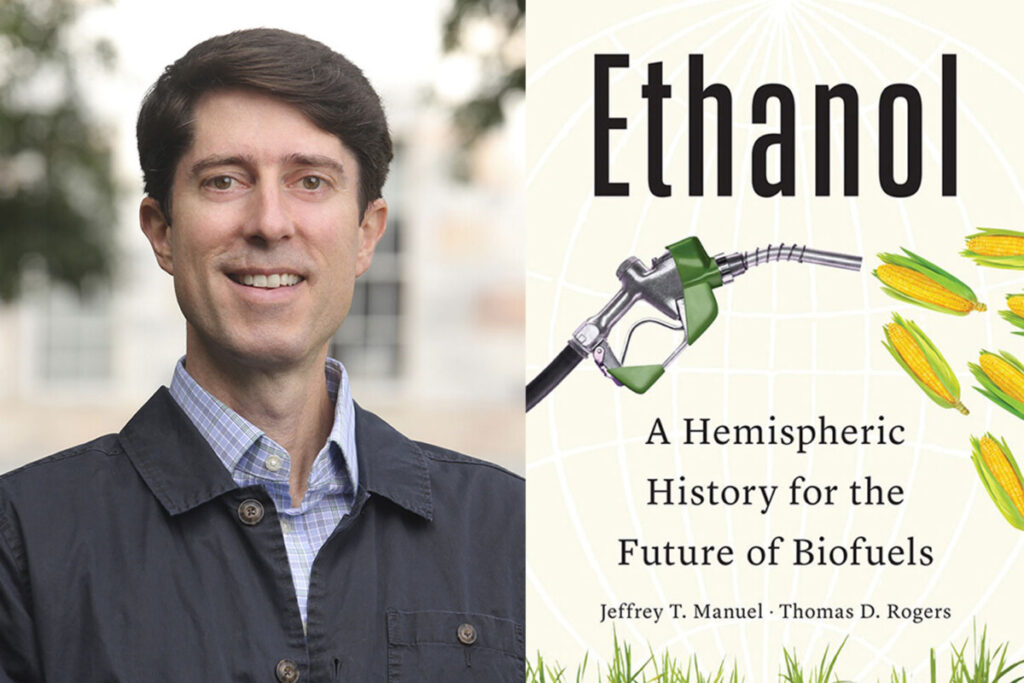
Dr. Thomas D. Rogers, Professor of History with specializations in environmental and labor history, has published a new book with co-author Dr. Jeffrey T. Manuel (Southern Illinois University Edwardsville). Titled Ethanol: A Hemispheric History for the Future of of Biofuels, the book chronicles the transnational history of ethanol in Brazil and the U.S. (the globe’s largest producers). Ethanol, which is Rogers’s third book,offers “the first full picture of the long history of this renewable fuel that from the beginning offered an imperfect alternative to oil.”
Though ethanol, a liquid fuel made from agricultural byproducts, has generated controversy in recent years—good or bad for the environment? a big-ag boon or boondoggle?—its use goes back more than a century. Tracing the little-known history of this promising and contentious fuel, Ethanol: A Hemispheric History for the Future of Biofuels reveals the transnational nature of ethanol’s development by its two biggest producers, the U.S. and Brazil. By drawing the connections between the shifting fortunes of ethanol in these two countries, the book presents the first full picture of the long history of this renewable fuel that from the beginning offered an imperfect alternative to oil.
Though generally presented as parallel stories, the histories of ethanol in the U.S. and Brazil are inextricably linked. Authors Jeffrey T. Manuel and Thomas D. Rogers show how policies in one country shaped those in the other. Brazil patterned its mid-century development on the U.S. model, adopting an automobile- and highway-focused transportation system and a fossil fuel-intensive agricultural sector. U.S. policymakers in turn took note when Brazil responded to the 1970s oil shocks by distributing ethanol nationwide, replacing half of its gasoline consumption. In the 2000s, the nations’ leaders worked together to dramatically expand ethanol production. Today, as a new generation of biofuels meant to power aviation and fight climate change again connects Brazilian and U.S. ethanol, Manuel and Rogers explain how the fuel’s future, like its history, is complicated by technical, scientific, economic, and social questions—about how to calculate carbon emissions, agricultural land use, national security and sovereignty, and the balance between government regulation and market forces. Understanding the future of biofuels demands a reckoning with this extensive, shared history—a reckoning that Manuel and Rogers’s far-reaching, deeply researched book brings into view.
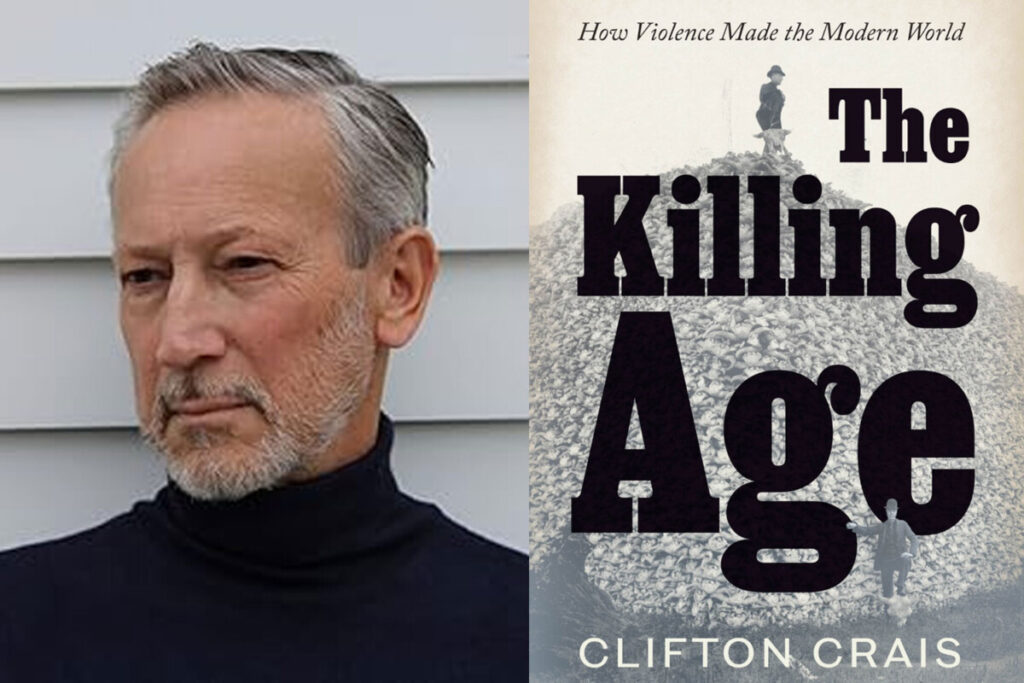
Dr. Clifton Crais, Professor of History, has published his most recent book, The Killing Age: How Violence Made the Modern World, with the University of Chicago Press. Crais foregrounds the role and significance of violence in the development of global capitalism from 1750 to the early 1900s, arguing that the period commonly described as the Anthropocene should, instead, best be understood as the Mortecene, or killing age. During this age, he writes, the new “ease and profitability of killing created a disturbing network of global connections and economies, eliminating tens of millions of people and sparking an environmental crisis that remains the most urgent catastrophe facing the world today.”
South African Nobel laureate J.M. Coetzee offered the following praise for Crais’s book: “Synoptic in its reach, overwhelming in its detail, The Killing Age leaves one feeling like Jonathan Swift’s Gulliver, who came to prefer the company of peaceable horses to membership of humankind.”
In the Q&A below, Crais gives us a glimpse into the making of the monograph as part of the History Department’s New Books series.
Books are produced over years if not decades. Give us a sense for the lifespan of this book, from initial idea to final edits.
In some respects, The Killing Age returned me to questions I have been interested in since graduate school in the mid-1980s when books by scholars like Immanuel Wallerstein, Eric Wolf and others called attention to the importance of understanding the world economy and the development of capitalism. But it was only about a decade ago when I decided it was time to undertake a new project, partly inspired by a graduate course Mark Ravina and I taught on comparative empire. I became convinced that the literature on the Anthropocene was inadequate or at least incomplete and that, more generally, we had a poor understanding of the role of violence in the development of capitalism and the making of our contemporary world of planetary peril.
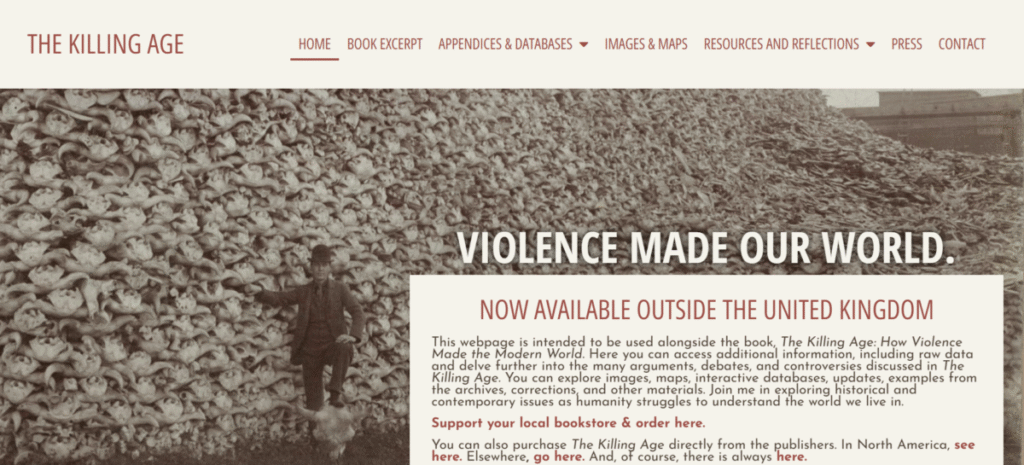
The research, writing and publication took about eight years. There was a lot of climate science and environmental history I had to first learn, and I had to decide on which archives I would delve into. I spent lots of time in England, but also many places across the United States. So, it took longer to research and write than previous books. Plus, The Killing Age is hefty, over 700 pages long, plus an associated website, thekillingage.com.
What was the research process like?
The Killing Age was by far the most difficult project I have undertaken. I had never done research in the histories of South America, Asia, and especially the United States. I also relied on multiple databases, some massive. The total amount of data I have stored and used for the project is more than 1 terabyte, in other words more than a million pages. One of the biggest challenges was how to navigate all the material while producing a book that is narratively driven and accessible to the general public. I ended up going through more than a dozen drafts.
Are you partial to a particular chapter or section?
I was originally trained in the history of Africa, so the chapters covering this part of the world had a certain familiarity; not so with other regions, including the United States. I am partial to the section “The American Ways of Killing” that explores the hunting of whales, beaver, and bison and its connections to economic change and the emergence of the US as a global power. Just learning about the entwined histories of humans and non-humans was fascinating, especially as I wrote some of these chapters during COVID-19.
How does this project align with your broad research agenda (past, present, or future)?
The Killing Age is both a kind of culmination and a departure. I have been thinking about many of the issues I explore for decades. At the same time, the project has convinced me of the importance of writing a global history of the twentieth century, about the possibilities of human progress and how these possibilities were so often subverted. In my next project I will be returning to the issue of violence and especially the redemocratization of the means of destruction, particularly after 1945.
In the summer of 2025 third-year History major Hannah Lo was a finalist for the U.S. State Department’s Critical Language Scholarship (CLS) program. The program supports U.S. citizens to develop foreign language and cultural fluencies through intensive summer training abroad. Lo, who is also minoring in quantitative social sciences, was among only four Emory students accepted for 2025. When the Chinese language program she was planning to attend at China’s Dalian University of Technology was cancelled, Lo pivoted to serve as an immigration intern with Asian Americans Advancing Justice and conducted research with Dr. Yami Rodriguez, Assistant Professor, and Dr. Chris Suh, Associate Professor. Read more about the 2025 Emory CLS cohort here.
The History Department annually awards its Clio Prizes to the best paper in a Freshman History Seminar and the best research paper in a junior or senior History Colloquium. This year, we are pleased to recognize outstanding work by Emma Rose Ceklosky and William Wainwright.
Ceklosky received the prize for the best paper written in a freshman seminar for her work, “From Exotic Blossoms to Budding Women in Science.” Ceklosky completed this paper in Dr. Judith Miller`s spring 2025 freshman seminar “The World of Jane Austen.” About the course, she writes: “I loved the stories I discovered about horticulture and how it empowered 19th-century women. Dr. Miller’s class brought history to life for me. I recommend her to everyone and am honored that she nominated me for this prize.” Ceklosky plans to double-major in English and Creative Writing and Psychology.
Spring 2025 graduate William Wainwright received the prize for the best research paper written in a history junior/senior colloquium for his work “Recentering the Black Sea,” which he completed in Dr. Michelle Armstrong-Partida`s course “Europe: Merchants-Pirates and the Slave Trade.” Wainwright graduated summa cum laude with a BA in International Relations (highest honors) and History in the spring 2025. Reflecting on the prize and his experience as a major, he writes: “Thank you so much for this. I am honored and grateful to receive this prize. The Emory history department, and Dr. Armstrong-Partida’s class in particular, have been hugely important for my academic development. I look forward to continuing to stay in touch with the professors and staff who have made it possible. Thank you again.”
Doctoral student Alejandro Guardado won the Albert J. Beveridge grant from the American Historical Association for his research project, “Reimagining Community: Indigenous Organizing in Mexico’s Neoliberal Turn, 1968–2000.” Guardado’s dissertation centers on Self Determination Movements in Zapotec and Mixe communities in the Sierra Norte of the Mexican state of Oaxaca. He analyzes how Indigenous intellectuals and activists developed networks with micro-regional political coalitions, anthropologists, liberation theologians, and NGOs as a means of renegotiating their relationship to the Mexican government and market forces.
The Beveridge grants support research in the history of the Western Hemisphere, and Guardado was among just 15 graduate students nationwide selected for the prize. Dr. Yanna Yannakis, Samuel Candler Dobbs Professor of History and Department Chair, serves as Guardado’s dissertation advisor.
In the summer of 2025, Emory College senior Lucia Alexeyev conducted research about the relationship between U.S. Naval occupation and residents’ health and access to healthcare on the island of Vieques in Puerto Rico. Alexeyev’s project, titled “Military Occupation and Changing Healthcare Landscapes: Vieques and the U.S. Navy, 1941-2003,” was funded by the History Department’s Cuttino Scholarship for Independent Research Abroad.
Alexeyev is a History major and Global Health, Culture and Society minor. Dr. Jeffrey Lesser, Samuel Candler Dobbs Professor of History, serves as her thesis adviser. Read an excerpt from the Nueve Millones piece below and find the full article here.
“Even with how politics has changed in the EPA, Estrada Martinez remains hopeful for the study’s completion. She’s inspired by the Viequense community’s 63-year struggle to remove the Navy from the island, plus an additional 20-year battle to obtain funding for VASAC in the first place. ‘This is just a rock on the road, and we will figure out together how to get rid of it and move forward, right?‘”